
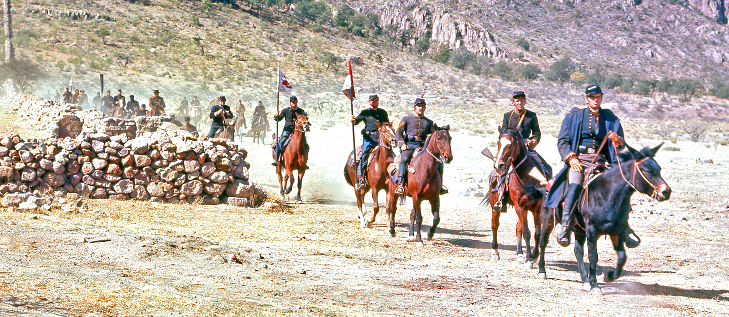


For the third year in a row we’re reviewing another new deluxe Blu-ray edition of Major Dundee. Arrow’s presentation is a dazzler, with new artwork and a striking booklet with beautiful color photos. I can’t complain that the show isn’t getting the attention it deserves. I also partly discuss previous disc releases, so I hope I’ve kept my comments about them discreet.
This time around I’m going to get to the disc appraisal sooner than usual. If you’re curious to learn why this so-called disaster of a movie deserves so much adulation, here are my earlier reviews:
The 2005 theatrical reissue / revision.
The 2005 Sony DVD.
The 2013 Twilight Time Blu-ray.
The 2019 Explosive Media GmbH (Germany) Blu-ray.
The 2020 Viavision [Imprint] Blu-ray.

That’s a lot of thought expended on a picture that often totally confuses first-time viewers. I first saw the movie at UCLA, from instructor David Bradley’s 16mm print. I was a 100% Peckinpah disciple eager to see everything he’d done, but my first viewing mainly just confused me. I literally couldn’t follow the story or the characters.
When I praise Dundee I’m not really playing fair — I’m really reviewing the movie with a heavy awareness of the screenplay, which fills in many of the blanks, at least in terms of Peckinpah’s intentions. Jerry Bresler had his editors simply take out what could be dropped and not injure the continuity — although Peckinpah’s continuity was pretty weak to begin with. That’s what happens when a narrative is just a skeleton on which to hang characters and themes … after cutting those things down the literal this-follows-that of storytelling falls apart. Just plain sloppy editing decisions don’t help either. Peckinpah reportedly shot multiple cameras on every scene, but too many scenes look like poorly planned, indifferent coverage.
Blame Games aren’t easy with this picture — there are just so many unknowables. How much feature editorial experience did Peckinpah have, anyway? He seems to have been disinvited from post production on The Deadly Companions. The sympathetic producer Richard D. Lyons (Stranger On the Run) helped Sam secretly provide input on Ride the High Country — he was locked out of MGM’s finishing process as well. When we see some of the rough edges in Dundee, how do we know whose doing they were? Was Peckinpah planning to do a finer cut, perhaps look for new camera angles here and there, and he never got to do it?
Producer Jerry Bresler was in charge for the actual finishing, so he gets the rap for the awful music decisions. Doing minimal dialogue clean-up and almost no sound effects work on the movie — Bresler was clearly in a rush, and using the excuse that he was not throwing good money after bad. Besides, the whole town was already blaming Peckinpah for everything. Jerry Bresler wasn’t trying to optimize Dundee. With or without malice, he squeezed it through the movie sausage machine as cheaply and as quickly as possible.

One thing I don’t think I’ve defended enough is the music score by Daniele Amfitheatrof, most of which is basically fine, just not distributed well. The opening music, up until Mitch Miller’s vocal march, is excellent. When I learned that Sony had commissioned a new score to replace the original, I thought it was a revisionist mistake. Yes, the Mitch Miller Gang is awful, inappropriate in the extreme. Too many scenes were unnecessarily scored with music (my theory being, to avoid doing expensive sound effects work). All that was really needed was to pull out most of the ‘noodling’ music that kept changing gears from ‘Dixie’ to ‘The Battle Hymn of the Republic’ to ‘Lorena,’ etc. Lose the music behind the quiet conversations between Dundee and Tyreen. And I’ve always thought that, after the fanfare over the Columbia logo, the instrumental of the Dundee March shouldn’t come back until the troops ride out of the fort on the ‘big mission.’
When Nick Redman and Grover Crisp produced the new score, their main objective was to eliminate Mitch Miller, and also the electronic music sting that surfaces whenever any visual or vocal ‘Apache’ cue is given. I’ve gotten numerous letters from readers that like that sting; I no longer have any objectivity about it. But I do use it for a ring tone on my phone. The Caliendo score is somber and reflective, and clearly not as ‘busy’ as the original. Sometimes the mood seems all wrong. When the music is pulled from action scenes, we’re left with the very sparse original sound effects. In battles these effects are really thin. It sounds like the audio is coming from the multiplex screen next door, not this movie.
One thing I really like about the Caliendo score are the orchestrations for the Mexican party music, which are a million times better and livelier than the limp, repetitious faux-Mariachi cues from 1965.
Why so many Blu-ray versions of Major Dundee? They aren’t really meant to be redundant — they’re regionally-licensed releases, two of which are easily imported. All are Region A compatible. Sony/Twilight Time’s 2013 disc came from the producer of the music revision, who did not include a full version with the original soundtrack. This was what I feared would happen, even though Grover Crisp said the original audio would never go away. The revised score is considered the default track, and one must go peck around to play the original.
The disc layout I thought best would be two discs of what Sony calls the ‘extended version,’ which is really the original release before a last minute 12-minute chop job, each with the different music mixes and appropriate opening credit sequences. Sony replaced all the opening titles with a plainer font, when they jettisoned Daniele Amfitheatrof’s credit card. You can see the contrasting main titles type styles side-by-side in David Cairns’ analytical video appreciation.
The version called the Theatrical Version, rudely chopped by 12 minutes at the last minute in 1965? I’ve yet to see anyone who likes it or wants to see it again… it’s missing too many important story points, and is now just a curiosity.

When Dundee was offered for licensing again, Explosive Media (a German Koch label) was there first, and was the first to gather all available versions, and to look for new video extras. Explosive’s producer was one of the Leone experts who helped me with the old MGM Leone DVDs, so I volunteered some advice, my collection of color Dundee stills, and an audio commentary. Instead of leaving a full a audio track in the background, I used a clean music track where possible. This is the commentary I’d recommend to spin first.

Explosive’s producer went to the trouble of adding Isolated music scores for both composers, enabling a direct comparison. He also fully subtitled my 215-minute commentary in both German and English, which is no mean feat. Those German subs for my words create a nice illusion of profundity!
At the outset of the pandemic friend Alan K. Rode was doing commentaries for the new Viavision [Imprint] line of discs, and recommended me for Dundee. I suggested a joint commentary and we were off to the races. It’s a more conversational track with more editorial opinionizing. Alan added some historical information about the Apache Wars and we both tried to put the very talented Sam Peckinpah on a less adulatory level than is usually heard.
That subject is worth a few words. I was around many professional industry people in the 1970s, including some that had worked for Peckinpah. All had at least one Peckinpah story that’s unprintable. Peckinpah was intensely decent and loyal to his actors, which I think accounts for some of the glowing memories we hear in interviews. We’re often told that some fine directors of the past — von Stroheim, von Sternberg, Fritz Lang — made enemies of the studio brass, alienated actors and were despised by their crews. Yet we still admire and appreciate the great movies they made.
Sam Peckinpah’s case is a little different. If Dundee had come a few years later, Peckinpah could have played the ‘auteur’ card and gotten his way. But in 1965 a director with no box office hits did not have that power. Even with all the rancor and hatred he generated, Peckinpah believed that the studio heads would see his rough cut, declare Dundee a brilliant piece of work and send him back for reshoots. James Coburn is on record saying that Peckinpah was in denial in regard to his status with his employers. As soon as Charlton Heston completed his scenes for Major Dundee and departed the Mexico location, taking his protective influence with him, Columbia and Bresler gave Sam Peckinpah the bum’s rush.


