


All hail Kevin Brownlow, the dean of classic film restoration. Since the 1960s he has championed awareness of our silent film legacy. He’s been reviving lost or fragmented films ever since, most notably Abel Gance’s epic Napoleon. But he began in the middle 1950s, as a kid starting out with a movie camera gifted by his mother.

Once upon a time, a pair of teenaged English boys decided to make a 16mm war movie with soldiers and guns and lots of excitement. Seven years later the ‘amateur’ production was finally finished, but as a theatrical feature released by a major studio. Director Tony Richardson helped find financing to shoot sequences in 35mm; to provide the ‘youngsters’ with film stock, Stanley Kubrick donated short ends from Dr. Strangelove.
The amazing thing is that their film is one of the earliest and most mature examinations of the nature of Fascism. It’s a compelling argument against the notion of national exceptionalism: that any country or people are immune to political extremism. The title is surely half-borrowed from the 1935 Sinclair Lewis book called It Can’t Happen Here. That social satire imagines a Fascist-corporate takeover of America. It’s not surprising that the book is back in print again.
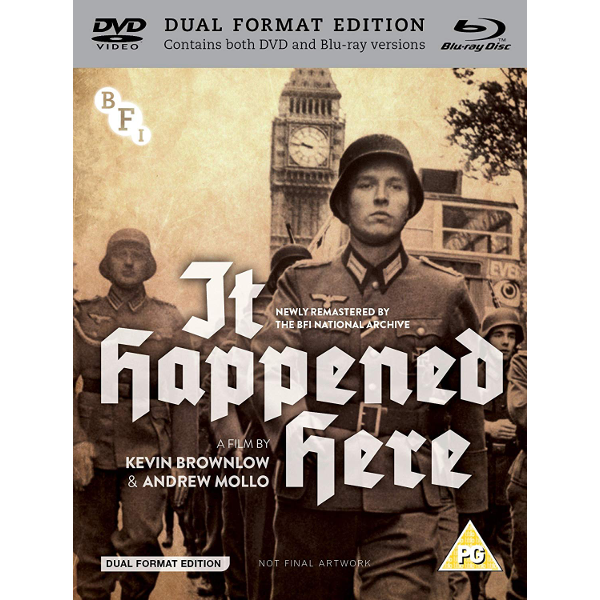
Called It Happened Here, Brownlow and Mollo’s movie made the rounds of a few European film festivals in early 1965, where it gained a certain amount of notoriety. The story of an England defeated by Hitler and functioning under Nazi rule, it left some British critics confused and incensed. Some were offended by the film’s notion that the proud Brits that withstood the Battle of Britain would ever knuckle under and collaborate with the Nazis. And many were made furious by what they perceived was a virulent pro-Nazi, anti-Semitic message. The real English Nazis in the film don’t just shout out the usual slogans. They’re instead allowed to spout their ugly rhetoric without being shot dead or contradicted by stalwart patriotic voices, as was standard practice in war movies.

It Happened Here received boos from a German audience at the Mannheim Film Festival. American filmgoers were equally unaccustomed to Brownlow’s directness with the ‘Nazi problem.’ Possibly because of the Cold War need to bolster West Germany, U.S. films were no longer presenting Germans in war films as despicable villains. In The Young Lions, young German Marlon Brando anguishes over his soul-rending moral dilemma.
Daily Variety called It Happened Here a science-fiction film, a story of WW2 in the ‘negative subjunctive.’ That is, a tale that did not happen, but if it did happen it might have happened like this. It’s actually an alternate reality story, a time-twisting concept not used much back then (in movies, anyway). Trashy books and movies in which ‘the Nazis won’ are now commonplace but there remains one classic, the visionary The Man in the High Castle by science fiction author Phillip K. Dick.

It Happened Here begins with the image of a map, like a dry instructional film. It takes as its springboard the simple idea that Hitler launched a full invasion during the Battle of Britain and quickly subdued England. Everything else follows with complete credibility.
The occupation of England is seen through the eyes of Pauline (Pauline Murray), a country nurse fleeing the fighting that has broken out between German occupation troops and resistance partisans. Using Ireland as a base, the Americans and ‘loyalist’ English guerillas are attempting to re-invade from the West. Pauline witnesses a massacre of civilians. Blaming the partisans, she decides that getting things back to normal is more important than patriotism.
“After all,” she sighs, “We did lose the war.”
Much of London has been bombed out. German military occupiers are everywhere, fraternizing with girls and reading optimistic war news from the Nazi publications on the newsstands. The English are split into two factions: a restless mob of unemployed, uncooperative have-nots and those that have chosen to collaborate with the New Order. To work and survive Pauline joins the National Socialist puppet political party called the Immediate Action Organization. The clerk that signs her up is coldly impersonal:
Pauline: “I’ve decided to join.”
Clerk: “We don’t accept your decisions. You accept ours.”

Pauline soon finds herself worked half to death training as a combat-ready ambulance nurse. Her Immediate Action uniform earns her the hatred of ordinary people in the street. The radio plays German marches and propaganda bulletins; as part of her party duties Pauline must attend indoctrination lectures extolling the glory of fascism, and torch-lit rallies and funerals where Nazi speakers stir up hatred with Hitler-like tirades.
Pauline is tainted by association with a luckless pro-partisan Doctor Fletcher (Sebastian Shaw). Her harsh Immediate Action supervisors eventually exile her to the countryside, to work in a tiny clinic curiously free of oppressive party supervision. That’s as much of the plot as is fit to reveal.
English audiences of 1966 were shocked by the film’s depiction of a conquered, largely collaborating English public. Democratic ideals and Churchill’s patriotic defiance have fallen by the wayside, as if they had been only bitter illusions. The conquering Germans have placed English fascists in positions of authority: the radio voices, the lecturers, the rabid Nazi propagandists are all English. A newsreel celebrates the wonders of National Socialism with the same confidence by which Britons were assured that ‘London Can Take It!’ during the Blitz. The newsreel reminds us that England had its own strong Fascist political faction before the war. Those traitors are now running the country for the Germans.

It Happened Here’s strength is in its details. The docu-like visualization of the war years is more convincing than that seen in big-budget studio pictures. It doesn’t look like a recreation, it looks Real. The uniforms, the paperwork, the posters on the buses, the patches on the sleeves, the ration cards all look 100% authentic. All this detail is what originally distinguished the film from home-movie status.
Co-director Kevin Brownlow was a cutting assistant in films and already a cinema history expert. As a child he cobbled together a 9mm film reconstruction of Abel Gance’s Napoleon from pieces found in film libraries. His military-buff sidekick Andrew Mollo collected German uniforms and equipment at flea markets. The pair linked up with a London collector of Nazi arms and vehicles, all stored at his country farm. Begun as an amateur film shot in two- or three-hour spurts on weekends with the help of friends that came and went, the project became an ordeal that went on for years. The filming sessions were full of last-minute improvisations. Brownlow’s writings reveal that he pulled German tourists off the London streets, and asked them to don SS uniforms.

The whole experience is documented in Kevin Brownlow’s book How it Happened Here. It’s difficult to imagine the gangly-looking Brownlow persuading London authorities to let him stage Nazi troopers marching on parade past city landmarks. Apparently fights broke out between the crew and street toughs — real Teddy Boys roughed up the filmmakers and stole their cameras.
That was nothing compared to the ordeal Brownlow and Mollo would be subjected to when the film was finished. Because It Happened Here maintains a documentary distance and refuses to moralize, some reviewers concluded that it condones Nazi attitudes. Brownlow and Mollo recruited real English fascist hate-mongers to play the collaborating Immediate Action spokespeople, thereby giving the fictional film a ‘true’ documentary aspect. The main Nazi spokesman (an odious Frank Bennett) composed much of his own dialogue, and we can tell that he really believes it. Watching the moronic Hitler wanna-be venting his hatred for Bolsheviks and Jews, we realize just how commonplace and banal ideological evil can be. As the Nazis are observed without editorial comment, for six minutes the film becomes a valuable vérité document. The use of ‘real’ Nazi testimony in a fictitious context is a genuine cinematic innovation: Brownlow and Mollo must have been aware of experimental pictures like the French Chronicle of a Summer.
In terms of documentary theory, the self-appointed Nazi spokesman Frank Bennett can be compared to Shirley Clarke’s interview subject Jason Holiday in her experimental Portrait of Jason. Jason is a clever fellow who already ‘plays characters’ to get along in life, and for Clarke’s camera he skillfully confects a special character. Clarke’s film is an exposé of the facades people erect and the games they play, while Brownlow simply entices a bigot a to unguardedly spill his ugly ideas.

United Artists insisted on the deletion of this six- minute non-scripted discussion sequence, citing the controversy it had attracted in festival screenings. The complaint was that normal audiences would think the film an endorsement of Naziism. The exact same thing happened thirty years later with Starship Troopers, a fantasy that suggested that our society is developing into a Nazi-like aggression machine. Seeing the heroes dressed in Nazi-like uniforms, a number of vocal critics misinterpreted and misrepresented the satiric message.
Perhaps the distributors that turned down It Happened Here were correct: the public at large resists ideas more complex than Good Guys versus Bad Guys. Even the documentary-like Battle of Algiers chooses sides: it pretends to be neutral, yet its emotional argument is clearly in favor of the Algerian rebels. Brownlow and Mollo’s film non-judgmentally depicts an imperfect (collaborating, even) heroine and lets the politics fall where they will.
The ideological critics didn’t want to hear Nazi ideas voiced in any media platform, period. They argued that nothing in the film directly refutes what the Nazis say. That’s not true: the Doctor Fletcher character denounces the Nazis, and says that the only way to get rid of Fascism is to use Fascist methods.

It Happened Here is by no means a straight political picture; it’s a fine film about the brutality of occupations and resistance fighting. It’s also a lesson in cinematic storytelling. The skill in the direction erases considerations of budget and the fact that the movie was shot piecemeal over a number of years. There’s nothing to apologize for. Without voiceover or too much expository dialog, we follow nurse Pauline’s every action and clearly understand her every reaction. It’s a model of great filmmaking by any definition.
Kevin Brownlow went on to become the dean of film historians. His wonderfully detailed interviews with silent-movie personalities, before the culture became interested in the subject, recorded the story of those years just in time, before the actual actors and filmmakers of the silent era passed away. He’s still active making documentaries.
Andrew Mollo’s knowledge of military history and costumes quickly earned him work as a technical consultant and costumer on big-budget movies. Peter Suschitzky, the cameraman who gave Brownlow’s film its Triumph of the Will– styled documentary look, later shot The Empire Strikes Back. And one of the film’s few professional actors, Sebastian Shaw, will have many fans wondering where they’ve seen him before. Look closely at Shaw’s eyes: he plays Anakin Skywalker in Return of the Jedi. He’s glimpsed only for a few seconds when his black Darth Vader helmet is removed.


It’s happening here, right now, in 2025.
Sadly agree. The warning signs have been there for some years but it seems the big, important lessons of history are not always learned in time by the right people. There’s always some deviant nutcase paying more attention to the same old fascist playbook lessons that lead to decent countries descending into ‘it happened here’ states.