At the tail end of the ’50s monster boom the pickings became lean indeed. For every killer matinee winner like The Blob or The Fly, cheap double bills encouraged by American-International’s example became even cheaper. Producers at Columbia, Allied Artists and United Artists turned out occasional turnips that had almost nothing to offer but a come-on title and a grossly deceptive poster. After seeing the actual films, kids must have felt betrayed by the advertising for The Lost Missile or The Day the Sky Exploded.
Invisible Invaders is a Robert E. Kent production. Look at his filmography and you’ll find scores of genre titles from the second half of the fifties, some backed by producer Edward Small and mostly released through United Artists. Kent was sort of an in-house/outsourced producer whose B product filled out UA’s release slate. The films he made were all shot in B&W under conditions that would stymie a television director — no real locations, dull sets, and flat, perfunctory direction, often from the lightning-fast Edward L. Cahn. The haste with which these pictures were made can be seen in the fact that Cahn racked up fifteen directing credits in both 1959 and 1960. That’s an average of one feature every six-point-five weeks.

The story by Samuel L. Newman promises major Sci-fi action. Aliens that long ago conquered the Moon, now attempt to conquer Earth by inhabiting human corpses and overwhelming the living. The entire world is thrown into chaos almost overnight. A tiny group of researchers holes up in a hidden cave lab to perfect some method of combating the armies of the dead. Overcoming their interpersonal problems, the human defenders finally emerge with an effective ray gun that shoots ultra-high-frequency sound. Alien invasion! Armies of walking corpses! A futuristic lab under siege! I’m ready for that movie, right now.
Don’t expect those grandiose scenes to appear in Invisible Invaders. Producer Kent’s movie has precious little ‘movie’ — it’s packed with filler. Newman’s sketchy script uses ponderous radio narration to fill in 90% of the story, telling us about terrible attacks and slaughter happening elsewhere. Meanwhile, mismatched and crudely edited stock footage of natural disasters, airplane crashes, etc., fail to flesh out these cataclysmic events. When a dam explodes, as in a Republic serial, we recall the Daffy Duck cartoon where filmmaker Daffy pitches his next movie to studio head Porky Pig: “then the cattle stampede, and the dam breaks, and the volcano erupts!”

In between the filler is a series of so-bad-they’re-fascinating dramatic scenes. Hitting his career rock bottom prior to working for Larry Buchanan, top-billed John Agar plays a soldier assigned to keep the scientists secure. The resources that the Free World has allotted to preserve mankind’s only hope amount to exactly one jeep and one G.I.. Agar naturally falls in love with scientist Philip Tonge’s daughter. She’s played by the cute and personable Jean Byron, a favorite from vintage TV shows.
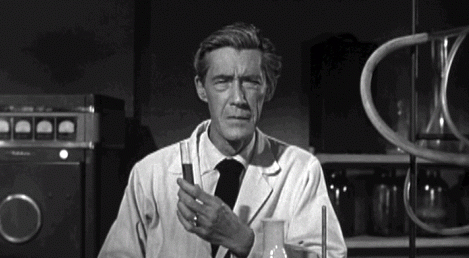
John Carradine and his echo-y voice make a brief early appearance as Dr. Carol Noymann, a dead scientist reanimated by the aliens for the illogical purpose of warning a colleague about the menace. As pointed out repeatedly in Tom Weaver’s astute audio commentary, the aliens’ invasion plan makes very little sense. Warning the scientists enables a research lab to be established even as the invasion is getting started. Carradine is always an arresting presence and his deep voice brings conviction to the most preposterous dialogue writers can cook up. But his function here is simply pointless. The resurrected Noymann is just the first in an uninterrupted stream of indigestible events.
The actual filming of Invisible Invaders is so threadbare, one gets the idea that director Cahn was given a six-day schedule, but decided to get the show in the can in half that time. The film contains only about thirty seconds of real action, all of it shot in Bronson Caverns. Characters don’t move unless they must, so most of the shots are static views of actors rooted in place to assure good focus. From the looks of the show, one doesn’t envision Cahn ever getting past take two. The actors are professionals under rigid instructions not to do anything that might blow a scene. To insure that all the dialogue cuts together, everyone keeps the dramatics at an even pitch. It’s a good example of filmmaking that emulates sleepwalking. Everything is smooth. Keep it up for slightly over an hour, and you’ve got a movie.

The economizing is evident in every frame of film. The invisible attackers preclude the need for special effects. None of the spectacle pictured on UA’s poster appears in the movie — no armada of flying saucers shooting death rays, no giant tidal waves. The crashing car is depicted with a repeat of the excellent car crash stunt from the previous year’s Thunder Road. The monster suit from It! The Terror from Beyond Space is used to provide a glimpse of an invader made visible by the researcher’s special ray. It’s painted white and double-exposed into the frame.
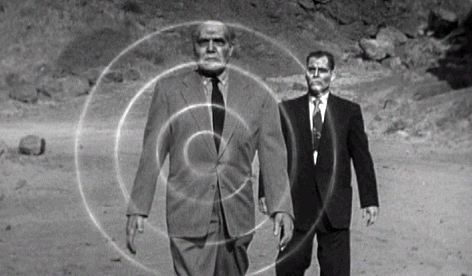
But the film’s one truly memorable visual is the odd sight of a dozen or so zombie automatons stumbling down a sagebrush hill. Dressed in burial clothes, with whitened faces and black eye sockets, they do have a certain cartoonish impact, at least the first time we see them. Cahn must have had the services of his cast of ten or so zombie actors for no more than half a day. Every time the narrator reminds us that mounting hordes of the dead are overwhelming the world, we cut back to the same angle of the same group of zombies, walking down the same hill, arms outstretched. Sometimes a spiral graphic is superimposed to lend visual contrast. By the end of the show, we’re really beginning to resent that superimposed spiral effect.
The incredibly cheap Invisible Invaders is the closest Hollywood came to making a backyard movie in the 1950s. Yet it has professional performances on soundstage sets, with hairdressers, prop men, etc. The optical bill can’t have been too low, considering how many shots have spiral superimpositions, or place stock shots into the TV monitors that the cast watches so glumly. These were experienced professionals trying to squeeze a watchable movie out of very little — every dollar not spent is a dollar the movie doesn’t have to earn back. Unlike some no-budget rip-offs, there’s nothing cynical about Invaders, although filming had to have its depressing moments for the actors and crew. When people join creatively to make something intended to have no merit beyond minimum commercial requirements, there isn’t much left to discuss. Hollywood zombies of the 1950s were few and far between: Creature with the Atom Brain, The Zombies of Mora Tau, perhaps a couple of others. Invisible Invaders does have a couple of zombie murders, featuring bloody corpses with gashed faces. Yet the scenes generate little excitement…. they barely make sense.
Eight years later George Romero improved mightily on this film’s basic idea for his game-changing Night of the Living Dead. Faithful fans of the genre were the only ones to notice a resemblance. There’s no comparison in impact, as Romero’s film really goes to town with his zombie concept. Living Dead emphasizes the notion that the dead coming back as zombies are our own relatives and neighbors, conjuring a full nightmare of universally-shared fears and taboos. Ed Cahn’s zombies are those same ten guys up on that hill, playing Frankenstein. “Okay, that was good, now go back up and walk back down one more time. And nobody smile!”