


Hollywood’s studios really scrambled to stay afloat in the 1950s, while putting out publicity that said all was well. MGM took another ‘graduating class’ picture of its remaining ‘galaxy of stars’ even though the big names were independent hires and most of the contractees were being shown the door. All the majors were releasing outside productions made on location, while their expensive studio facilities lay fallow or, if they were lucky, were hired for TV work.
Yet the MGM front office was still making deals that required finding good movie prospects for talent. A hot name in 1955 was Jack Palance, whose previous role for WB was as a deranged prophet in the costume picture The Silver Chalice. Could the studio have been rethinking their hopes for big profits from Palance?

There must have been a need to get a film into production quickly, because 1955’s I Died a Thousand Times is an almost shot-for-shot remake of Raoul Walsh and Humphrey Bogart’s High Sierra from only fourteen years earlier. All that has been changed is the cast, a few updatings of details and a high-speed chase at the finish with the cars actually speeding. Oh, and WarnerColor and CinemaScope, which was marquee bait back in ’55. Screenwriter W.R. Burnett adapted his novel a second time, although there’s little sign that much was needed beyond a dialogue polish. Curiously, John Huston had a co-writing credit on High Sierra, but his name has been excluded from the new credits roll.
Dick Dinman reminded us that I Died a Thousand Times is actually a second remake of High Sierra. As everyone knows but I forgot, 1949’s Colorado Territory is director Raoul Walsh’s own western take on the same story. Dick is always quick to remind us of his preference: “I Died Three Times but the second was best.”

Could the original cast have been improved?
The notorious ex-con Roy Earle is the role that boosted Humphrey Bogart into leading man status. The equally luckless Marie Garson was played to a high emotional pitch by Ida Lupino. Paroled from prison, Roy crosses the desert and holes up in a mountain cabin. He’s been hired to rob a new desert casino hotel for some gangster kingpins in Los Angeles. He develops a crush on the farmer’s daughter Velma (Joan Leslie), advancing the money to have her club foot surgically corrected. But Earle is also drawn to the unhappy Marie, as they both are in search of the means to ‘crash out’ into a better life. Thanks to the incompetence of the punks hired to aid Roy in the robbery (Alan Curtis, Arthur Kennedy and Cornel Wilde) the heist ends in disaster. As if fulfilling a fated destiny, Roy is cornered by the state police up in the ‘clean, cold’ Sierra Nevada mountains.
Burnett and Walsh’s original film was an interesting mix of tough-guy realism and old-fashioned sentiment. Despite the melodramatics, it rates as an early film noir by dint of Roy Earle’s disillusionment over the affections of Velma, the gee-whiz country girl who becomes a real user once her club foot is repaired. Various double-crosses and a blabbing accomplice do the rest. Poor Marie is forced to watch her lover’s tragic end, as radio announcers turn the manhunt for Mad Dog Roy Earle into big-time radio entertainment. Only she will understand.

A remake with a new star.
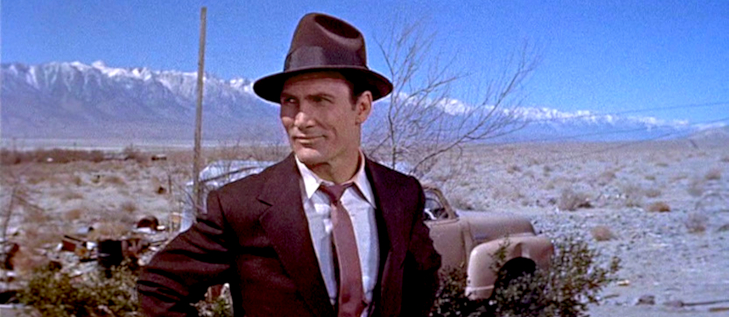
At first glance the re-titled remake I Died a Thousand Times is a nice package. Although he doesn’t carry the same charge of world-weary fatalism, young Jack Palance is understandable as the new Roy, if not particularly sympathetic. In purely physical terms he’s much more menacing. Earl Holliman and Lee Marvin, the new punks assigned as his side men, look rightfully terrified of him. Roy Earle is once again a man out of time, a ’30s gangster caught in the age of stereophonic sound. The color and widescreen give his situation a new edge, with those mountain peaks looking lonelier than ever.
As the new Marie, Shelley Winters naturally makes a different impact than Ida Lupino, the first film’s actual star. Winters delivers a variation on the sad sack female loser she played many times before, in A Place in the Sun, He Ran All the Way, The Night of the Hunter and The Big Knife. In that last one, she again played opposite Jack Palance. One look at Winter’s downcast face and we know she’s going to be miserable — she doesn’t brighten our spirits the way Ms. Lupino did.
Lee Marvin’s supporting career was just beginning to boom. In ’54 and ’55 he played menacing heavies in The Raid, Bad Day at Black Rock and Violent Saturday, and Jack Webb had just given him a good scene as a non-belligerent musician in his Pete Kelly’s Blues. It would be a full seven years before John Ford lifted Marvin’s status to that of co-star.

For the most part the remake is a more than satisfying big-scale thriller — the story’s classic contours haven’t changed and the ending has a brutal finality. Bogart fans will of course play a comparison game. The family of farmers still behave like Steinbeck Oakies, two decades later; Olive Carey and Ralph Moody don’t seem as sympathetic, and their old flivver looks like a ghost car from The Grapes of Wrath. Velma’s new friends come from the Warner pool of delinquents: Richard Davalos and Dennis Hopper. The movie sticks to the old script like glue, even if we wonder why 1955 kids with money would be wearing suits and dancing the mambo in the afternoon.
Young Lori Nelson (Revenge of the Creature) is perhaps a good update casting choice. Bright, sweet Joan Leslie fit the idealistic innocent image of 1941, while Nelson both looks and acts like she’s not afraid to grab what she wants, no matter whose feelings are hurt. The Velma character is the stickiest thing in both versions — the robbery seems to be timed around her recovery — but Ms. Nelson keeps that subplot from falling down. Ms. Nelson had a reputation for being drop-dead beautiful. The one movie where her allure really comes across — just as eye candy — is John Sturges’ Underwater!
The location shoot out by Lone Pine is updated with more realistic action — no undercranked cars struggling to climb those inclines. Roy and the pursuing cops fishtail around treacherous mountain curves instead of being artificially sped up. A motorcycle stuntman takes a spill on his bike (twice) to add some juice to the chase. Most of the camera angles seem identical to the original, even copying the same pans. The second-unit camera crew probably found the same tripod anchoring spikes in the ground from 14 years before. This second version doesn’t milk Velma’s emotional finish, so the show wraps up in a hurry, without making as big of a bang.

It’s likely that a substantial part of Bogart’s impact as Roy Earle was his haircut … many thought that prison cut was in itself intimidating.
A quick comparison of Palance and Bogart shows how movies were changing in the ‘fifties. Palance is less openly sensitive and is more explosive in the violence department; he refuses to serve as a father figure to his punk cohorts. When things go wrong during the escape he seems more out of control than Bogart ever was. Both pictures end with Roy Earle trapped atop a mountain. The first time around, Bogart’s final moments were clear tragedy. Palance’s final gesture is performed just as well, but has less impact.
Some of the support comes from what remained of Warners’ contract roster. A young Nick Adams proves he can nervously rattle a tray of glasses better than anyone. Handsome Perry Lopez ( Chinatown) does a mean mambo with Shelley Winters, who’s still in great shape. Lon Chaney Jr. is okay as Roy’s friendly mob connection, while Pedro González Gonzáles has a part big enough to give more dignity to the script’s ‘simple Mexican’ stereotype. The familiar James Millican has a lot of screen time in the thankless role of duplicitous gangster boss. Mae Clark, Myrna Fahey and Dub Taylor also make brief appearances.

Director Stuart Heisler lets the cameraman duplicate earlier setups for the most part. The only visual flourish we notice are occasional tilted ‘Dutch’ camera angles. In the early extra-wide CinemaScope, these must have had theater patrons tilting their heads.
The ASPCA wouldn’t be amused by a stunt in the first scene. A car swerves to avoid a jackrabbit on the highway, a shot apparently achieved by springing a live stunt bunny onto the roadway right in its path. The rabbit escapes injury, but not by much. I wonder how many they ran over before they got the shot?


I saw I Died a Thousand Times on its initial release and was okay with it, but left the theatre thinking Lon Chaney’s few scenes were by far the best and warmest. On the other hand, I was sixteen, and I stand by that.