


The Front Page:
1931 / B&W / 1:33 flat full frame / 101 min.
Starring Adolphe Menjou, Pat O’Brien, Mary Brian, Edward Everett Horton, Walter Catlett, George E. Stone, Mae Clarke, Slim Summerville, Matt Moore, Frank McHugh, Clarence Wilson, Fred Howard, Gustav von Seyffertitz.
Cinematography Glen MacWilliams, Tony Gaudio, Hal Mohr
Film Editor W. Duncan Mansfield
Written by Ben Hecht, Charles MacArthur from their play
Produced by Howard Hughes, Lewis Milestone
Directed by Lewis Milestone
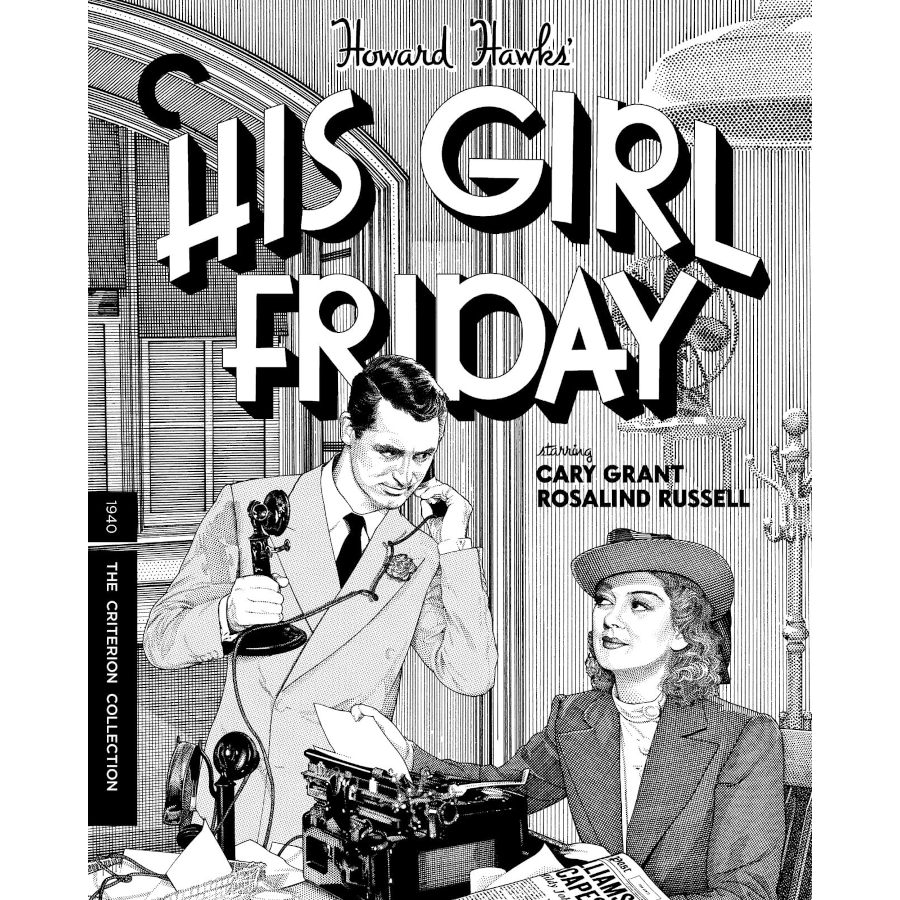
Eight years ago Criterion did a favor for lovers of vintage Hollywood, with a Blu-ray set that combined Howard Hawks’ His Girl Friday with a restored The Front Page, the early talkie made from the hit play that brought Ben Hecht and Charles MacArthur to Hollywood. The Front Page was rescued from blurry oblivion by the discovery of a 35mm file print in producer Howard Hughes’ archives in Las Vegas. It was not only in good shape, it was the film’s original American cut, the preferred cut of director Lewis Milestone. It hadn’t been seen since the film was new.
Most of Hughes’ personally produced movies were unavailable for decades, and The Front Page is one of the last holdouts. I remember going to Sherman Torgan’s New Beverly theater once in the early 1980s to see Scarface and Hell’s Angels, only to find the doors locked. Sherman showed me a letter he’d just been handed by a lawyer from the Howard Hughes organization, forbidding the screening.
This new release is motivated by a new 4K Ultra HD remaster of His Girl Friday; The Front Page remains in HD-only.
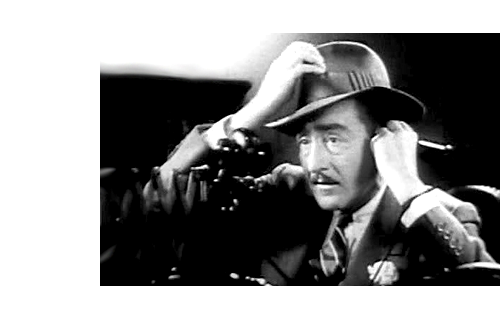
Let’s start with the original. The smash hit Broadway play of The Front Page (1929) introduced the world to a pair of wisecracking newsmen who made heartless remarks at the expense of the people they wrote about for the tabloid papers. Reporter Hildy Johnson (Pat O’Brien in the 1931 film) wants to quit to get married, but his devious boss Walter Burns (Adolphe Menjou) connives to keep him on the job. Helping Burns to do this is the scoop of the century, the escape from death row of anarchist Earl Williams (George E. Stone). It happens right beneath the windows of the pressroom. Hildy not only hides Earl from the cops away, he has the exclusive story from Molly Malloy (Mae Clarke), Earl’s streetwalker girlfriend. Hildy uses this subterfuge to uncover a scheme by the Mayorto use Earl’s hanging to win an upcoming election.

Director Lewis Milestone came to this play adaptation straight from his masterpiece All Quiet on the Western Front. His direction isn’t compromised by ‘early talkie’ audio problems — dialogue is spoken while Milestone’s mobile camera moves from room to room. The film’s novelty was its snappy, briskly-paced smart talk. Why don’t all early talkies sound this natural? One of the oldest Hollywood quotes is a telegram Hecht sent MacArthur, urging him to come to California to write, because there was a fortune to be made and the only competition was idiots.
The 1931 The Front Page may be pre- screwball, but it is plenty wild. It doesn’t fall back on too many physical slapstick gags — Hildy doesn’t tackle anybody in the street. Pat O’Brien’s patter isn’t always a verbal machine gun, and his relationship with his girl (Mary Brian) is sentimental, not buffoonish. Adolph Menjou’s Walter Burns isn’t at all sentimental … he’s a master of lowdown dirty tricks.
The assembled reporters are competitive wordsmiths that joust with smart remarks in search of the most devastating insult or bon mot. Walter Catlett is the biggest noise in the police press bullpen, but Edward Everett Horton is terrific as a fussy, hypochondriac colleague. Frank McHugh (playing a reporter named McCue) brightens up the jokes with his perfect deliveries, and his signature high-pitched laugh: “Hah – Hah!” McHugh clocked 13 movie appearances for 1931.

Walter Burns is introduced via some forceful trucking shots through the newspaper’s printing plant. Louis Wolheim died before he could take the part, but his All Quiet on the Western Front colleague Slim Summerville plays the easy-going messenger who tries to deliver Earl William’s reprieve. Mae Clarke is fine as Molly: she scored big in three more 1931 releases: The Public Enemy, Frankenstein and Waterloo Bridge.
This was the year that the producer Hughes begam fighting the censors over Scarface. Hughes refused to cut his shocking preCode gangland tale, perhaps partly because The Front Page was forced to make a number of compromises. In the final scene, a typewriter noise covers the offending word in the phrase, ‘son of a bitch.’ If you watch the new 4K of Hell’s Angels you can hear that same line shouted from an airplane cockpit, along with, ‘Jesus Christ.’
His Girl Friday transformed the newspaper classic into a prime Screwball Comedy. Hawks had launched the Screwball ethos with Twentieth Century and perhaps made its purest statement with the madcap Bringing Up Baby. Howard Hawks would return to screwball mode after His Girl Friday, but he would never top it. The big change is of course the gender switch, which makes explicit what seemed to be a male-bonding relationship between Burns and Johnson: why not just go for it and make Hildy a woman? The switch required little adjustment.
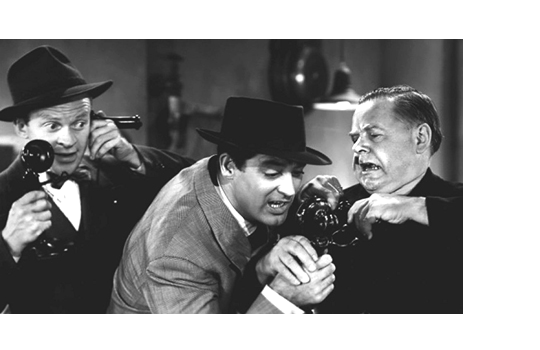
The assembled newsmen in the original The Front Page are happy with a line of work that allows them considerable freedom to run wild. Writing means slamming two fingers on an old typewriter, or dictating over a telephone at a rate nobody could possibly transcribe. This was perfect for Hawks, who praised all professional activity. Whether a gunslinger, a gangster, a soldier, a scientist or a reporter, a Hawks hero always seeks the thick of action. The much-studied ‘Hawks women’ embrace daring and danger because (Hawks insists) that’s where the best men can be found.
Do Nice Guys ask for abuse?
Hawks and his actors go for broke with the snappy ensemble work. Instead of a sweet love interest for Hildy, we have Ralph Bellamy’s Bruce Baldwin, a genuine nice guy whose romantic flaw is that he isn’t as hip as our manic leading players. Bruce and his mother suffer a series of indignities, including several false arrests, including one for counterfeiting. But we never worry for Bruce; when Hildy cries over what’s happening to her fiancé, she’s really crying for her own confusion. It’s obvious that her heart belongs to Walter.
His Girl Friday gets away with torturing poor Ralph Bellamy because he’s such an overly literal boob, and also because he takes it so well. It was also almost expected of the actor: he’d performed the identical clueless dope duty in Boy Meets Girl and Leo McCarey’s The Awful Truth.
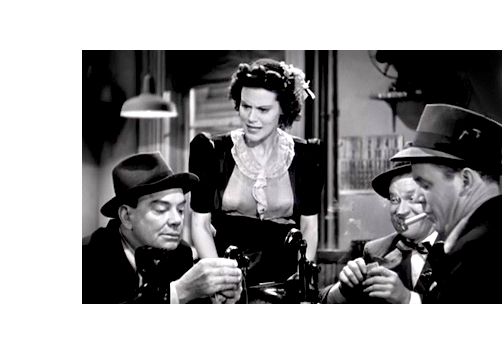
Cary Grant really works for this one. He’s matched at every turn by Rosalind Russell, in what must be her career-best appearance. She is dynamic and actually sexy … even when she (or her stunt double) hikes her skirt up to chase and tackle a man on the street. The scores of complex, rapid-fire speeches ae delivered so quickly that awards could have been given out for enunciation above and beyond the call of duty. Helping with the overlapping dialogue are a new gang of smart-mouthed newsmen: Porter Hall, Cliff Edwards, Roscoe Karns, Frank Jenks, and Regis Toomey. Abner Biberman is Burns’ on-call gangster aide, who thinks that ‘albino’ is a foreign nationality; his girlfriend is a useful tool for getting poor Bruce arrested for mashing.
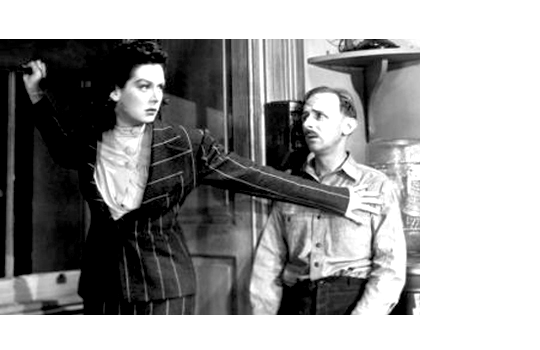
The political angle has changed. Played by the anemic-looking John Qualen, Earl Williams is this time an even more woebegone loser. Instead of a fatalistic anarchist, this new Williams is just an unemployed stoop confused by the Commies preaching in the park. Helen Mack is THE poster child for Depression- era injustice, far more pitiful than Mae Clarke. When Mack’s Mollie leaps from a window, it takes our breath away.
That drama doesn’t break up the crazy-house screwball vibe. The editing goes mad every time the newsmen rush to their telephones, and the jokes about civic corruption are even more pointed. The trigger-happy deputies that shoot innocent civilians are all relatives of the sheriff (Gene Lockhart, hilarious).
His Girl Friday is such a high-energy kick that it can generate a headache if one is unprepared. It is one of those films that grabs us the moment it comes up on the TV dial. I’ve seen the beginning of the show only two or three times, but the last half probably a dozen.
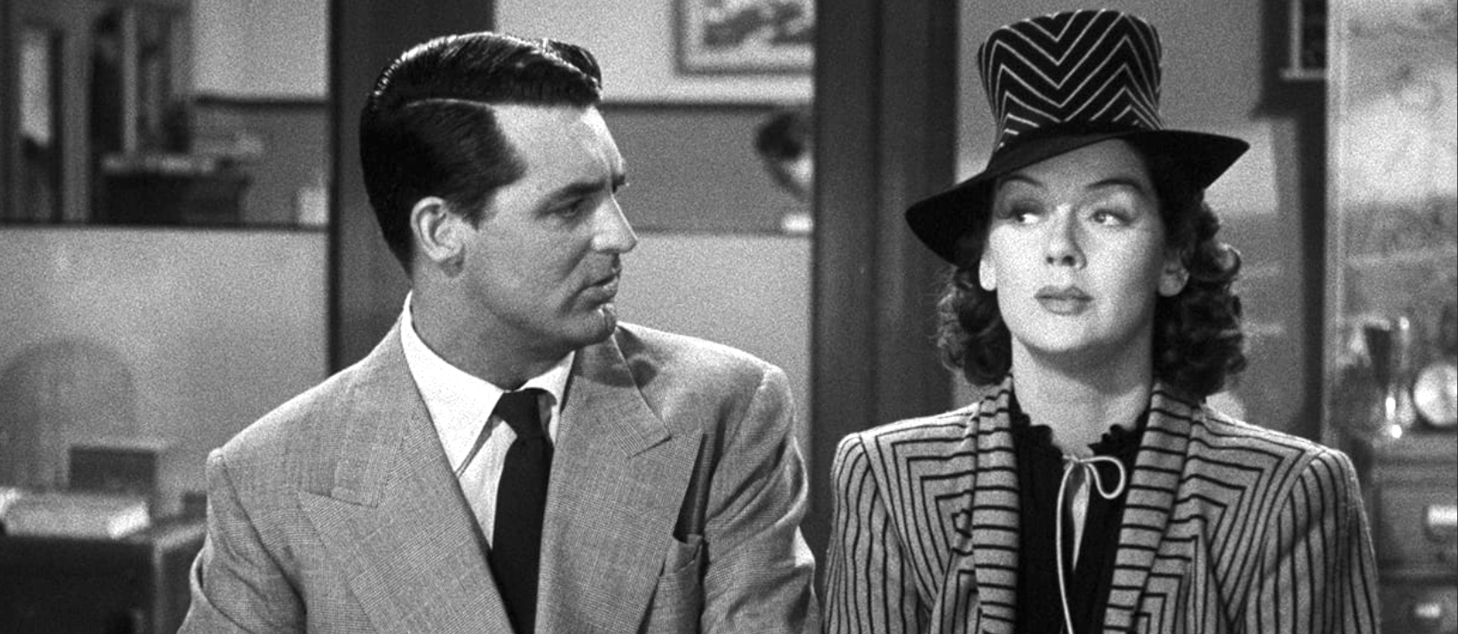

At least top 10 screen comedy. Cary Grant is one of the greatest screen actors ever. Here’s the proof
Yes
Most of Hughes’ personally produced movies were unavailable for decades, and The Front Page is one of the last holdouts. I remember going to Sherman Torgan’s New Beverly theater once in the early 1980s to see Scarface and Hell’s Angels, only to find the doors locked. Sherman showed me a letter he’d just been handed by a lawyer from the Howard Hughes organization, forbidding the screening.
Don’t forget that a few years ago Flicker Alley prepared, I think, three late 1920s Hughes silent films for release and about to go when some one from Hughes’ camp pulled them and Flickr lost what they had put into their restoration etc. Never heard anything more to date. I could go on about Mrs Sam Goldwyn arranging to destroy all Sam’s silent films (those after he lost Goldwyn Films and restarted) except anything Gary Cooper whom she liked, thus MGM/Amazon has Barbara Worth. I wanted Ronald Colman’s Two Lovers (1928) but it is incomplete. It was the opening film for a new moviehouse in Melbourne/Australia back then and by luck one of a few houses still existing today.