


Suppose they had a space war and nobody came? Toei Animation’s 3-D extravaganza Harlock: Space Pirate 3-D was prepped and primed to take the world by storm, but like too many foreign super-productions it didn’t even get a U.S. release. Although this smacks of protectionism, you could make the case that it has commercial ‘issues’ — its themes are rather morbid, what with a leading character who, if I read him right, is allied with a fantastic ‘dark matter’ entity that he doesn’t even understand, a dark force that provides the superduper power for his superduper space ship Arcadia.

Toei’s branded Harlock franchise has many features that would seem derived from the Star Wars franchise, although the original shows appeared in Japan more or less at the same time. The adventures of the moody space pirate have made several circuits around the franchise track, with TV shows, miniseries and theatrical features, the one previous to this effort being made only three years before, in 2010.
Harlock: 3-D is real eye candy from start to finish. In terms of entertainment value it is better than or equal to the majority of digital animation features, but its only visibility in America has been a flat DVD from an outfit called Ketchup Entertainment. Twilight Time corrects that injustice with a sterling-quality two-disc set that presents both the Japanese and International versions, each in either 3-D or 2-D versions. The label is fulfilling its role as a niche purveyor of limited editions: collectors get access to quality product available nowhere else. I’m not a follower of newer Japanese fantasy but I know plenty of fans who are, and Harlock 3-D will delight them.
In a nutshell, this re-imagining of space opera conflicts sees a lone space nomad and his crew of freedom-loving space pirates challenge the Gaia Coalition, the official law in the known galaxies. After the Earth was despoiled, humankind left to colonize thousands of worlds; now that the planet has healed the Gaia prohibits repatriation and has even fought a Homecoming War to keep returnees away. Nobody has found any alien races anywhere, but Captain Harlock seems to be aided by a representative or perhaps last survivor of an alien race, who also seems to be the sole entity that understands the ‘dark matter’ that propels his self-maintaining ship Arcadia. Harlock enlists a new pirate cohort, Logan, who quickly learns the ropes and befriends fellow crew-folk. In the first of a series of reversed assumptions, Logan is actually a Gaia agent tasked with assassinating Harlock. His brother is Ezra, the crippled general of the Gaia forces. Logan and Ezra share their own troubled, morbid backstory and share a love interest; Logan is performing this mission for his brother out of obligation. Logan was sincere when he claimed a desire to join Harlock to fight for freedom. The more he sees of the pirate’s operation, the more he is tempted to switch loyalties. It’s a difficult choice, considering that Harlock’s rather extreme solution to the sorry state of humanity. He is planting superduper explosive charges in various chakra points special places around the universe, that when exploded will blow away temporal boundaries, and return everybody to the good old days of the past, when Earth was still intact. Or something like that.

You want space opera? Harlock 3-D delivers it in spades. It can flaunt at least seventy minutes of feverish space battles, martial combat, all the usual stuff that appeals to seven year olds and their adult fan counterparts. If it wasn’t based on Star Wars it certainly uses the same fantasy building blocks, and its supposed ‘dark’ vein turns out to just as sappily sentimental. Perhaps the marketers were correct in assuming that U.S. viewers didn’t need another eclectic space opera that throws everything into the hopper that isn’t nailed down – we get Robin Hood and Errol Flynn pirate action, and martial arts battles with specially suited combatants that strike the same 3-point-landing poses as Marvel Superheroes. Most of the dialogue is exposition, or superfluous chatter, and some of it is painfully arch: “It’s party time!” We also get a hint or two of adult animé eroticism. The space babe warrior takes a nude shower, doing a dolphin flip in zero gravity, with convenient bubbles providing PG camouflage (which would have helped if the movie was ever rated for U.S. release). Who needs Jane Fonda?
But considering what now passes for kiddie entertainment, most people will probably judge Harlock 3-D okay for all but the youngest small fry. As in most action-oriented entertainment, the prevailing notion is that constant warfare is the eternal state of affairs, and that the only path for a youth ‘following his heart’ is violent conflict. The positive symbol of flowers growing again on the ruined Earth doesn’t carry much weight, when the show cheerfully depicts the annihilation of hundreds of human combatants. Make that estimate tens of thousands if you count all the space ships that are discombobulated by various UPSW’s (Unthinkably Powerful Space Weapons). Harlock 3-D subscribes to the infantile combat action hysteria syndrome that I can only call Martial Masturbation: whenever the plot drags, or another climax (!) is needed, the writers reveal an even more potent technological ‘UPSW:’ The Dark Matter, the Photon Converger, or the Jovian Accelerator, which is basically a Death Star blast fired from the ‘eye’ of the planet Jupiter.
How does the movie look? How is it directed? I was impressed with my viewing on a home 3-D setup, and I’ll bet it really looks good on a big screen. I may not be overwhelmed by the story’s general contours, and I’m not moved by the storyline that tells us Logan is fated to take over as the new Harlock, Princess Bride- style. Logan even receives the correct ‘Mark of Cain’ at the appropriate moment. But the design and execution of the space vistas and spaceship hardware in Harlock 3-D is spectacular. The space warp illusions, ray blasts and other finishing touches are always very close to photo-real, at least what passes for such in the Star Wars realm. The Arcadia’s massive prow is a glowing skull on the end of a long battering ram, that resembles various phallic Geiger designs for the Alien franchise. A ‘work ship’ that descends to the surface of a planet to plant a bomb is pretty nifty too. That episode sees our heroes clinging to an unstable hovercraft, action that seems culled from the first film in the Star Trek reboot. The most blatant ‘repurposing’ is from The Empire Strikes Back, when the work ship flees from the interior of a planet, and barely escapes the jaws of a nearly identical colossal worm-snake thing. Using as it does ‘dark matter’ to flit around the universe, the Arcadia sometimes leaves an enormous cloud of black smoke in its wake, even in space. The smoky contrail reminds us of the dramatic flights of the Wicked Witch of the West. Pretty much everything about the ‘dark matter’ works well. This ship seems to run on an inexhaustible supply of Bad Karma.

One website reports that the show did well in Europe, but wasn’t a big hit in Japan. The marketers that ixnayed Harlock 3-D for the U.S.A. may have remembered Titan A.E. (2000), an elaborate animated space epic that was heavily promoted but (I’m pretty sure) didn’t catch on. Harlock also is not part of a franchise with a big U.S. following, which in this exhibition climate would also mitigate against a domestic release.
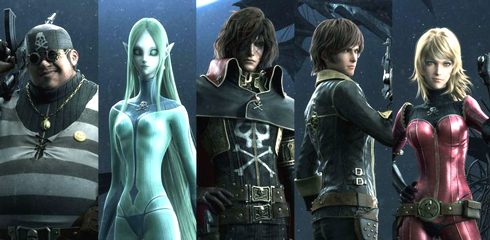
I should also think that the mode of animation — motion capture — was a negative factor. When used as a facet of CGI animation, or live action augmentation, the motion capture of actors’ bodies and faces is of course a proven craft capable of fooling everybody but an expert, which I definitely am not. The loudest protests against the technology came ten years ago with the movies Polar Express and Beowulf. Their awful motion control figures moved terribly, and the animators couldn’t even keep the characters’ eyes from crossing. The MC in Harlock 3-D is a huge improvement, yet it still results in characters with the facial expressions and body motions of precocious department store mannequins. The characters look fine in stills, but the lack both the reality of a human performance, and the artistry of an animator stylizing the action and expressions. If you like this MC method, it’s done fairly well — and every so often a shot will reflect a pleasantly human character. With the basically dull and predictable character Harlock strutting around spinning his cape and striking artificial poses, there is still a human element missing.

Seeing as how the digital sets, environments and actions are almost photo-real, the somewhat unoriginal characters do become a bit trying. On the other hand, I can imagine future a home video technology that will allow a customer to plug himself into a movie like Harlock. The customer would record a series of his/her facial expressions, which would then be inserted into an existing template movie: “Harlock Seven-D, starring Jimmy Hotchkiss of Daly City.” Or maybe you’d like to see yourself take the place of Glenn Ford in Gilda, and kiss Rita Hayworth. Just pay your thousand dollars, please, and more if you want to do more than kiss. Even if the effect is crude, it’ll come off better than this year’s Trumbo, in which actor Dean O’Gorman’s face is pasted over that of Kirk Douglas in Spartacus. We laughed our heads off at that abomination.
I haven’t gone into the film’s motion performers or voice actors here, because their input is fairly invisible. The actual character names are different in the Japanese and International versions, which keep me from being sure I’d cite the correct performer anyway. You’ll have no trouble telling the buff, impossibly lithe and perfect leading players from the supporting characters. A comical techie like Yulian can be dumpy and non-sexy. A holdover from animé days is the characters’ hair, which tends to look like bird feathers. At least there aren’t any stylized ‘cartoon’ folk around, looking like Yokai- spooks with their Margaret Keane eyes. They give me the creeps in things like the Japanese animated 2001 Metropolis. In place of a pirate’s parrot, Harlock’s mascot is a pleasantly gawky space pelican, which happily is not anthro, anthropo… given human character traits.
Harlock: Space Pirate 3-D will be just the ticket for a certain stratum of sci-fi / manga / Japanese fantasy fan. I found it quite beautiful and consistently engaging.
