
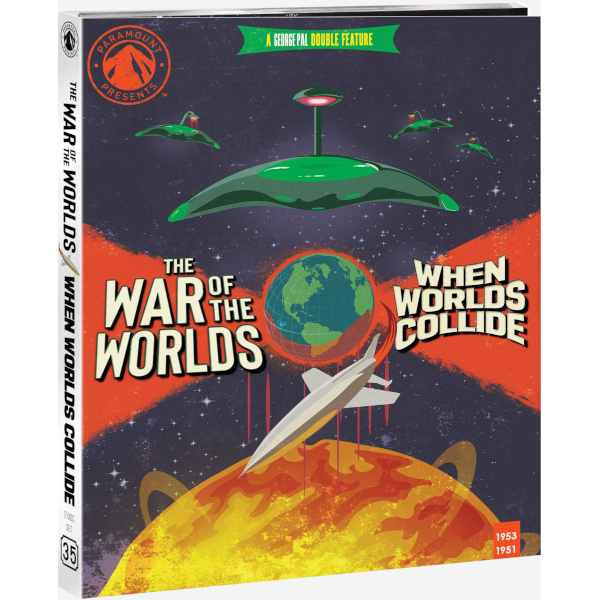
George Pal’s Technicolor dazzler reigned for decades as the top Sci-fi spectacle about an alien invasion: the fantastic, still-impressive visuals say it all. Paramount’s much-awaited full restoration job does the picture justice, even if fussy fans continue to debate the ‘what about the wires?’ controversy.
Even though it couldn’t boast movie stars, The War of the Worlds is A-Picture science fiction, made before Hollywood decided that spaceships and aliens were best left to the quickie producers. The intelligent & exciting adventure links H.G. Wells’ original tale with 1950s atom worries: will mysterious enemies threaten us with unopposable weapons of super-destruction? Can science protect us?

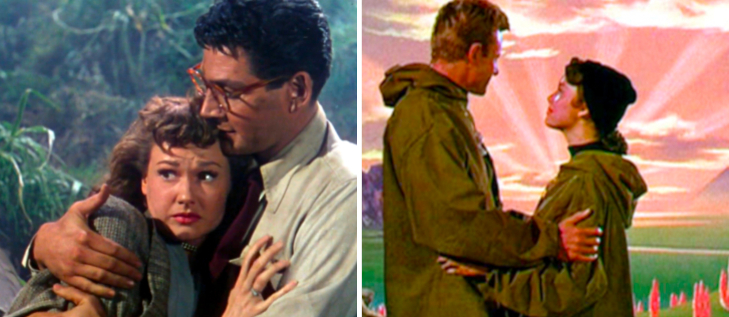
One would have to have been raised on Mars to have never heard of The War of the Worlds. Vacationing Pacific Tech scientist Dr. Clayton Forrester (Gene Barry) is summoned when a meteor lands intact in a California forest. He meets attractive library specialist Sylvia Van Buren (Ann Robinson) at the impact site. The meteor is actually the first of hundreds of alien landing craft, from which emerge gigantic hovering fighting machines. Armed with heat rays and disintegrator beams, the evil-looking machines are protected from attack by invisible force fields. They begin an all-out assault on human civilization. In a matter of days the entire world is overrun by the Martian invasion. Clayton and Sylvia rush to organize a scientific defense at Pacific Tech even as the battle front reaches downtown Los Angeles.
We first saw Pal’s show in a 1965 reissue, at a kid matinee. We weren’t accustomed to such effective filmmaking in monster movies or war movies. I remember vividly the screams that accompanied the first blast of the heat ray. The picture played the audience like an early Steven Spielberg thriller. It had emotional highs and lows and special effects that at the time simply looked real. We were at the edge of our seats for the entire running time, mouths agape.

Pal’s movie version updates the story to the Cold War years and removes Wells’ first-person point of view. The designs for the alien menace are brilliant. Albert Nozaki’s sinister fighting machines still pack considerable extra-terrestrial appeal. They seem to float, even though it is established that an invisible electronic tripod is substituting for Wells’ original mechanical legs. Charles Gemora’s hideous Martian is a crab-like biped with a three-hued eye. Wells’ investigatory tentacle becomes a spy camera that looks like the gladiator helmet of the God of War.
Under director Byron Haskin the tension doesn’t let up for a minute. Relatively serene passages alternate with intensely suspenseful or violent highlights. Pal and Haskin bridge transitions with loud noises, as with the jarring cut to the alien landing craft just as its portway-lid slides to the ground like a heavy manhole cover. The big beachhead battle is given a masterful buildup of anxiety and dread. The show was nominated for best editing and sound effects, which peak at the dynamic moment when the battle commences. A yellow heat ray blast cuts to a red-tinted close-up of Ann Robinson screaming and the barrage erupts. It’s a stunning sequence.

What is it about 1950s Sci-fi that makes us so eager to see ‘Earth’s puny weapons’ out-fought by giant robots and alien death rays? The cumulative firepower of WW2 blasts away to no effect whatsoever. The aliens sit behind their protective blisters for a few moments, relieved to learn that their opposition is still stuck in the age of gunpowder. Their counterattack blasts forth with two kinds of rays (and their associated weird sound effects), a cyclone of white-hot sparks and green ‘meson flux.’ When the Martians lay siege to Los Angeles, America suffers the kind of punishment it avoided in WW2. In secure, complacent 1953, we are suddenly the victims of super-weapons, under threat of extermination.
The emotional, melodramatic climax works for most audiences — how many of us have a family plan in case of a national emergency? Sylvia and Clayton reunite in a church, among helpless refugees cowering as war machines close in for the kill. The War of the Worlds has survived with only a few unintentional laughs, and its uplifiting finale still impresses.
A 2018 digital restoration restored The War of the Worlds’ original Technicolor appearance; we discuss that fully in our review of the 2020 Criterion Blu-ray. The restoration was also a bit of a revision, in that Paramount removed some visible wires here and there, and cleaned up a a few other effects. That’s discussed in the older review as well.

When Worlds Collide
Blu-ray
1951 / 83 min.
Starring: Barbara Rush, Richard Derr, Larry Keating, John Hoyt, Judith Ames, James Congdon, Stephen Chase, Frank Cady, Hayden Rorke, Kirk Alyn, Casey Rogers, John Ridgely, Stuart Whitman, Leonard Mudie, Mary Murphy, Roy Thinnes (?).
Cinematography: W. Howard Greene, John F. Seitz
Visual Effects; Gordon Jennings, Tim Baar, Jan Domela, Paul K, Lerpae, Chesley Bonestell
Film Editor: Arthur P. Schmidt
Original Music: Leith Stevens
Written by Sydney Boehm from the novel by Edwin Balmer & Philip Wylie
Produced by George Pal
Directed by Rudolph Maté
George Pal’s ambitious science fiction classic has conceptual imagination and visual wonder to spare, along with a million awkward and dated details. Gee-whiz spectacle is the order of the day — how many End Of The World movies actually show terra firma expunged from the Solar System?
We dearly love When Worlds Collide despite a screenplay that introduces a new absurdity in almost every scene. Just the same, this core Sci-fi thriller was a popular hit and took home an Oscar for special effects. Most of those effects have limitations, but the fabulous silver spaceship remains a wondrous spectacle.

The original Balmer & Wylie book (and its sequel After Worlds Collide) were likely inspired by Abel Gance’s French talkie La fin du monde (1931). Paramount purchased both for Cecil B. DeMille right after publication. Sydney Boehm’s screenplay indeed reads as if it were written in 1934. With the discovery that two rogue planets will soon strike the Earth, scientists scramble to build a Space Ark to ferry a small group of humans to safety. Before the final impact, one of the planets will pass by close enough to cause cataclysmic earthquakes and flooding. If the Ark Project survives that disruption, there’s still no guarantee that the spaceship can be completed in time.
With only 40 seats on the Ark, most of the project’s scientists and engineers will have to be left behind. On launch day some of them riot and attempt to seize the ship.
The overly simplified screenplay is crowded with scientifc, logical and moral absurdities. An incredibly advanced rocketship Ark is designed and constructed in just eight months, with no flight tests. The script evades all consideration of reproductive reality beyond chaste go-forth-and-multiply terms. Domestic farm animals are gathered literally two by two, Noah-style. The laws of genetics are ignored as forty randomly paired lottery winners are chosen to take the trip — a wholly inadequate species sampling. We’re instead given a monogamous love triangle, to distract from thoughts of future birth defects.

The moral logic of When Worlds really breaks down with the lottery to select those forty lucky Ark passengers. Not one of the young engineers and scientists objects when the project head Cole Hendron (Larry Keating) arbitrarily reserves space for his personal entourage, including his daughter and her boyfriend, a random kid and a stray dog. Hendron gives another seat to a lottery loser, so she can join her boyfriend. No wonder the also-rans revolt.
The project head then takes petty revenge on the Scrooge-like millionaire (John Hoyt) who funded the Ark, denying him his agreed-upon reserved seat. The reality of doom unaccountably restores the wheelchair-bound man’s ability to walk, just like Doctor Strangelove. It’s a nasty, vindictive ‘miracle:’ You’ve got five minutes to live, Mister Moneybags, so go have yourself a stroll.

Artist-designer Chesley Bonestell’s Space Ark remains a marvel, a gleaming rocket silhouetted against dramatic painted skies. It is an icon of the Sci-fi boom years, representing the ideal that technological progress will save mankind. The mile-long launch ramp swoops down into a valley before zooming up a steep mountainside. This design choice allows for the Ark’s construction to take place on a dramatic promontory, not at the bottom of a gulch.
When Worlds Collide won an Oscar for Visual Effects and was nominated for best cinematography. Many of its visuals still spark the imagination. Views of the onrushing planets looming in the night sky are appropriately frightening. A cataclysmic disaster montage has just one full effects composite, a not-bad traveling matte of the Atlantic pouring into Manhattan’s Herald Square. A briefly-glimpsed painting depicts capsized ocean liners floating next to the Chrysler building. George Pal’s editors then assemble every bit of Technicolor volcano, flood, and earthquake stock footage that they could find.

The rocket’s roller-coaster launch is breathtaking, but the actual astral collision is under-represented. Our planet and its history are gone in an instant, but our survivors show no reaction. The only plan to alight on the new planet is a ‘thumbs up and hope’ crash landing. Happily, a convenient field of mountain snow materializes. A woman passenger squeaks out “We’re HEERE!”, as might Minnie Mouse on arrival at Disneyland. The finale has been debated ever since. When the hatch is opened, the view is surprisingly unsatisfying, a cartoonish landscape more suitable for Disney’s Fantasia. It’s attractive, but artificial in the extreme. The new planet might as well be a Sunday School Heaven. Any grim considerations are bypassed in favor of storybook sweetness and light.
The bigger irony is that When Worlds Collide has always been a favorite, flaws and all. We love its fanciful rocket and the spectacular special effects, and its apocalyptic tone feels like a prophecy of fearful scientific challenges to come. One re-imagines the tale in multiple forms. It’s core 1950’s Sci-fi Sense of Wonder stuff, an ambitious idea fleshed out just enough to stimulate the imagination.
