A look at Donald Siegel’s filmography shows that between his standout ‘fifties titles — Riot in Cell Block 11, Invasion of the Body Snatchers, Crime in the Streets, The Lineup, he suffered through his share of unrewarding cheapies, especially at Columbia. Released between two Elvis Presley movies, 1959’s Edge of Eternity is a smartly-assembled program thriller with spectacular elements that a studio publicist would say ‘are readily exploitable for general audiences.’ Not exactly well written but well crafted by its director, cameraman Burnett Guffey and some excellent stunt men and stunt flyers, Edge of Eternity hung its hopes on a ‘B’ – level leading man and an ad campaign that promised high jeopardy above the Grand Canyon. I remember the trailer well: it showed people clinging to a rocking ore bucket by their fingernails, a zillion feet above what looked like a bottomless abyss. That was enough to bring ’em out in those days — it was pleasurable to look at ninety minutes of pleasant characters and gorgeous scenery, awaiting the Big Thrill scene.

The spectacular finish was indeed the big draw. The story seems an amalgam of elements from other movies, only partly developed: a tepid murder mystery with a sketched father-son setup something like The Man from Laramie, joined with a few desert car chases. In a remote mining town near the rim of the Grand Canyon, Arizona Deputy Les Martin (Cornel Wilde) comes up against difficulties when the murder-by-hanging of an unidentified man seems related to two more killings. Avoiding an invitation by his bartender buddy Scotty O’Brien (Mickey Shaughnessy) to skip out to Vegas, and the amorous distraction of Janice Kendon (Victoria Shaw), the daughter of the local mining baron Jim Kendon (Alexander Lockwood), Les finds that local politics puts both his job and that of Sheriff Edwards (Edgar Buchanan) in jeopardy. Various suspects include Bill Ward (Jack Elam), an engineer at the local Guano mine, which is reached by a precarious cable car. Janice’s kid brother Bob (Rian Garrick) is a wastrel who spends his time getting drunk. Les searches the bottom of the canyon in an airplane to find a missing miner… but he still needs help to solve the mystery.
It’s all in the production: nothing in Edge of Eternity is more complicated than an average detective or mystery show on TV. The relaxed script introduces its characters and desert setting in a pleasing way, with plenty of leisurely drives between locations. The beautiful Janice explains how the mining town has fallen into decline because the price of gold has dropped. Apparently her father has suspended operations until the profit margin improves. Is that how things work — a vital resource is suppressed until such time as a rich man decides it is worth going after? Les does theorize that somebody may be sneaking ore from a gold mine and taking it out of the country where the price is much higher. If that’s so, why doesn’t Jim Kendon do the same thing, legally? I’ll never be a capitalist, it seems.
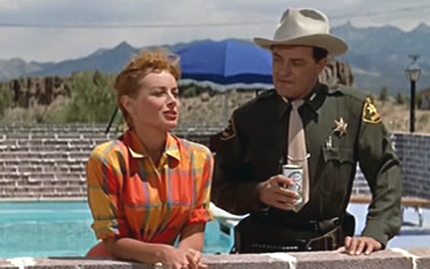
The show’s mystery element has flat feet. Good ol’ Les hears that the killings might be related to somebody stealing ore from a closed-down gold mine, but is assured that such a scheme would require special science knowledge, plus a way of moving the stolen rock. Almost immediately, he’s told that a certain character is not only a geologist, but a pilot too. Les puts none of this together, and the mystery more or less solves itself. The main baddie babbles out a ridiculously comprehensive exposition dump- cum confession in record time, and the film converts into a perilous action manhunt.
But the picture hangs on its production values, pleasant characters and impressive action. The CinemaScope images taken across the breadth of northern Arizona are entertaining in themselves. At my first screening of 1941 I could see that the most spectacular images in the film are not its effects, but a few POV shots of a P-40 fighter plane flying through the Grand Canyon. Giant models may blow up nicely, but there’s no competing with the wonders of reality. Edge of Eternity spends at least six minutes flying above the desert and zooming deep into the canyon, and even shows a seaplane landing on the river at its bottom. It’s impressive because it’s real — the pilot is basically flying in a deep trench, where he must follow the bends of the river. He’s in a groove, and cannot turn around. This beautifully filmed footage is inspiring. We’re told that Siegel and Guffey did their own 2nd- unit work.
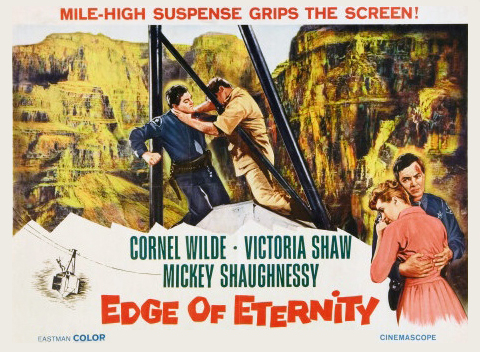
The acting gets a ‘B’ for skill and an ‘A’ for effect. Who cares if Cornel Wilde isn’t Laurence Olivier? He’s a nice guy and is always good company. Except for his Incredible Disappearing Accent, Wilde’s deputy is a more than adequate leading man. Les Martin is not even a macho stud. He’s gracious to the leading lady and is not superman in the fight scenes. Several of the other featured players are right off the Columbia contract list, although the engaging, cast-to-type Mickey Shaugnessy and Edgar Buchanan were surely valued freelancers. Jack Elam, Dabbs Greer and Tom Fadden had already become fixtures in Don Siegel movies, while handsome Rian Garrick’s career as a featured player seemed to end before it began.
Contract actress Victoria Shaw did good work but still did not find fame, despite good placement opposite Tyrone Power in one of her first movies. As Cornel Wilde isn’t exactly an effusive personality, Ms. Shaw carries the burden of enlivening things. Her Janice Kendon is outgoing and positive minded, if a bit reckless as she happily zooms her Thunderbird through desert roads. Go out to the desert sometime — locals don’t ride with the top down in the sunshine unless they’re in a parade. For fun Janice dresses up in a designer outfit and then goes to sit by herself out behind a dirty mineshaft. Buried in what is essentially a ghost town, the fact that fashion plate Janice isn’t ridiculous is a compliment to Victoria Shaw’s performing and Donald Siegel’s direction. Unmotivated car chases and unlikely characters are just fine in a movie without pretensions, one that just advances from one entertaining scene to the next.
I suppose that lack of pretension is indeed what makes Edge of Eternity so satisfying.
The locations are rather fanciful. To my knowledge nothing like the town seen in the movie is within a short drive of the Grand Canyon. The sizeable town (now a city) of Kingman is half a state away to the West, and Arizona is a big state. We even see the Mohave County courthouse.
The little ex-mining town in the hills is Oatman, Arizona, across the Colorado River from Needles and just North of Route 66. It’s recognizable from other movies by the canine tooth- shaped rock in the background of some scenes. Oatman should be famous for its history as a getaway-hideaway escape destination for Clark Gable and Carole Lombard. Just plain folks at heart, they’d shack up in what couldn’t have been much of a hotel, and in 1940-’41, certainly not air-conditioned. Scenes for 1962’s How the West Was Won were filmed there. The mine-top construction and shaft we see might be the very same site featured when George Peppard shows his kids the deep hole, and Eli Wallach arrives to harass them.

Burnett Guffey’s cinematography was always precise, even though he’s best remembered for his B&W ’50s noirs, and Bonnie & Clyde. The rear-projected driving scenes in the show are some of the best I’ve seen, although it is likely that a specialist supervised them. In the commentary Nick Redman mentions that the people are doing wild things with their steering wheels when driving basically straight ahead. I didn’t notice, because on pre- ’60s full-sized sedans without power steering, steering wheels were much bigger. I remember spinning them like a top to do a sharp turn. But Nick is right, the mime is a little excessive.
The effect shots during the stunt-fight finale on the aerial tram bucket are not rear-projected, but done with good traveling mattes. Somebody worked hard because the matte lines are mostly hidden (except for some halation around Victoria Shaw). The film grain doesn’t take a big jump – it’s finer than that in the film’s ordinary opticals and title sequences.
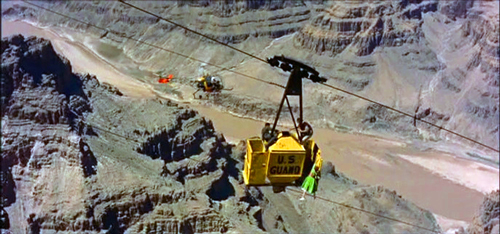
The stunt action on the tram over the Grand Canyon is particularly good, especially after similar, patently phony scenes in shows like RKO’s earlier Second Chance. Yes, the players mid-canyon are likely tethered to the ore bucket in case of slip-ups, but when the stunt man doubling Cornel Wilde first jumps on he is definitely not, and he makes a point of immediately hanging by one hand. He’s nuts! If he slipped, he’d have at least twelve seconds falling to think about the extra $500 stunt fee that his widow will be spending instead of him. The fact that a helicopter is buzzing around isn’t as risky as the commentary implies — with the long lens needed to film the scene, it’s nowhere near the canyon wall or the sky-bucket ore tram.
Almost risible today is the revelation that the ore tramcar was built to haul guano being mined in a bat cave (!) and used for fertilizer. A title card at the end acknowledges the cooperation of America’s guano industry. The car even says “U.S. Guano” on the side, which these days would surely elicit nods of agreement from Mexican viewers.
One last thing — I really doubt that that small plane near the end can carry so much ore… there would be serious weight issues. It’s a dumb observation, but it did cross my mind. I’m an armchair crime caper critic.
But hey, the conclusion of Edge of Eternity was indeed a great payoff for audiences of 1959.