
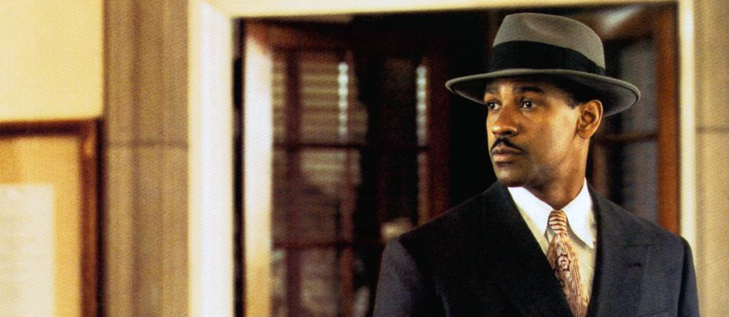
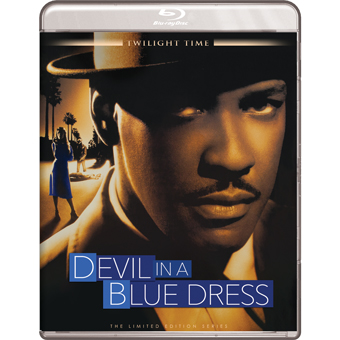

Carl Franklin was cheated, Easy Rawlins was cheated and WE were cheated: the 1995 feature film Devil in a Blue Dress, adapted from the first of Walter Mosley’s black detective books, should have been the first chapter in an ongoing series. Denzel Washington is terrific in this excellent rendering of Rawlins’ Los Angeles in 1948, where South Central is the home neighborhood and blacks are discouraged from drifting into the West Side. Everything clicks. More importantly, director Franklin has the taste and talent to create a feeling of ‘being there’ without overstating the period trimmings.

The show was executive produced by the makers of Silence of the Lambs. Like the bigger success Philadelphia, it offers star Denzel Washington a worthy leading role, the kind that black actors before him rarely received.
The story is smart but not overly clever. It’s less a neo-noir than it is a classic detective hero genre reboot, with a realistic attitude regarding race relations in the late ’40s. Unemployed aircraft worker Ezekiel ‘Easy’ Rawlins wants to keep his snug little house in the Adams district, and so takes on some shady errands for a white gangster, DeWitt Albright (Tom Sizemore). The job is to find an elusive white woman known to frequent black company, Daphne Monet (Jennifer Beals). Rawlins soon discovers that she’s mixed up with powerful men, both running for political office: the thuggish Matthew Terrell (Maury Chaykin) and the bookish Todd Carter (Terry Kinney). But Easy’s investigation gets the woman of a close friend killed, and the plans of the unpredictable DeWitt include framing Easy for other murders as well. Rawlins has no choice but to send to Texas for his own unpredictable but undeniably effective strong-arm man — Mouse Alexander (Don Cheadle).

Writer-director Carl Franklin first came to our attention way back in 1992, with his One False Move. He was an apt choice to bring Walter Mosley to the screen, as borne out by the quality filmmaking on view here. Devil in a Blue Dress isn’t an ordinary detective tale painted black. Neither is it anything like the old blaxploitation subgenre, in which the main joke in every scene is to underscore an infantile kind of Black Power, ‘puttin’ whitey in his place. If anything Easy Rawlins is a more cautious character than in Mosley’s books. Denzel Washington has him tread lightly when rousted by the police. Blacks in 1948 didn’t go strolling on the Santa Monica Pier, and Easy’s not there five minutes before some teen punks start trouble. No attitude or heroics ensue — Easy knows better than to assert his rights in a situation where he can’t win. As it turns out, he’s saved by an even scarier white gangster, played to perfection by Tom Sizemore. When Easy says he doesn’t want trouble, the gangster has a fairly sane response: “When you step out of your door in the morning, you are already in trouble. The only question is, are you on top of that trouble or not?”
Easy goes through most of the standard private dick moves, chatting up Jennifer Beals’ mystery woman and holding his own with the rich and powerful. He doesn’t intimidate people, but maintains his dignity by insisting on fair dealings, and keeping a tally when someone wrongs him. Besides, there’s always his crazy pal Mouse to mix things up, if trouble is required. It’s just that Mouse can’t be trusted to keep a lid on the violence. He kills one of the bad guys, and gives the excuse that it was too much trouble to tie him up: “Look, Easy — if you ain’t want him dead, why you leave him with me?”

The production doesn’t scrimp on the trimmings – it plants us firmly in an earlier era where the cars are enormous and shiny, most everybody dresses up to leave the house, and the cops feel entitled to rough up the black population whenever they please. South Central is in some ways a wide-open district. Everybody looks the other way when the cops are on the prowl. If the action is black on black, Easy can storm into a bar and remove a man at gunpoint, and get away with it.
The Easy-Mouse relationship is hilarious. Don Cheadle’s Mouse is a charming psychopath, a real hair-trigger, a loose cannon who never turns down an offer of food. Never afforded much praise as an actress, Jennifer Beals is an impressive femme mystérieuse. Daphne Monet doesn’t really expect to be believed when she flashes her big dark eyes. Interestingly, Mosley and Franklin give her a background as a poor girl trying for respectability, only for her mixed race and city politics to get in the way. She’s like a luckier version of the tragic Elizabeth Short.
Franklin energizes an interesting group of new and underused actors. Albert Hall (Apocalypse Now) is Easy’s somewhat mousy neighbor, and Mel Winkler the jovial bartender who steers Easy toward shady detective work. Lisa Nicole Carson is charm personified as Coretta James, his best friend’s girl. Coretta coaxes Easy into sleeping with her in a series of irresistibly casual steps. In his commentary, director Franklin says that he invented the character of Dupree Brouchard

(Jerrard Burks), a benign nutcase in Easy’s neighborhood. Sort of a mad gardener, Brouchard goes about chopping down unguarded trees. Easy’s constantly chasing him off.
How many movies do you know that show black people living in a largely black middle class neighborhood? In the midst of all the genre intrigues is a vision of a real place where people could live normal lives. The enormous volume of war industry work in Los Angeles brought an exodus of African Americans to town, and the defense plants offered good workers solid jobs and the ability to buy homes of their own. Devil in a Blue Dress stresses the fact that Easy Rawlins’ main ambition is to remain a happy bourgeois homeowner. He derives pleasure from being respected by his neighbors when he pulls into his own driveway. It is a friggin’ crime that the studio behind this movie didn’t see that they had a potential winning franchise on their hands, with a sizeable crossover audience.
