
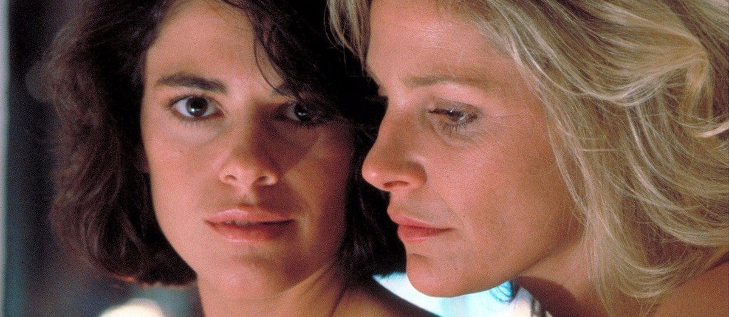


Desert Hearts is a fine movie that’s also one of the first features ever about a lesbian romance, or even with a lesbian theme, that doesn’t end in tragedy, or with the offending woman retreating to a male partner. No matter how one looks at William Wyler’s two versions of Lillian Hellman’s play (These Three and The Children’s Hour), the essential takeaway is that unnatural behavior results in unnatural loss, acknowledging injustice with a sigh that says, ‘well, that’s just how things are when you go against nature.’ Perhaps those shows made people aware of the issue, but it’s unlikely that they struck much of a blow for tolerance.
Donna Deitch’s movie comes from lesbian-themed writer Jane Rule, who along with the rest of an earlier generation of women trying to understand their own feelings, was undone by a notorious 1928 book called The Well of Loneliness. The title of Rule’s book was similarly hope-challenged: Desert of the Heart. One look at the bright and positive Ms. Deitch in Criterion’s welcome extras, and we see right away that she had no desire to make a doom and gloom movie. That intent is reflected in the title change.

The 1985 color feature is a true independent, financed without a distributor. When screenwriter Natalie Cooper passed away in 2004, film critic Judy Stone explained what made Desert Hearts different: “It treated the story of two women falling in love as casually as any heterosexual affair.”
It’s sometime in the late 1950s. Arriving in Reno to wait out the seven-week residency period to secure a divorce, New York English professor Vivian Bell (Helen Shaver) is met at the train station by dude ranch proprietor Frances Parker (Audra Lindley). Vivian is exhausted and not looking for a lot of social activity, but the effusive Frances soon has her meeting her ‘stepson’ Darrell (Dean Butler) and ‘stepdaughter’ Cay Rivvers (Patricia Charbonneau), She’s soon meeting their local friends, who like Cay work at a casino. Cay’s being hit on by her manager, while her pal Silver Dale (Andra Akers) is about to be married. Vivian is at first put off by the lack of cultural acuity in this crowd, but finds herself attracted to the vivacious Cay, who sculpts in her off hours. Vivian is also surprised to discover that her new friend is a lesbian. Cay engages in casual sex with Gwen (Gwen Welles) and possibly with Silver as well; they share a bath together while Silver’s fiancé serves them drinks. Darrell is equally open-minded but Frances can’t handle the thought that Cay and Vivian might have an affair. The un-hysterical but deeply troubled Vivian tries to sort out her feelings, as the determined Cay presses for a physical relationship.

At its core Desert Hearts is like any other tentative romance, where confused individuals find themselves on unfamiliar ground and discover new things about themselves. Breaking into any established family will cause problems — in Cay’s case, her nervous stepmother wants to hold onto Cay and Darrell because she’d like to pretend that their father, her late boyfriend, is still around. Vivian has her own sensibility about things and isn’t frightened when another divorce resident-vacationer expresses disdain for Cay, the ‘queer.’ With only a bit of discussion with her attorney, we find that Vivian isn’t that much of a sensualist, and that her marriage with a fellow professor apparently was mostly academic. Natalie Cooper’s adaptation and Helen Shaver’s performance evades all the stereotypes about this — having lived for a time more or less asexually doesn’t mean that Vivian is a stranger to passion. Although Cay is aggressive and impulsive, she’s not destructive, out of control or in any way a menace to society.
This writer is no expert on LGBT matters — I have to make sure I get the four letters in the right order. But I also responded positively to John Sayles’ Lianna, a less heralded movie with a lesbian theme. [ Its actress Jane Hallaren was also a student of my wife, and at a couple of parties I got to talk to her at length.] Lianna precedes Desert Hearts by a few seasons but sticks to the old formula — the lesbian relationship soon crumbles under a furious social backlash. I also found Ms. Deitch’s movie to be more satisfying than Todd Haynes Carol (2015) that shows a much more temperamentally mismatched lesbian couple slogging their way through yet another doomed ordeal. For us straights the message is too easily interpreted as, ‘unnatural unions are fundamentally no good.’ That’s just not borne out by real life.

Desert Hearts is simply a good movie. The excellent script and dialogue bring our Eastern lady into contact with people that under other circumstances she might shun as uneducated and directionless — and show her taking a liking to some of them. Vivian Bell steps off the train like Spencer Tracy in Bad Day at Black Rock but then drifts into a setup comparable to Clare Booth Luce’s The Women by way of Arthur Miller’s The Misfits. But from then on the movie is its own animal, with different things to say about people — mostly positive things.
All of the actors were new to me; director Deitch helps make them vivid individuals. Helen Shaver succeeds in breaking through the stereotype of academics with attitude. Audra Lindley’s insecure dude ranch owner has the feeling of somebody one might meet in real life, the kind of person you want to know more about. Patricia Charbonneau is just amazing. I previously knew of her only through a glorified cameo she did five years later for producer Jon Davison (or was it director Irvin Kershner?) in the science fiction thriller RoboCop 2. I had thought that Charbonneau had been chosen for the minor part of a sympathetic Robo technician because her eyes could be made to look like Barbara Steele. I now think that the makers of RoboCop 2 were hoping to channel some of the first movie’s bittersweet sentimentality through the expressive Charbonneau character. The part isn’t bigger in the shooting script than it is in the finished film, so I’d have to guess that her caring Robo-tender is just another undigested element in a film that doesn’t fully come together.

In Desert Hearts the Shaver-Charbonneau combination is incredible. I’m sure viewers will ask, are they, you know, really lesbians in real life? Beyond the none-of-our-business aspect of the question, this movie helps make such thoughts irrelevant: they’re simply vivid people trying to live and love in peace. As a culture we need to get beyond the Frances Parker mindset, as soon as we can.
First time director Donna Deitch displays an excellent instinct for where to place the camera. Nothing looks as if a style has been imposed, yet everything on screen shows intelligence and taste. Unlike the bury-’em-in-art-direction approach of Carol, this 1950s world is sparse but telling in all aspects. Anybody that can express relationships this well is a fine, fine director, period.
