

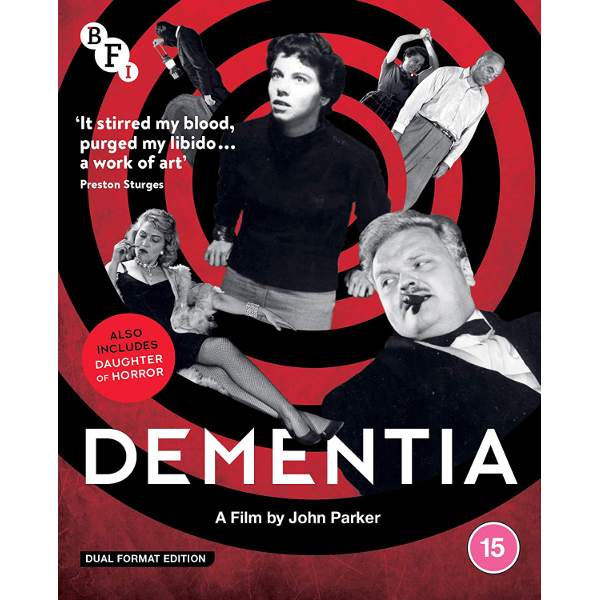

I screened John Parker’s Dementia at UCLA in 1972, at a time when the film seemed so obscure, I saved my Audio Brandon 16mm catalog just to be able to prove that it even existed. (I include that rental catalog entry near the bottom of the page. ↓ This most sacred of cult attractions became a holy grail after coverage in the 1985 Incredibly Strange Films book, which motivated a horde of film fans to investigate forbidden corners of exploitation ‘shadow cinema.’ Dementia first came to home video around 1988 on a murky Sinister Cinema VHS, but in its butchered but highly entertaining re-issue version Daughter of Horror. Fellow editor Steven Neilson proclaimed it the best movie he’d seen that year. It was difficult to make out what we were looking at, the image was so poor. But the terrifying voice was there … the Demon voice … in the dark:

You – you out there. Do you know what HORROR is?
The scarcely hour-long show has little in common with other ‘debut’ independent films of ’53-’54. Roger Corman’s Monster from the Ocean Floor is a conventional show scaled down to a minimum, production-wise. Stanley Kubrick’s Fear and Desire seems an unsuccessful experiment. But Dementia feels fully formed — it knows exactly what it is doing and pursues its cinematic agenda in every shot. Fans of the bizarre might find that Dementia harmonizes with the weird filmic world of David Lynch.
Film students, art students, lovers of the unusual … John Parker’s unloved psycho-horror shocker will appeal to all of them. It’s essentially a silent movie — no dialogue — that combines expressionist imagery with the demonstrative performances one might see in an avant-garde movie. Most of Parker’s show was filmed on the sandy beach-adjacent streets of Venice, five years before Welles’ Touch of Evil. The cameraman is Edward D. Wood’s William C. Thompson, but the direction is forceful and assured: good blocking composed in deep-focus, expressive trucking shots. The soundtrack features an obsessively eerie George Antheil score, with a wailing vocal by Marni Nixon. Add a dab of slightly pretentious Maya Deren / Curtis Harrington-style experimental film atmosphere and you just about have the recipe. The cumulative effect is a nightmare sensation of distorted reality. It’s original horror art, that’s for sure.

John Parker must have been destroyed when his filmic creation was so soundly rejected by the gate-keeping New York censors. It eventually had a very brief run in one little theater in New York, disappearing after barely making a ripple. It’s not even clear what became of Parker. He didn’t drop off the art-film awareness radar, because he was never ON it. It’s as if Parker fell into the forbidden zone of his own creation:
For this is a place where there is NO love, NO hope
In the pulsing, throbbing, world of the INSANE MIND
Where only nightmares are real.
How obscure was Dementia? When it returned as Daughter of Horror in 1957, it saw so few bookings that even Forrest J. Ackerman didn’t take notice of it. Forry once ran an image of its poster as a ‘mystery photo’ in his Famous Monsters of Filmland magazine. In his next issue he admitted that he didn’t know if it were a real movie or not!
Dementia begins in a nighttime city of the Damned. ‘The Gamin’ (Adrienne Barrett) wakens in her tawdry rented room. Dressed like a beat chick from pre- rock ‘n’ roll days (except for an attention-getting medallion), she takes a switchblade from her dresser and steps out on the town. She witnesses an arrest for spousal abuse, sees some winos and is accosted by a news hawker (Angelo Rossitto) who gives her a paper announcing a murder. That paper and its prophetic headline seems to follow The Gamin as she walks. A pimp, aka ‘The Evil One’ (Richard Barron) accosts The Gamin and sets her up with a John in a chaufeurred black car. The porcine Rich Man (Bruno ve Sota) takes her to a series of nightclubs, including one where he ogles a dancer.

In the car, The Gamin re-experiences a horrifying episode from her childhood that plays out in an unreal, foggy cemetery. A ghostly Demon escorts her by lantern light through a replay of scenes with her parents, amid furniture arrayed between gravestones. Two killings occur. When The Gamin emerges from this nightmare-in-a-nightmare, the Rich Man takes her to his apartment in a building with an enormous staircase. (Author James Ursini identified the location as an old hotel on Alvarado Street, across from MacArthur Park.) There she watches him eat a greasy meal of chicken. When The Rich Man makes advances The Gamin savagely attacks him — as predicted in the newspaper. From that moment forward events and perceptions no longer have even the pretense of reality … the nightmare of murder and mutilation continues.
The 1957 Daughter of Horror is an ‘improved’ re-edit by distributor Jack H. Harris. He replaced some of the credits and eliminated both John Parker’s directing credit card and the cast re-cap at the finish. Harris’ main revision is the addition of a ‘horror’ voiceover that explains The Gamin’s state of damnation, forever guilty, etc.. It was said to have been recorded without credit by TV announcer Ed McMahon. A shadow image of the narrator is added to the star field up front, identifying him as the ghoulish Demon seen later in the cemetery horror flashback. The voiceover removes the ambiguity from The Gamin’s story, but it’s one of the most effective ‘spooky voices’ on film. McMahon indeed sounds like a hell-demon from beyond the grave:

Yes, I am here. The DEMON that possesses your soul.
Wait a bit. I have so much to show you.
So much that you are afraid to see.
After the murder The Gamin evades a policeman (who looks like her father) by ducking into a beat nightclub, where the hopheads hang out and the oily police detective takes his bribes. The pimp gives her a sleeveless dress — which she puts on in a ‘magical’ editorial trick straight from Cocteau’s Beauty and the Beast. Anthiel’s music score gives way to several minutes of bebop jazz from Shorty Rogers and his Giants. The nightclub jazz set piece is well directed and very atmospheric, a nightmare in the vein of Jack Kerouac.

The busy, throbbing Antheil score then returns uninterrupted save for some laughter, gunshots, and screams. The young Marni Nixon, at the time married to music supervisor Ernest Gold (the future major film composer), wails practically non-stop throughout the Antheil score. The weird vibe may have been directly lampooned in a vintage skit-film seen on Saturday Night Live. In that skit a female motorist is terrorized by nervous, wailing singing. She traces it to its source, to find that it originates from a woman shrieking into a microphone on the floor of her apartment.
Dementia was no amateur production, either on the soundtrack or behind the camera. Editor Joseph Gluck cut westerns and serials, E.A. Dupont’s The Scarf and TV’s Nanny and the Professor. Technician Everett Baker was a cameraman on Beast With a Million Eyes. Matte painter Albert Simpson created special effects for movies as diverse as From the Earth to the Moon and Hawaii. Cinematographer William Thompson delivers precise visuals at all times — the show couldn’t be less like one of Ed Wood’s movies. The nightmare montage finale is extremely effective, even if it owes a debt to the classic wrap-up to the British horror classic Dead of Night (1945). A similar lone person is surrounded by laughing, accusing demon-people:

Now all the images of horror,
the DEMONS of
your mind crowd in on you to DESTROY you!
Exactly twenty years ago Kino released a double bill DVD of Dementia and Daughter of Horror, allowing us to compare the two versions of the film. Its main extra was Dementia: A Case Study, an illustrated essay by Bret Wood that offers one research revelation after another. Parker undoubtedly conceived and directed the movie (despite Bruno ve Sota ‘sort of’ taking credit for directing in a later interview). Parker did solicit Preston Sturges’ support for the film. He did submit the movie ten times to the New York censors between 1953 and 1955, only to be refused a license for exhibition due to its horror content. The actual documentation is part of Bret Wood’s essay. The censor board’s gripe sheet lists just about every forbidden item in the Code: prostitution, pimping, police corruption, adultery, incest (maybe) and heroin addiction. The censors demanded the deletion of practically every event in the film. Parker did everything he could to get his movie distributed, to no avail. It had a brief run at one forlorn art-house in New York, double-billed with a short subject on Picasso.

The BFI’s Blu-ray + PAL DVD of Dementia has a fine HD transfer of the original 1955 version, but otherwise the presentation has some serious issues. Yes, Dementia looks very good, sharp and stable, with far more detail than before. We can see the stocking masks that turn various bystanders into Cocteau-like ghouls. We can also see a shot or two that were flopped and repeated. The audio track is much clearer as well. It’s quite a concert, a solid hour of music composed by George Antheil and coordinated by Ernest Gold.
But there’s almost immediately a downside. Cohen’s film source is different from the old Kino DVD; the extras mention the film receiving clearance for UK exhibition in 1970, so perhaps it was further altered by the British censor. A text scrawl has been added to the start of the film, the full quote from Preston Sturges praising the movie. The credits play as we expect until part of a pullback from the animated star field is repeated, a jarring jump-cut. It’s been done to cover the missing director credit. But if one watches carefully after the George Antheil credit, 3 or 4 frames of John Parker’s director credit fading up are still present, before a hard cut to the star field. Why remove the director’s credit? Animosity? Parker’s own request? The commentary and the essay have no reaction to this editorial surprise.

Other parts of the film may be a little different, but a glaring change at the end, in the jazz club scene, almost renders the disc presentation invalid. A key cutaway to the Rich Man at the jazz club’s basement window has been removed, the important one that reveals the bloody stump of his arm. The shot is intact in the uncut Dementia on the old DVD. ←
This is a KEY SHOT. Nothing on the disc or in the extras acknowledges that it is missing. For completeness, this supposed special restoration of Dementia gets a big FAIL.
The copy of Daughter of Horror on the BFI disc, listed as an extra, is the same dirty encoding we’ve always seen, less distinct and with a much less clear audio track. It certainly cues us to appreciate the transfer quality given Dementia.
Kat Ellinger’s audio commentary argues some very good points: this is in no way a feminist film, and The Gamin is not a ‘victim.’ I also like Ellinger’s insight into the completely unexpected main character, pointing out that The Gamin becomes enraged at the Rich Man, who contemptuously ignores her, but dotes on the smarmy advances of the Pimp. Kat relates that behavior to The Gamin’s hunger for attention. Ellinger gets Adrienne Barrett’s last name wrong, not a big crime. But she takes at face value an old interview in which Ed McMahon suggested that he may have played the Graveyard Demon on screen as well. He is almost certainly not the Demon in the graveyard scene, and neither is Adriene Barrett doubled. The reason McMahon may have remembered being filmed for Daughter of Horror, is that his might be the shadowy face we (barely) see reciting the first lines of the Demon’s narration. McMahon was in New York in 1957, when Jack H. Harris would have been retrofitting Dementia to create Daughter of Horror. Having witnessed my share of veteran performers unable to recall details of their early work for interviewers, I can readily believe that Mr. McMahon felt bad that he could remember so little about the movie, and simply said that ‘it could have been me.’
The galling thing about the BFI disc is that none of the extras mention Bret Wood’s very thorough research item on the older DVD, which remains the authoritative info source for Dementia. Ms. Ellinger mentions finding only one article referencing the movie. The older DVD is in the hands of a great many collectors, at least in the U.S..
An interesting little extra item is Alone with the Monsters, a 1958 experimental fantasy short subject funded by the BFI, directed by Nazil Nour and filmed by the noted cameraman Walter Lassally. Extensive film damage obscures some of the show’s good points — Ms. Nour combines horror and dance with the same kind of expressionist zeal as Dementia. A crook-backed old woman is persecuted by a jeering crowd, and tries to escape through dance. Nour plays a younger version of the humiliated woman.
Although we love the improved transfer quality, we learn little new about Dementia from Cohen/BFI’s new disc release. The demerits almost outweigh the stunning new transfer of the main feature. Nobody addresses the how or why of the cuts between the versions — they didn’t catch the remnant of the director’s credit card, or bother to mention the excision of the film’s strongest horror image. If the gore shot was missing from the good negative, we’d have accepted a substitute from the inferior source. I wouldn’t call this movie properly restored — a company like Powerhouse Indicator would have compared and mixed and matched items. Kat Ellinger notes that the film’s outright horror content is confined to the graveyard flashback, which is correct if she never saw the missing image of the mutilated Rich Man at the finale.

Audio Brandon 16mm non-theatrical catalog listing, 1972.
Here’s Joe Dante on Dementia (AKA Daughter of Horror):