


Let’s just clear this up, right from the start: the title Deep Crimson sounds an awful lot like Deep Red but trust me when I say that the two films couldn’t be more different. I’ve no doubt that people have rented Deep Crimson and started watching it expecting the surreal craziness of Dario Argento’s 1975 Deep Red and instead being puzzled by seeing a Mexican period piece in its place. Both films are about murders, but otherwise they’re utterly unlike each other. So now that we know what Deep Crimson isn’t, what is it? In his knowledgeable introduction to the Criterion edition of the movie, director Ari Aster (Hereditary) refers to it as a masterpiece. I wouldn’t go quite that far in my assessment, but there’s no doubt that this is a great and disturbing film.

Director Arturo Ripstein’s film transposes a version of the real-life Lonely Hearts Killers murder spree from the late 1940s in the United States to an unspecified but similar time period in Mexico. Coral (Regina Orozco) works as a nurse in a terminal ward and is raising two small children by herself. This sounds like it could be inspirational, but it’s not. She’s a terrible mother (she admits that sometimes she forgets that her kids exist) and is really only focused on the visions of romance that she reads in cheap novels and sees in the films of Charles Boyer. When she sees a personals ad from a man claiming he looks like Boyer, she responds to it eagerly.
Nicolás (Daniel Giménez Cacho) is a con man who makes his living by stealing money from lonely women. He looks vaguely like a Spanish version of Boyer, but only when Nicolás is wearing a toupee to hide his semi-baldness. When he meets Coral, she worries that her self-perceived fatness and bad breath will drive him away, but she’s thrilled that it doesn’t. But that’s because he’s only there to sleep with her and steal her money while she’s asleep, which he does.

Nicolás is very surprised when he returns home one day to find Coral and her two children in his house. She declares that she and the kids are moving in with him because of the great love between her and Nicolás. He insists that he couldn’t possibly live with the kids, hoping that will make her go away. Instead, shockingly, she dumps the children at an orphanage. Touched by the extremity of her act, he agrees to let Coral be part of his thieving life, posing as his sister.
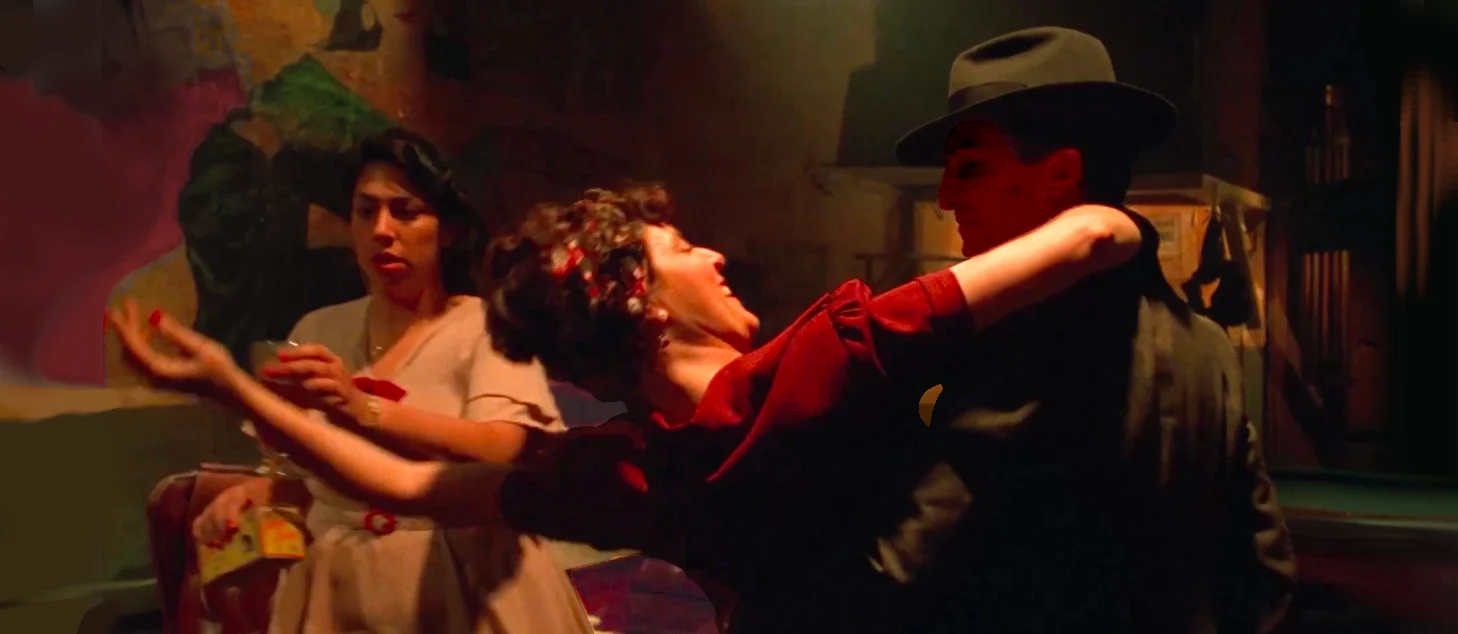
Their first mark is a drunk lady named Juanita (Julieta Egurrola), who meets them in a bar and immediately starts brazenly flirting with Nicolás. That’s the plan, but when Juanita insults Coral’s weight, Coral becomes violently jealous and puts rat poison in Juanita’s drink. Adapting quickly to the situation, they take her money and leave her to die on a bench outside a train station. Eventually the murders of the target women just become a routine part of the scam, but when Nicolás actually falls in love with one of his victims, his dark romance with Coral finally comes to a horrifying conclusion.
The Ariel awards are considered the Mexican equivalent to the Oscars, and in 1997 Deep Crimson won the awards for Best Actor and Actress, as well as Best Supporting Actress, and, indeed, the performances in this movie are outstanding. Orozco, who prior to this project had primarily been an opera singer, is amazing as Coral, taking a character who is monstrous in so many ways and making you identify with her tortured humanity regardless. Cacho is great as Nicolás, terrific at delivering his seductive patter (leaning on Spanish literary cliché, referring to Coral as his Dulcinea) but even better at displaying his character’s self-disgust (he thinks his baldness makes him “deformed”), lovingly brushing his treasured toupee. Egurrola gives the picture a jolt of rude energy as Juanita, jamming in an entire film’s worth of character detail into one scene in an intense, funny portrayal.

Considering the generally uncomfortable (and sometimes very disturbing) subject matter, Deep Crimson never feels exploitative. Director Ripstein’s work instead seems more distanced, not so much judging the characters as simply presenting them and letting the audience members decide for themselves how they feel. He’s fond of long takes, the camera swooping about like a snoopy but unhurried voyeur. Everything looks shabby and run-down, and yet Guillermo Granillo’s (Ariel award-winning) cinematography captures it with an elegant grace. David Mansfield’s score is emotionally resonant, a cheerful processional on the road to Hell.
Paz Alicia Garciadiego’s script is detailed and weirdly tender between all the murders, positing that even such seemingly irredeemable protagonists as these can still feel love for each other. There’s a strain of dark humor to mitigate the seriousness, as in a line where someone says of Coral’s breath, “It’s as if there’s something dead in her mouth,” or when a religious woman offends Coral by offering her a tablecloth to wear. The writing is full of quirky and memorable incidents, such as a wedding held in a cemetery or Coral creating a new toupee for a grateful Nicolás made from her own hair. But Garciadiego’s script doesn’t look away from the truly awful things that happen in the story, including a couple of moments that are extremely hard to watch.
