
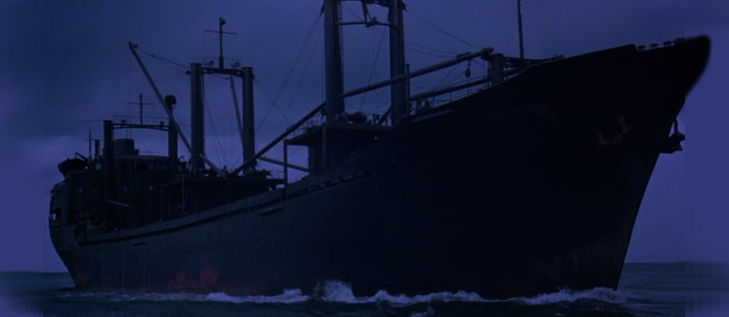
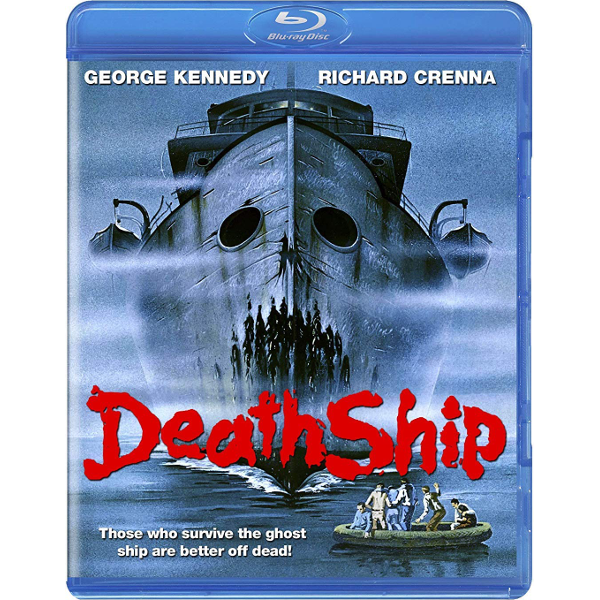

What in the living Hell is on board?
Are ships intrinsically spooky? I note that every time somebody films the real Titanic rotting away underwater, they always show part of the rail where the young lovers from the James Cameron film might have clung. The history books are packed with mystery / ghost ships where the crew and passengers disappeared but the boat was left intact — too many incidents to all have been clever insurance scams.
Scorpion Releasing’s new Blu of this Canadian-financed shocker repackages DVD extras that make the show twice as interesting. Death Ship seems to have been started as a more ethereal ghost tale. Initial treatments and a screenplay were written by Jack Hill, the fave director of Spider Baby, Blood Bath, and Pit Stop.
In the lengthy making-of piece, Hill gives us the clearest explanation of what happened. As the only creative on board with horror experience, he hoped to direct as well. But when the tax shelter deal came through, the key creative positions needed to be Canadian. So we’re looking at one of those movies that is first and foremost a DEAL. Death Ship delivers more than enough horror content to earn its release, but the script is such a low priority that little makes sense, and nobody seems to care. The interior-logic supernatural setup is woefully arbitrary, inconsistent. Instead of feeling any real sensation of horror, we marvel at the professional stamina of the cast, who perform the entire film in what look to be miserable, even unsafe, conditions.

An ocean liner in the Caribbean is under stress. First Officer Trevor Marshall (Richard Crenna) will be taking over on the next voyage because Captain Ashland (George Kennedy) is retiring. All aboard can’t wait for that to happen, because Ashland has become bitter and resentful about everything, rude to the passengers and abusive of the crew. Then the liner is hit and sunk by a ‘mystery freighter’ that defeats the helmsman’s attempts to avoid a collision. The few passengers left alive include Marshall and his wife and two kids (Sally Ann Howes, Jennifer McKinney, Danny Higham), another deck officer, Nick (Nick Mancuso) and his girlfriend Lori (Victoria Burgoyne), the ship’s entertainer Jackie (Saul Rubinek) and another lady passenger, Sylvia (Kate Reid). Then Captain Ashland shows up as well, just in time for a freighter to drift in their direction. The ship appears to be an unmanned derelict, but the survivors are barely on deck before unexplainable things begin to happen. Doors become stuck and un-stuck, inanimate equipment moves and operates by itself, and the engines are running without benefit of fuel. When even more bizarre things happen the castaways try to leave. But the ship has already killed three survivors, ‘and wants more blood.’

Abandon all hope, ye on the shuffleboard deck!
If my review has spoilers, it really can’t be helped. As the lesser name actors begin dying off, we can imagine each actor asking for his death scene to be filmed next, so they could get free of the set, a rotting, stinking tub in the oily waters of Mobile Bay, in the full heat of an Alabama summer. The perspiration on George Kennedy’s face is likely not applied by a makeup man. Crenna and Kennedy are at one point soaked in what looks like industrial waste. Poor Nick Mancuso is lowered into the ship’s flooded hold with the elaborate skeletal corpses mocked up by the effects men. The fetid water is likely teeming with germs, and/or toxic chemicals. Ain’t show business glamorous?
The logical non-sequiturs of the horror plot place this rather realistic, literal movie in narrative limbo. The script’s shocking, impossible events are witnessed by most of the cast, often in broad daylight, but their response is to under-react or not react at all. No sooner are they on deck than a man is killed by a freight boom apparently controlled by nobody — it can’t be a freak accident. Yet the cast isn’t all that concerned. Without a plan or discussion, the group splits up to investigate the ship’s thousand recesses and corridors. Even the little kids (nicely played and directed) are allowed to wander off alone. No reasonable mother would let them out of sight.
There’s a functioning disconnect between events and responses. Trevor and Nick keep behaving as if things are manageable, long after several horrible occurrences. If there was no time to think straight, or if everyone were operating under some kind of psychic force, what we see might be explained. Nope, a freight boom murdered a guy and a woman broke out in crazy disfiguring facial welts and another woman was trapped in a shower stall while unmotivated blood poured over her. I mean, do ya think the ship could be… haunted? But let’s still be surprised by the next irrational incident, like the ship’s two lifeboats automatically launching themselves to make escape impossible. Where’s Bill Murray?: “You’re right, no human being would run a a boat like this.”

If Jack Hill is telling the truth, his darker psychological treatment (which sounds a bit like The Shining) was scuttled in favor of a Bad Cruise Ordeal motivated by — Nazi ghosts. (spoiler) The ship turns out to be The Flying Deutsch-Man — a Nazi torture ship that’s still out trawling for new victims. Nick and Trevor find a functioning freezer locker where hang the frozen bodies of the crew; other interrogation rooms are strewn with gruesome corpses, a la Poltergeist, and there isn’t even an Indian graveyard below decks. The soundtrack reverberates with echoey German voices barking orders. In the final indignity, George Kennedy’s Captain Ashland is possessed by the ship and goes Full Nazi. He dons a navy uniform and dispatches two victims personally. There’s apparently no way to neutralize the EBNK (Extremely Bad Nazi Karma) on board… and it goes without saying that the whole show slides into terrible taste. Okay, okay, we’ve got Nazi ghosts, but what about the ghosts of the victims? A little winner like Shock Waves can get away with facile holocaust references, because it’s basically unpretentious (and it has Brooke Adams). Not this ponderous thriller.
When in doubt, praise the Editor.
Editor Mike Campbell should have been awarded something — 50% of the picture is held together with creative, mood-inducing montages that make the most of whatever the put-upon cameraman could come up with to make the ship ‘look alive’ — zooms in and out of pistons grinding, views down weird corridors, camera movements that seem to dance with Ivor Slaney’s synth music track (which ain’t bad). It doesn’t add up to much, but it at least stays busy. Although the producers shot on a real ship partly at sea, the corner-cutting is pretty extreme. The action of ship collisions is all implied, not shown. A fast montage of destruction and flooding aboard the ocean liner is lifted verbatim from Andrew and Virginia Stone’s The Last Voyage — including a quick cut of actor Jack Kruschen about to be blown to smithereens above the ship’s boiler.

The most forced content, both thematically and editorially, takes place just as the survivors realize that their lives are threatened by weird things nobody understands. Let’s see here, people are dying, and nothing makes sense. Maybe it’s time to take the kids to see that movie, the one that automatically projects itself. Scenes from a 1930s British musical end up intercut with Nazi rallies, with mind-splitting music playing. Did Nazis perfect haunted movie theaters? Nick is driven batty and tears away the screen — to reveal another screen. Trevor rips up the projector and tosses it to the floor, but the movie projection on the screen is unaffected. I didn’t know that Tex Avery was a Nazi.
Death Ship has little if any swearing; the ‘R’ rating can be chalked up to one of the longest nude scenes in horror film history. It’s the blood shower gag, which goes on for an eternity. The amazingly strong-willed actress screams in panic, twisting and turning, unable to avoid the gushing hemoglobin. She’s then dragged naked up on deck, lifted on high and tossed out of frame — I only hope it was a body-double stunt woman. Even the filmmakers wonder if it’s all necessary — they say that (executive producer?) Sandy Howard decided on the scene, and then insisted that it play as long as possible.

