

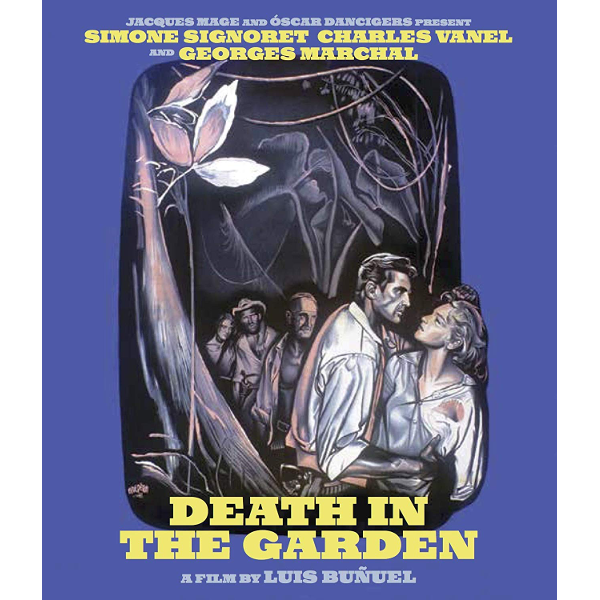

The unavailability of the Mexican-era films of director Luis Buñuel is a crime that needs correction. His avant-garde career cut short by the Spanish Civil War, Buñuel eventually made a phenomenal comeback in Mexico with artistic, popular pictures like Subida al Cielo and the internationally acclaimed Los Olvidados. By the middle 1950s he was ready to reach out for larger productions and larger audiences. A brief visit back to Europe in 1954 won him new contacts and a future of European co-productions. 1956’s Death in the Garden (La mort en ce jardin) is a Mexican-French co-production with big-name French stars, filmed in color on location in Mexico.

The original French title La mort in ce jardin is said to actually translate as “Death in this Garden”, perhaps to make more of an issue of the film as a social morality play. It is considered the second of a Buñuel political trilogy following Cela s’appelle l’aurore and preceding El fièvre monte à El Pao. They aren’t necessarily about actual revolutions but involve various kinds of insurrection against social injustice.
We’re in the Amazonian region of an unnamed South American country, where a group of enterprising diamond miners have struck a rich vein in their claims. They rise up when the corrupt governor revokes their claims and orders them to leave, without explanation. An entire community is affected. Having collected his sack of uncut diamonds, miner Castin (Charles Vanel of The Wages of Fear) plans to return to France with his deaf-mute daughter María (Michèle Girardon) and, if she’ll accept his marriage proposal, the local prostitute Djin (Simone Signoret). When the grievances turn into a bloody riot the military authorities declare Castin a ringleader and order him held for execution. Also fleeing is adventurer-criminal Chark (George Marchal of Cela s’appelle l’aurore and The Colossus of Rhodes). Chark has already been robbed and imprisoned by the corrupt police, with the aid of Djin and her despicable partner Chenko (Tito Junco), a pimp who operates a riverboat and is in cahoots with the corrupt Captain Ferrero (Jorge Martínez de Hoyos). Chenko also informs on the demonstrating miners. Chark helps the rioters blow up the police headquarters. The idealistic Father Lizzardi (a young Michel Piccoli) flees as well, as does Djin, who is now considered an accessory for hiding Castin in her rooms.
All of these people end up aboard Chenko’s boat. Chark takes Chenko prisoner and leads the flight to freedom in Brazil. They tangle with the army, which eventually withdraws in the certainty that the escapees will perish in the jungle. But even when left in peace this small sampling of humans can’t seem to cooperate with each other.

Death in the Garden paints society as rotten to the core, even in this Amazonian back country. Henri-Georges Clouzot blamed an American oil company for the evil conditions depicted in The Wages of Fear, but Buñuel indicts everyone, corrupt leaders and powerless citizens alike. It’s every man for himself. The governor can steal the fruits of the miners’ labor with just a formal edict. But there is no solidarity among the entrepreneurs. A reward of $5,000 pesos insures that Castin and Chark will be betrayed by their own peers. The mercenary Djin sells out Chark without a second thought. Chenko just as casually bears false witness against Chark, condemning him to death for a few pesos. When Father Lizzardi covers for Castin, the locals automatically assume that the he’s another of Djin’s customers and unfaithful to his vows. On the other hand, Lizzardi is himself an unknowing pawn of the mining companies — he proudly shows off the watch they gifted him, not realizing that the businessmen use his mission work as a way to pacify the Amazonian tribes, and take their oil.
Chark’s tough-guy entrance shows him strolling right through an armed standoff in the street, ‘giving the finger’ to a troop of soldiers pointing rifles. For 1956, the gesture is a jaw-dropper, as Chark also seems to be flipping off the audience as well. He’s selfish, surly and ruthless, especially after Djin’s cruel betrayal. There’s nothing ‘adventurously romantic’ about Chark’s escape from jail: asking for a fountain pen to write his mother, he jams the pen-point into a guard’s eye. The name fits: Chark sounds like ‘Shark.’

We nevertheless look to the handsome ‘action man’ Chark for our moral compass. The irony is that he’s forced to take responsibility for others as well on the cross-country escape through the jungle. In Latin American literature, the savage and unforgiving forest- wild is no minor obstacle. La selva silently swallows up unprepared trespassers. The military police know this all too well, and abandon the fugitives to their fate.
With unerring, unsentimental logic, Buñuel advances his familiar misanthropic ideas about human nature. The scheming Chenko maroons his captors without adequate food. Morale breaks down. Djin proves she’s no whore with a heart of gold — In one impressive scene she slaps the innocent María, tosses Castin’s diamonds back at him and proceeds to damn them all. Chark’s un-chivalric response is to grab Djin by the hair and throw her roughly to the ground. María is drawn to Chark, while Castin becomes increasingly disoriented and confused.

As might be expected, the film doesn’t follow a standard adventure template. Father Lizzardi at first seems to be gaining in stature — becoming pragmatic, he’s willing to use pages from his Bible to help his fellow fugitives start a fire. At one point the visuals equate him with Chark. But Lizzardi’s tolerance and trust lead time and again to serious trouble. Every time Chark allows the padre to follow his humanitarian instincts, something goes very wrong. In this jungle (or Garden of Eden), only Chark’s unsentimental pragmatism makes sense.
None of Buñuel’s human specimens transcends the experience, or finds honor, faith or meaning in hardship or conflict. When it’s a practical necessity, Chark commits cold-blooded murder. Classic surreal Buñuelisms are few but strong. In one scene the starving party rushes to start a fire to cook a partially skinned python. When the fire is finally lit, they look over to see the raw snake meat covered by ants … and twisting as if still alive. Audiences find it disturbing when one of the characters sits by the river, idly tossing away precious diamonds: seeing him cast away his future is as big of a jolt as scenes in which characters are killed. The moment seems designed by Buñuel to push our essentially bourgeois materialism right back in our faces.

In the final act Buñuel departs from the novel, borrowing a page from Robinson Crusoe. In a typically absurd turn of events, the starving, ragged fugitives stumble on the wreck of a crashed passenger plane, which carries food they can eat, and also clothes and luxuries like makeup and jewelry. In no time at all, they reassume their ‘civilized’ roles and pretensions. Wearing the clothing of the dead, the women dress more elegantly than they did back in town. Djin is once again a classy Parisian. The restoration of the material world triggers a resurgence of selfish behavior, and hastens the violent ending.
Even critic Raymond Durgnat got his plot synopsis wrong for Death in the Garden, which shows us how rare the picture once was. Biographer John Baxter said that the French producer David Mage hired Jean Genet to write a script, but the writer took the money and disappeared. Not wanting to be separated from her husband Yves Montand, Signoret purposely put a Communist newspaper among her belongings, hoping that the New York customs people would send her back to France. But she wasn’t caught, and unhappily proceeded to Mexico. Actress Michèle Girardon was reportedly an amateur forced on the production by her parents, and difficult to direct. Nevertheless the actress later won a coveted role as ‘Brandy’ in Howard Hawks’ Hatari.

