
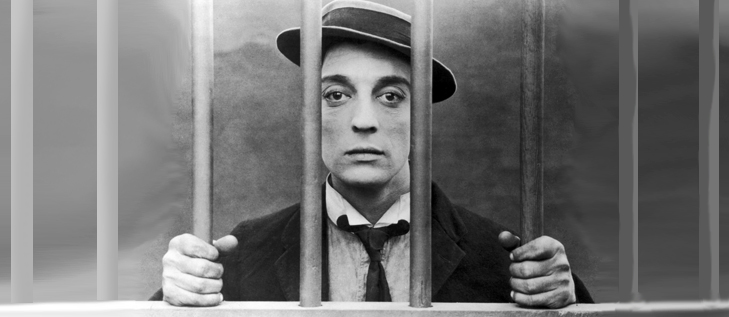


What’s this, a full compilation of Buster Keaton Shorts? Kino has released sets of these before, including a 3-disc Blu-ray package from back in the summer of 2011 and overseen by Kino’s Bret Wood. I’ve also seen a fairly tidy collection of Keaton’s ‘apprenticeship’ short subjects co-starring with Fatty Arbuckle, although those were in much rougher shape.
So why this new set, which contains both sets of shorts, on five full Blu-ray discs? For those readers not yet informed, the press material for Buster Keaton The Shorts Collection 1917-1923 says right up front that this new collection uses no previous masters, but all-new 2K and 4K scans. The producer this time is Lobster Films (Serge Bromberg, Eric Lange) in conjunction with Blackhawk (David Shepard), augmenting the usual sources with better material and missing snippets from other prints on file in archives across Europe and the world. Before I go any further, here’s a full list of contents.

The Roscoe “Fatty” Abuckle shorts are on the first two discs. Many of them co-star comic Al St. John, another Arbuckle disciple with a distinctive style: Disc One: The Butcher Boy, The Rough House, His Wedding Night, Oh Doctor!, Coney Island and Out West. Disc Two: The Bell Boy, Moonshine, Goodnight, Nurse!, The Cook, Back Stage, The Hayseed, and The Garage.
Buster’s solo shorts, most of which were made with Eddie Cline and Fred Gabourie, fill out three more Blu-rays. Disc Three: The ‘High Sign,’ One Week, Convict 13, The Scarecrow, Neighbors, The Haunted House, and Hard Luck. Disc Four: The Goat, The Play House, The Boat, The Paleface, Cops, and My Wife’s Relations. Disc Five: The Blacksmith, The Frozen North, Day Dreams, The Electric House, The Balloonatic, and The Love Nest.
Keaton is so popular that it’s just unnecessary to do a sales job on his appeal. If you haven’t seen him you’re missing something, and if you have, a full line of his restored features is out there to enjoy. On other discs I was most taken by John Bengtson’s detailed explanations of where the films were shot, as many locations are very close to Savant central. With the disc of Sherlock Jr. a few years back, Bengtson’s location featurette showed me that part of a key scene in that film was shot on Larchmont Blvd., in fact on a spot less than a hundred feet from my home office window. In seven more years that unknown but legendary filming site will have its100th anniversary.

The Arbuckle-produced shorts are a remarkable resource of comic creativity. Keaton seems wholly amenable to Arbuckle’s style and supports him well; not long into the series he’s achieved featured player status and remains a rung or two higher than the talented Al St. John. Keaton is arresting even when he plays characters unlike the semi-stoic persona he eventually settled into. But he still doesn’t burst out into laughter very often, or otherwise do anything extreme with his face — he’s the Buster we know.
Arbuckle is a great discovery unto himself. He’s unexpectedly coordinated and almost as light on his feet as Chaplin. He pulls off cute tricks of juggling. Although these slapstick shorts abound with cruel humor (in Out West the two of them slay bad guys left and right), Arbuckle’s personality is immediately likeable. He’s a good guy even when being a royal pain, endearing in a non-cloying way.
The Keaton Solo pictures we know better. It’s interesting to see Cops in its uncut length, which is darker and more politically edgy than the cut version we were shown in high school — the first time I can remember seeing Keaton. At the time I thought he was imitating cartoons, especially the way he’d make his body do seemingly impossible things, like be yanked horizontally out of the frame by a passing street car. Only in college, with Bob Epstein showing us The Boat and The Play House did we realize that Keaton is the source of entire genres of sly slapstick and stunt-oriented physical gags — that the cartoons were imitating him.

