
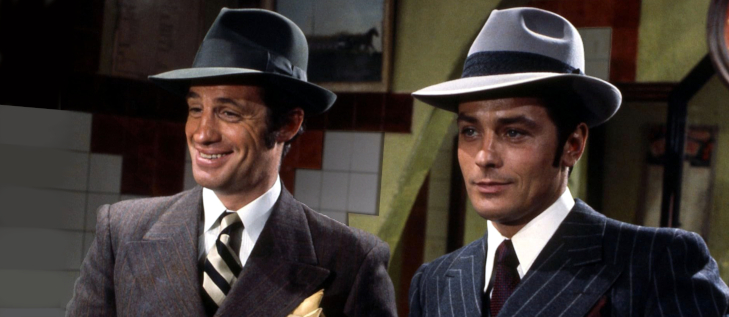


Some of the disc experts weighing in on 1970’s Borsalino venture that producer-star Alain Delon may have been influenced by the tremendous success of the previous year’s Butch Cassidy and the Sundance Kid. Average moviegoers made that connection almost instantaneously — instead of an all-American action/romance duo Newman and Redford, the semi-comic gangster saga stars les glorieuses stars du cinéma français Delon and Belmondo.
Alain Delon is on record as saying he studied two real-life Marseilles crime figures from which to pattern his gangster heroes, leaving out their later collusion during the German Occupation. Delon invited fellow French superstar Jean-Paul Belmondo to co-star and lined up a winning production team. The title ‘Borsalino’ comes from the famous felt hat manufacturers. The company agreed to participate only if their logo appeared on the advertising. Filming went smoothly in Marseille and Paris, discounting spats between the two male leads about upstaging and scene-hogging … that read like semi-planned publicity items.
In other words, Borsalino was a smart production in an insecure industry, trying its best to insure success all around.

Big stars now control big-time French filmmaking, not directors.
The generic gangland tale relies heavily on its considerable star appeal. The show is loaded with fancy sets, costumes and vehicles from its period setting. Director Jacques Deray sees to it that one if not both of the stars is never off screen for more than a few seconds.
The storyline pushes personalities. Slick operator Roch Siffredi (Alain Delon) is released from jail. He discovers that his girlfriend Lola (Catherine Rouvel of Mr. Freedom) is now with another low-level crook, François Capella (Jean-Paul Belmondo). One brawl later, Roch and François have formed a firm criminal partnership. Doing crimes in Marseilles means doing business with established gangland operators like nightclub owner Le Danseur (Christian De Tillière) and big bosses Marello, Boccace and Rinaldi (Arnoldo Foà, Julien Guiomar & Michel Bouquet). The partners do the hard work of hijacking a truck and rigging a boxing match, only lose out to bad luck, or more frequently, trickery from the big bosses. Only by muscling in do they get anywhere, making inroads in the fish market, the prostitution trade and eventually a gambling hall.
Some killings occur over women. François likes Ginette (Nicole Calfan of The Three Musketeers ’73) ↓ , the kept woman of restaurateur Poli (André Bollet), an attraction that comes to a bad end. For a while the boys team with Lydia (Hélène Rémy), who runs a racket for her paralyzed husband. The Marseilles crime bosses retaliate by framing Roch for the killing of one of their own. François begins to think that his partner has betrayed him, until the glamorous Madame Rinaldi (Corinne Marchand of Cléo from 5 to 7) tips him to what’s really going on.

Important lessons in bankability learned from Butch and Sundance.
Alain Delon was so big in 1969 that he could initiate almost any film project he wanted. Both he and Belmondo were perfect for action movies, but European action cinema was focusing on political themes, about real corruption and (especially in Italy) anarchistic violence that many said glamorized terrorism. The unbreakable ‘buddy’ picture formula of Butch Cassidy and the Sundance Kid surely confirmed Delon’s choice to concoct a fun thriller stressing macho action, pretty women, and unpretentious subject matter. William Goldman’s witty script generated comedy by undercutting serious genre situations, and the easygoing mood allowed Newman and Redford to be ‘cute’ to their heart’s content. Newman rode a bicycle while a romantic song played on the soundtrack. No Sam Peckinpah bloodbath at the finish: the politically safe formula wooed Nixon’s Silent Majority into the theaters.
Borsalino takes similar pains to avoid anything political. Delon & Co.’s gangster fairy tale hasn’t the artistry or wit of Butch Cassidy but it certainly scores glamour points. The stars are stylish fashion plates. With American Thompson machine guns smuggled in through Morocco, Roch and François adopt the iconography of James Cagney and Paul Muni — slick suits, dapper hairstyles, vintage touring cars and fantastic women.

If anything Borsalino oversells the period glitz — there’s not enough room for all the designer décor. The moment the boys hit the big $$$, the screen is awash in gaudy cars and palatial houses, their interiors filled with precious antiques and modern-art chrome and glass. The expensive excess has a double point — producer Delon is proclaiming that he can do anything Hollywood can. Some of the sets are so ‘busy’ that the camera seems to be avoiding them — all those colors in the background can be distracting.
Le Delon & Belmondo, the whole Delon & Belmondo, and nothing but Delon & Belmondo.
All of the attention goes to the highly charismatic co-stars. The decorative supporting cast is packed with beautiful actresses — Corrine Marchand is especially elegant — and top character faces to play the various hoods. Arnoldo Foà has a mafioso attitude and Christian de Tillière is flamboyantly gay. Ugly-mug André Boa has a face like a fireplug. We recognize the fine actor Michel Boquet from a recent Kino release where he plays a rogue cop, Un condé. All fill their roles, make the required visual impression, and move on or are rubbed out. Frizzy-haired Dennis Berry is a ‘good’ hoodlum, a bodyguard for François. He’s not that good of an actor, but we’re impressed anyway: he was apparently the husband of both Jean Seberg and Anna Karina . . .
The focus remains on the behaviors of the leads. Alain Delon’s Roch deadpans some scenes and gives out with smirks and smiles in others; he’s playing his reserved, intimidating persona. At one point Marchand tries to be honest with Roch, and he just tells her that she should not be speaking to him of such things. Then Roch turns around and dotes on his mother, with some dialogue in Italian. Delon has the film’s most adept bit of violence. He kills a foe by throwing a knife at him from across a room, and the timing and mime are perfect.

François is a variation on Jean-Paul Belmondo’s looser, more open ‘Gallic’ character — by 1970 the star’s face had begun to settle into a rumpled, friendly, unmistakably French look. François is not one of Belmondo’s action dervishes, but he does do some serious running. He also prone to affairs of the heart, which mostly means that a girl or two must bite the dust so he can (not quite) shed a tear before taking his revenge.
We know the pattern for Borsalino as soon as Belmondo and Delon launch into a meet ‘n’ greet donnybrook in a poolroom. It’s like something out of a John Wayne film — lots of confident gestures, ‘cute’ reactions and haymaker punches. The scene ends with the exhausted pair sliding down a wall together, their initiation into Buddy-hood complete. Through all the violence and treachery that follows, the only bump in the bromance is when François thinks Roch might have killed somebody sans accord commun.
Few critics were charmed by Jacques Deray’s direction. The chosen camera style constantly undercuts the movie. The lighting is mostly flat. Deray occasionally finds a good camera angle, and now and then movies the camera to good effect. But most scenes are constructed by riding a zoom lens, which allows Deray to get whole scenes in the can in just a shot or two. The expert camera crew execute these zoom pulls well, but the result is a visual cheapness — mid-zoom compositions have a ‘neither here nor there’ quality. The direction doesn’t even do the sets justice. Random coverage doesn’t give us the full effect of rooms. A dazzling staircase is on screen for just a couple of seconds.

The action exteriors appear to be arranged by specialists — they’re better designed and executed. The closest thing to a hairy stunt sees seven cast members bouncing along a dirt road in two vintage cars; it looks like Belmondo is teasing Delon with near- misses, to try to get some craziness into the scene. One cutaway shows a near collision in which one car could very well have turned over, with what looks like the real actors and actresses in it. Or, at least, that’s the impression.
Hey, the stills from this movie look GREAT.
The movie is ostentatiously fashion conscious, but its period sense is not wholly convincing. Many of the costumes have a ‘dress-up’ quality, and the camerawork undercuts any sense of formal period style. We identify this effect as ‘Bonnie Parker Syndrome:’ 101 imitations of Bonnie & Clyde threw old clothes and old cars at the screen, thinking that was all that was needed to create period verisimilitude. Meanwhile, a single close-up of a boiling radiator in Chinatown instantly transports us to 1937 Los Angeles.

The glamour angle carries through the action scenes as well. Our heroes are dead shots, of course. ← The most oft-printed photo from Borsalino is a shot of Delon lying on the sidewalk, firing his pistol. (The still is one chosen for the disc’s set of photo-cards.) We do appreciate Delon’s slicked-down, parted-in-the-middle hairstyle. Only a guy as handsome as he can make that look good.
Delon did make a sequel that takes Roch Siffredi into the Occupation years, Borsalino & Co.. But this movie’s finale pre-empts the idea of Belmondo’s François returning for a rematch. The gangster buddies are instead given an ultra-chivalrous send-off, each acknowledging that the partnership must end. If they’ve learned anything at all it’s that everybody betrays everybody, and by breaking up they’ll remain faithful to one another. It’s a halfway decent finish to an attractive film with few surprises.


Jacques Deray filmed a really great Thriller in Barcelona. Un papillon sur l’epaule. Lino Ventura gave a good performance about a man lost in an strange situation
Long past time. I haven’t seen this since the 70s, which is about the same time I wore out the LP.
It’s a pity the direction seems flat here, because Deray absolutely brought his A-game to Flic Story