


Although I hear a fair amount of grousing against the Coen Bros. entire approach to filmmaking, they’ve earned their place through the sheer entertainment value of their work. Reading a Variety review of movies debuting at a film festival in 1984, a notice for Larry Cohen’s Q, the Winged Serpent was accompanied by one for a movie with a funny title. The reviewer was charmed by the violent, hilarious complications the film generated around a film noir infidelity-and-murder tale. I had to wait several months to see this picture, but I knew I was going to like it.

Not much critical respect has been lavished on the adventurous neo-noir films of the early 1980s, when a few progressive filmmakers aspired to reawaken the rich atmosphere and compromised morals of the classic American style. Lawrence Kasdan’s Body Heat may have officially kicked off neo-noir three years earlier, but Joel and Ethan Coen’s debut sizzler shifted the form into high gear. Wittily scripted, cleverly directed and given a production gloss that defies its humble origins, Blood Simple launched careers and proved that there was plenty of oomph left in the old Double Indemnity formula.
The Coen brothers’ story oozes laid-back, laconic Texan passion. Bartender Ray (John Getz) is helping his boss’s disaffected wife Abby (Frances McDormand) flee across Texas when they suddenly begin a torrid affair at a motel. Little do they know that Abby’s husband Marty (Dan Hedaya) has hired detective Loren Visser (M. Emmet Walsh) to get the goods on them — and then in a jealous fever hires the same detective to murder them as well. From that point forward the noir twists twist into double-crosses, as a sordid murder-for-hire becomes a study in desperate characters.
It’s fun to look back at the first films by established directors. Blood Simple confirms that many of the celebrated Coens’ most familiar themes were already firmly in place. It shows us the clever, playful camera tricks of the brothers’ first cinematographer Barry Sonnenfeld, such as the floating viewpoint that shadows a German shepherd down a hallway. Another show-off trucking shot follows the tennis shoes of bartender Meurice (Samm-Art Williams) and cruises down a long bar-top, soaring like a rollercoaster to avoid colliding with a passed-out patron. It’s true that some of these camera stunts earn disparaging remarks from critics that like more formalism.

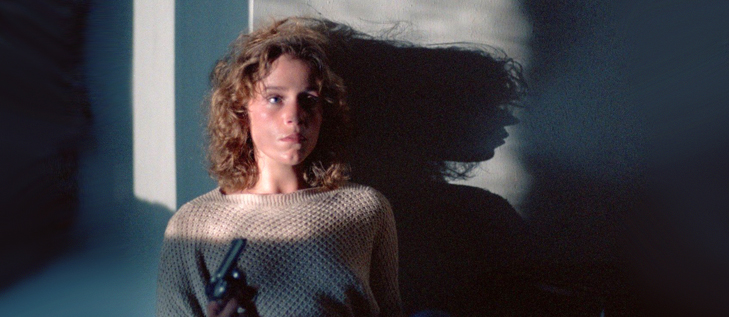
Blood Simple also gives us a chance to see everyone’s favorite Fargo police chief in her first role. Frances McDormand is arrestingly good as the harried spouse of the weasley bar owner. Dan Hedaya, he of the permanent five o’clock shadow, got everyone’s attention with this role. So did M. Emmet Walsh, whose weary, grudge-holding, Russia-obsessed detective is tone-perfect. As Loren Visser negotiates with Marty, the insects buzzing in his hair seem to be feeding off his insanity. Murder is fine with Visser; he’s just concerned with the tendency of murder conspirators to ‘go simple’ afterwards. From Arthur Penn’s The Chase onward, many movies have pictured Texas as an alien planet where the heat makes lovers more desperate and villains more venal. Blood Simple pegs the sour mood with the first look on every actor’s sweaty face.
As narrative storytellers Coen & Coen have us in their power from the beginning. Carter Burwell’s music syncs up with the windshield wipers of the lovers’ car, not with Psycho’s nervous strings but a droning Texas beat. Lean scripting limits the interior locations to a bar and a couple of residences but the wide-open highways and plowed fields keep claustrophobia at bay. Once the set pieces settle into place, we’re too busy watching the characters’ every facial twitch to become overly concerned with production values. The final 2/3 of the show are non-stop tension scenes.

We know going in that this is a movie about killings and double-crosses, and the Coens entice us into their scheme with a Hitchcockian concern with incidental detail. Budding detectives should make note of various details. The pearl handled revolver. The envelope with incriminating photos. The cigarette lighter. Marty’s fishing catch, rotting on his desk like the uncooked rabbit in Repulsion. The safe. The hammer. A shirt with bloodstains. The back seat of a car with more bloodstains. We watch the four characters interpret these objects, a mystery for which none of them has a complete picture. Each acts in concert with their dispositions and natures. The slimy boss formulates his counter-extortion plan. The unethical detective uses his cackling laugh to cover up an inner rage. The runaway wife is desperately in search of a single trustworthy human. The bartender becomes an after-the-fact accomplice to murder because he’s acting on a completely false set of assumptions.
Neatly tricked out with those expressive (and yes, gimmicky) camera angles, Blood Simple almost looks too good to be an independent quickie. The Coens’ storytelling style seems to have burst in full bloom without need for development. The violent, funny and unpredictable chain of mayhem and misunderstandings has the feel of a demented episode of The Alfred Hitchcock Show, except that the ironic twists don’t stop for 95 minutes straight.
Here's Josh Olson on Blood Simple
