
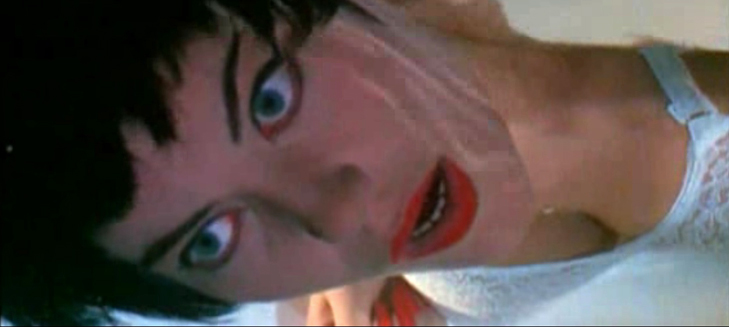


When Arrow Video released a U.K. Blu-ray a year ago April of Mario Bava’s Blood and Black Lace (Sei donne per l’assassino), there were as many groans as cheers — although it was listed as Region A+B, most American disc buyers don’t reach overseas to buy. In the interim the company has been busy expanding into our domestic market. There may be more pressing political goals in this world than the removal of international barriers to disc distribution, but try telling that to an angry mob of horror fans.
American fans that first saw this shocker in 1965 have surely been wondering all this time if it could possibly be as dazzlingly colorful as they remember. For all I know, European viewers haven’t been seeing it in tip-top condition either, especially the way it was censored in some countries. My first taste came in 1993 at the American Cinematheque; the occasion is a strong personal memory.

Blood and Black Lace has already been the focus of a dozen studies by international experts on horror and the Italian giallo subgenre of suspense thriller. It’s certainly central to the work of Mario Bava, the visual artist who consistently took color fantasy imagery beyond normal limits. Bava uses color the way Ennio Morricone uses instruments — pure and clean, not trying to hide each primary hue’s individual qualities. Animator Robert Swarthe once cut off my verbal defense of Bava with the axiom that ‘great art direction does not a director make.’ Bava’s powerful images are never simply decorative, never just pretty pictures or clever art direction. As Bava’s many champions say, his work is prime cinema because the moving pictures are doing the talking, creating emotional reactions directly, without the intervention of words.
There’s plenty of talk in Blood and Black Lace, an annihilating serial murder mystery that locks a dozen distinct characters in a web of dishonesty and double-crossing. Yet a goodly portion of the movie is wordless, backed only by Carlo Rustichelli’s jazzy score. Some of the mystery mechanics are rather good and the only klunky moment comes in a flurry of explanations at the finale. I confess that I’m too distracted by the movie’s visuals to worry much about Agatha Christie- style whodunnit logic.

On a dark and stormy night, fashion salon manager Massimo Morlacchi (Cameron Mitchell) and owner Contessa Cristina Como (Eva Bartok) are busy riding herd on their staff of models and assistants. When a compromising diary turns up among the effects of a murdered fashion model, a masked maniac with a clawed glove goes into action. All associated with the salon have sordid, even criminal reasons for keeping the diary secret, as drug use and blackmail are very much a part of the salon scene. As if in retribution for their sins, one by one the top models are eliminated, with each killing more horrible than the last. Inspector Silvester (Thomas Reiner) slaps all the male suspects in jail, only to see them exonerated when the masked killer strikes again. The grisly slaughter shows no sign of letting up.
Blood and Black Lace is acknowledged as the first full-bore modern giallo. It introduces a fixation on sadistic killings by a diabolical mystery figure with nightmarish visual properties — a faceless mask, exotic weapons. Older thrillers were more reticent about the rough stuff, often cutting from a screaming face to an aftermath where someone tells us what’s been done to the body. Although there’s a lot to be said for understatement, Bava overturns that applecart by veering in the opposite direction. The string of beautiful, disposable females per l’assassino scream and suffer for the express purpose of titillating the audience. The sensually charged images encourage us to anticipate the next gruesome killing, briefly converting us all into sex killers. Fashion is about surface beauty, and Bava’s visuals highlight contrasts of texture — warm skin, cold plastic coats, lush furs, silky hair, sparkling eyes, glittering blood. The Contessa’s gorgeous models invite us into the fast lane of excitement and luxury. The killer goes about his business as if committing gory acts of performance art.

Bava’s pictures offer the argument that visual style can in itself create engaging cinema. Often described as ‘delirious,’ his images become disturbing when sexual excitement is met with bloody death. But nearly the entire picture is a sensual delight for the retina. Every third shot is an ‘ooh-ahh’ moment, whether it be a backlit figure in a red plastic mackintosh navigating a misty corridor of trees, or a single close-up of a nervous model, with Bava’s lighting making her look as glossy as a piece of candy.
Sex and sadism have traditionally landed horror films in trouble — censors once went crazy over any blending of the two. It’s hard to understand how some ’30s movies could even have been released, just for suggesting this taboo — Murders in the Rue Morgue, Island of Lost Souls. In a holdover from ’40s Freud-fad movies, Hitchcock’s Psycho went psycho-clinical with its shocks, encouraging a generation of horror movies derived from twisted secrets of the personality. Bava took the other fork: instead of lecturing us on psychology, he confronts us with expressionist horrors direct from our morbid fantasies. The motivations are strictly conventional: greed, lust, shame. The dimension of visual delirium displaces outright supernatural elements incompatible with a slick, realistic thriller. Bava’s horrors are all too physical. The killer’s eye-gouging claw isn’t even sharp and therefore seems all the more brutal. A stove used to sear a human face glows as if it were red-hot. Seeing is Feeling in Bava. We almost expect the victim’s head to burst into flame.

Blood and Black Lace counterpoints its gruesomeness with a beauty that enchants even this reviewer’s prudish instincts. Most of the giallos of the 1970s only stand out by virtue of a narrative or situational gimmick. Hitchcock might have liked the idea of a witness trapped between two glass walls, as in Argento’s first giallo. This picture leaves me stunned every time — especially now in this incredible restoration — and prompts an uncharacteristic vote in favor of its gleeful sadistic excess.
Bava’s large cast is clearly into the movie’s spirit. His actors usually look good and his actresses always look fabulous, and that’s enough to get an enthusiastic performance out of any actor. The ensemble plays well together. Did Bava ever handle this many active characters on screen at one time? This new disc restores the original Italian title sequence, which introduces most of the main characters in ‘moving portraits’ as striking as a layout in a glossy Italian fashion or architectural magazine. The ‘six dolls’ are haute couture victims for our delectation. Like women in a men’s magazine, they’re packaged as a commodity, gorgeous and interchangeable.

One of the donne is so distinctive that it would seem impossible for her to be confused with anybody. The first time I saw the TV show N.C.I.S. I did a double-take at Pauley Perrette’s character Abby Sciuto. How to say this properly… her general type immediately reminded me of a ‘good girl’ version of Black Lace’s Tao-Li, the model played by actress Claude Dantes. The difference is that Ms. Dantes’ wicked allure isn’t just a tease. With her exaggerated eyebrows, Dantes’ face is in itself a shocking graphic assault, a graphic-novel illustration of sexual excess… or exotic male sex fantasies. The cutaways to her portrait close-ups are some of the film’s most arresting shots, and her murder is the most shocking in the film — those staring eyes! The power of il maestro is such that even the moralistic prude Savant responds — it’s murder aestheticized. The beauty of Dantes’ dead stare, with the cloud of crimson billowing through the bathwater, is a psychopath’s nightmare. This is the scene that Spain’s great Pedro Almodóvar — another lover of unusual, striking faces — chose to excerpt in his perverse horror thriller Matador.