
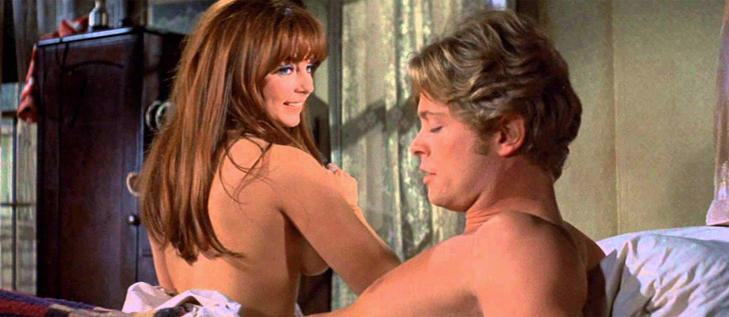


Young reviewer Roger Ebert had a strong background in film. He was capable of dishing the cinema-speak on European and Japanese classics and had a good handle on pop culture movies as well. Even as he complained that little children were being shown the gruesome Night of the Living Dead, he wrote that he thought it was a great horror film for adults. Ebert’s special yen for straight-out exploitation caused him to happily follow the exploits of the independent filmmaker Russ Meyer. The ex-girlie photographer invented the ‘nudie-cutie’ peep show attraction and from there moved on to various adults-only comedies that exploited bodacious female nudity. Ebert championed Meyer in the legit press, and Meyer befriended him. When Hollywood imploded with the success of Easy Rider, panicked executives at Fox got the crazy idea of hiring Meyer to make a sequel to Jacqueline Susann’s trashy show-biz exposé Valley of the Dolls. Realizing that no studio scribe could adapt to his weird style, Meyer hired Roger Ebert to write it for him.
The two outsiders ran amuck in the dream factory. Because Meyer was always under budget the studio gave him the freedom to ‘play with the toy trains’ just as Orson Welles had thirty years before. Meyer’s prior micro-budgeted epics had been campy comedy-dramas packed with absurd drama and overheated characters from trashy potboilers. And with copious, gratuitous, unashamed and unabashed female nudity. The sequel Beyond the Valley of the Dolls is not a sequel, but an eccentric, cartoonish satire of Hollywood decadence. Meyer’s ‘vision’ has nothing to do with reality, and everything to do with the public perception of a town of glamorous hedonists and wild orgies, ruled by greed, lust and rock ‘n’ roll. And topless women.
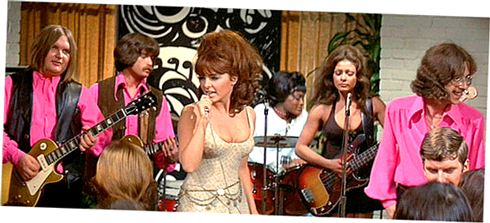
The story launches from Valley’s basic setup of three newcomers to Tinsel Town. They’re an all-female rock group, something fairly unheard-of in 1970: Kelly, Casey and Petronella (Dolly Read, Cynthia Myers & Marcia McBroom). Accompanied by their young manager Harris Allsworth (David Gurian), the three women have no sooner arrived than Kelly’s aunt Susan Lake (Phyllis Davis) invites them to a wild party given by the hip & happening rock promoter Ronnie Barzell, aka “Z-Man” (John LaZar). The band gets a new name, “The Carrie Nations,” and the girls find new romantic partners. Everybody hits on everybody but Petronella meets medical student/waiter Emerson Thorne (Harrison Page), Casey is eventually wooed by lesbian fashion maven Roxanne (Erica Gavin) and Kelly is given an amorous full court press by Z-Man himself. Abandoned, Harris is picked up by the nymphomaniac porn star Ashley St. Ives (Edy Williams). Also figuring in the tangled web of flaky relationships is the pretty boy/gigolo Lance Rocke (Michael Blodgett), Susan’s repressed and impotent business manager Porter Hall (Duncan McLeod) and pro boxer Randy Black (Jim Iglehart), who forcibly takes Petronella away from the sweet-hearted Emerson. Susan is shocked when her former love Baxter Wolfe (Charles Napier) re-enters the scene. Petty jealousies and drug-induced madness finally come to a head when Z-Man, spurned by the forceful Kelly, goes murderously nuts, with both a sword and a .45 automatic, igniting a bloodbath worthy of Helter Skelter.
1970 was a year of studio auctions, sales of back lots and surely the retirement of a ton of studio executives that couldn’t handle the ‘new Hollywood.’ 20th-Fox was putting out X- and R-rated pictures left and right, as if convinced that America wanted its movies as trashy as possible. Michael Sarne’s Myra Breckenridge was probably the worst offender, being both ridiculously vulgar and witless to boot. It employed the film critic Rex Reed as an actor, pretty much putting an end to his credibility in any capacity. Beyond the Valley of the Dolls has an edge because Ebert’s script is a self-conscious study of trash filmmaking. Yes, the movie subscribes wholly to Meyer’s patented ‘Breasts ‘R Us’ philosophy. In this cartoonish catalog of Tinsel Town excess most everybody is grossly oversexed. The sweet Petronella, the ambitious Kelly and the depressive Casey find themselves up to their necks in weirdos. Cross dressers and crazy old people provide variety in the party crowds that dance mindlessly at Z-Man’s parties; Ashley St. Ives gyrates and seduces as if her live were un unending orgasm. Wandering through the crowded dance floor is Meyer favorite model Haji, nude and painted solid black. She’s in about eight shots, each of which seems less than two seconds long. Or is that only because we want them to last longer?
The paper-thin characters are plastic ‘beautiful people’ taken not from reality but from the cheap images in magazines and TV commercials. Everything is purposely stylized like a Bad Movie. All the dialogue is arch; people speak in declaratory sound bites that instantly diagnose their problem or accuse those that offend them. When Baxter sees Susan he recaps their past relationship in two sentences, announcing his intention to break off his engagement and marry her. People shout wonderfully inane/overstated thoughts, the best being Z-Man’s inspired exclamation, “This is my happening and it FREAKS ME OUT!”

Other lines hit new highs of grotesquery — both Ashley and a painted old crone try out the come-on, “I’d like to strap you on sometime!” In this universe, aberrant sex = sick violence. When Z-Man flips out he purrs, You will drink the black sperm of my vengeance.” Another throwaway line makes a cheap joke about Nazis and ovens. Today Beyond seems benign — but in 1970 its content was R-rated culture porn, begging to be labeled execrable trash. In other words, good old Roger was having the time of his life.
Although everybody we see makes a claim on being “in” with the latest trends, nothing in sight resembles real youth culture. The women are as artificial as the characters in the animated Josie and the Pussycats come to life, many wearing impractical party outfits. If all of Los Angeles were costumed and art-directed as in Beyond the Valley of the Dolls, we’d all spend our days throwing up.
Meyer and Ebert know that that their crazy send-up of Hollywood is a ridiculous exaggeration. Remember that Russ Meyer is an outsider whose former audience was lonely guys and servicemen that fantasized over his photos of pliable-looking women with Amazon-grade breasts. Only recently had it become it hip for college students to glom movies like Mudhoney and Vixen: the lines formed for Meyer on one side of the street, and Jean-Luc Godard on the other.
The Carrie Nations perform in montages that represent their concerts and rise to commercial success. They come off as freeze-dried fakes, and even Dolly Read’s good singing is dubbed, by Lynn Carey. Also at the parties is The Strawberry Alarm Clock a real Top-40 band riding the fading psychedelic trend. Richard Rush’s perfectly phony Haight-Ashbury epic Psych-Out had exploited The Alarm Clock’s pop hit Incense and Peppermints, burying any hope of authenticity. Being a trendy imitation of something real in youth culture that commercialism had already stamped out, the band is a perfect fit for Beyond.

Meyer’s editorial style is distinctive. As if afraid to let things get boring, he keeps the screen alive by constantly cutting, often arbitrarily. The makes cross cutting makes some sense in the party scenes, but most every scene becomes a party scene or a music montage. I noticed a long time ago in The Super Vixens that he’s really tight with the nudes — the stunning silhouettes of his stacked actresses always cut long before we’ve absorbed them. On one level this is a tease, like a kid in school flashing a picture from a dirty book and then running away. The principle might be, ‘Always keep ’em begging for more.’ Or maybe Meyer is trying to keep his audience in a state of sustained arousal.
Most of Meyer’s cast had never been in a film before, but most were also experienced professionals — girlie models and Playboy centerfolds that took the business seriously. For them Beyond was a big-time job for a pro director who would make them look good and treat them fairly. Erica Gavin and a couple of the other women had starred for Meyer earlier, as had Charles Napier. With John LaZar Meyer made a perfect bit of casting — the man’s face carries a permanent look of wanton perversion. Dolly Read is forever being described as the ‘girl next door’ type. Her smile does project enough personality to break through the plastic sex-dream image of rosy-fleshed Playboy pictorials.

Meyer’s big studio picture is a comedy original that teases viewers with their own absurd fantasies of the imagined wild life of luxury and sex behind the tabloid TV headline stories. Either that, or it’s for Meyer’s audience of middle-aged squares that read Playboy in search of thrills, with the vision of a topless woman being the culture’s highest ambition. It’s an original freak show straight from Russ Meyer’s personal dream life, and as such is the work of an artist. If Robert Crumb had been bitten by the filmmaking bug and put his personal sex fantasies onto film, imagine the kind of movies he might have made.
Arrow’s Region B Blu-ray of Beyond the Valley of the Dolls is accompanied by the companion feature produced on Russ Meyer’s Fox contract, the atypical drama The Seven Minutes. An attempt at a fairly straight story, it’s an odd misfire that helps us better understand where Meyer was coming from. The Irving Wallace book source is sort of an “Inherit the Wind” that substitutes pornography for Darwinism. The script is a talky screed showing a common book clerk caught in a manufactured scandal driven by a politician up for re-election, aided by some society bluenoses and a Catholic Church representative who might as well be a 1971 Witchfinder General.
Russ Meyer’s cutting style is even more exaggerated, with a cut coming every three seconds or so, no matter what is happening on screen. Meyer confects to have plenty of parallel actions to cut between, but the preponderance of close-ups and lack of variable pacing turn the movie into a big headache. He seems most interested in the sex scenes, which arrange to ‘almost’ show nipples, etc., so as to skirt the ratings. The show’s tease factor isn’t as high, because even Edy Williams’ role is a straight one, and there are none of Meyer’s cartoonish, in-your-face displays of nudity, his ‘special visual effects.’ As the characters do little more than rattle off their dialogue in as efficient a manner as possible, our involvement is kept to a minimum. We’re told that after his two Fox films Russ Meyer retreated to independent filmmaking, but I doubt the reason was any artistic difficulty. He probably came to that decision the first time the Fox accountants reported that he had earned no profits, even after Variety reported Beyond taking in millions.
Helpful corrections from Shaun K. Chang.
