

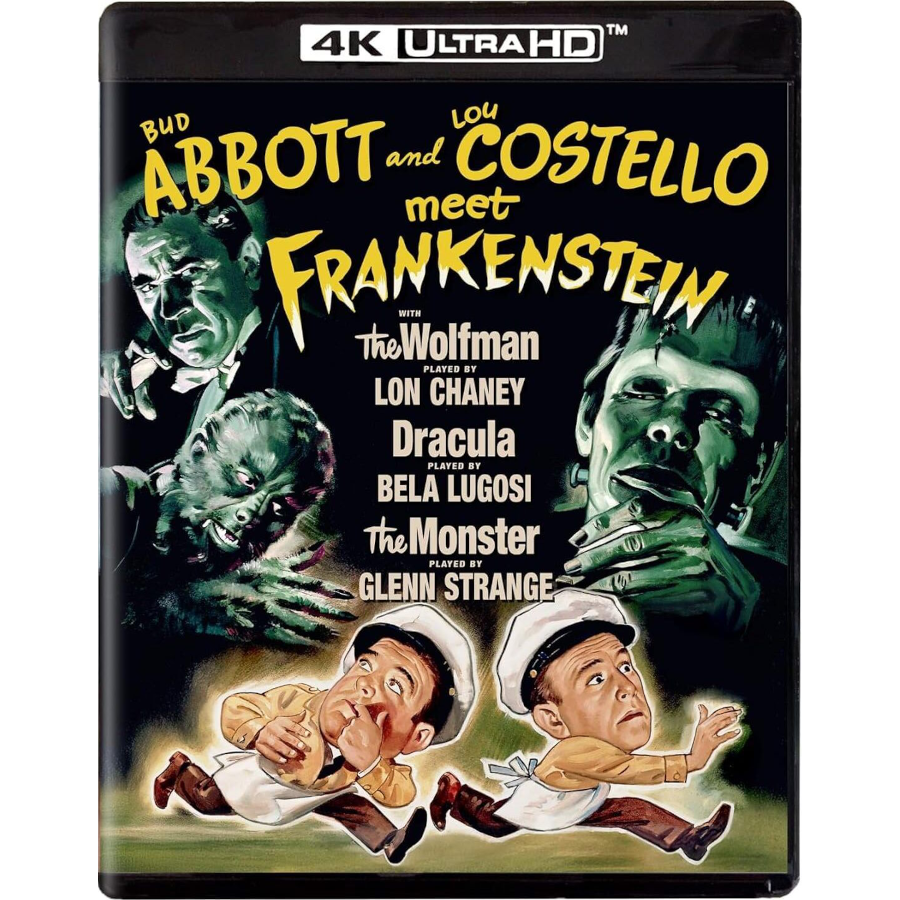

The obvious thing to do with this review is to skip right down to the evaluation paragraphs — it’s all good news. Who knew that this comedy could look this good?
America’s biggest comedy team was still bringing in audiences when Universal Pictures merged with International Pictures in 1946. The ’40s equivalent of superstardom could be fleeting, as A&C had only been teamed in movies for about seven years. The new front office kept them on contract even as other studio assets from the wartime years were being phased out: Deanna Durbin, serial westerns — and horror movies. A&C were trying to adapt by producing their own movies on the side. They also tried out more story-oriented material. They were no longer sharing marquee space with The Andrews Sisters, but they didn’t want to change too much. A sizable segment of their audience wanted to see repeats of the team’s tried & true burlesque routines.
Who Is On First, but Bela Lugosi is warming up in the on-deck circle.
One of Abbott & Costello’s biggest hits had been a haunted house comedy, Hold that Ghost, so why not try another horror comedy? The ‘new’ Universal-International may not have wanted their name associated with their own horror heritage: for reissues, monster movies were licensed to an outside company. When fishing around for a ‘spooky’ idea for A&C, the studio got the idea of killing two birds with one stone. Universal horror had already devolved into bargain-bin multi-monster rallies starring ‘obsolete’ vampires and werewolves. The previous entry House of Dracula even billed a female hunchback. Why not dispose of the monsters by turning them into burlesque clowns for Bud and Lou?
What sounds like a recipe for trashing the studio horror legacy became something else entirely — a horror-comedy that respected the monster ethos. Dracula does not become a patsy for Bud and Lou’s verbal routines, and Frankie isn’t made to stagger around in a ballerina’s tutu. The Wolfman has to perform a few pratfalls, but we would’t call them abusive. The rest is history — the Universal filmmakers, including the stars, must have loved the classic monsters.

Monsters were Serious Business in the Third Grade.
Abbott and Costello Meet Frankenstein has been a standard item for going on 70 years of TV viewing, always playing somewhere on some channel. It always garnered praise from kids of the early 1960s, a ‘crossover’ attraction between Abbott & Costello and the monsters. Somewhere between the 3rd and 4th grade, this impressionable writer fell in with the schoolyard crowd hooked on weekend TV offerings of horror and science fiction. From little Arthur Gaitan I learned all about Frankenstein, Dracula, the Wolf Man and the Mummy. The movies formed narrative chains with a continuity to be memorized — the Frankenstein Monster is found in ice at the beginning of one movie, because of the way he ‘died’ in the previous movie. We took these literary details as part of a master plan. You know, Serious Business.
The movie won little critical attention at first, even when reviewers called it a winner. Even non-A&C fans found parts of it funny, and the monster action was terrific. We ’50s kids saw it a lot when we were young, and may not have returned to it until we needed something unobjectionable to show our own little kids. It remains solid entertainment that doesn’t cry out for a shot-by-shot analysis. Our latest viewing was a happy surprise. Here are our thoughts, after doing a bit of reading, and consulting with the experts. It’s too bad that I lost track of Arthur Gaitan in the 5th grade.
Let the screening reactions commence.
Bud and Lou seem to respect the material. The experts say that Lou Costello called the show hooey and dissed the script, but we see no signs of such attitude in the film itself. Nobody looks disengaged. Director Arthur Lubin built a career on channelling the duo’s manic energy long enough to concentrate on getting shots in the can. From what we can see, it looks like A&C thought monster movies were great, and didn’t mind sharing the spotlight with them.
Supporting character actors like Frank Ferguson and Jane Randolph surely got hired for their ability to stay in character and on task no matter how much ‘the boys’ were cutting up. Some of this shows through in the uncensored Meet Frankenstein outtakes reel that has circulated for ages. It reminds us that Bud and Lou were career Burlesque funnymen, and that their movies didn’t begin to touch on their long experience with vulgar off-color jokes. Mr. Scorsese, where is your ‘gritty New York bio’ of the abrasive, sometimes self-destructive Bud and Lou — ‘Raging Top Banana?’
The picture is beautifully produced and assembled. It doesn’t look like a rush job. The whole point of the U-I merger was to raise the studio’s level of prestige. Nunnally Johnson’s light fantasy Mr. Peabody and the Mermaid was filming around the same time, and Meet Frankenstein is crafted with just as much care.
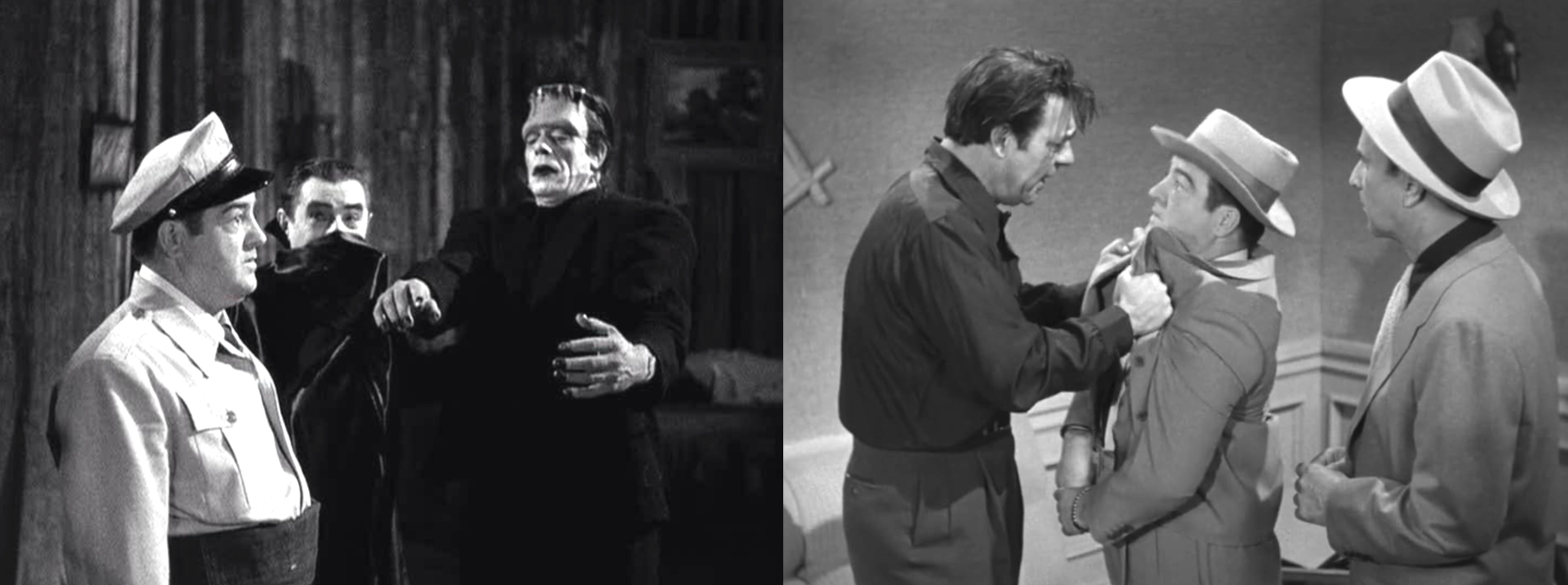
“Well, you young people. Making the most of life. While it lasts.”
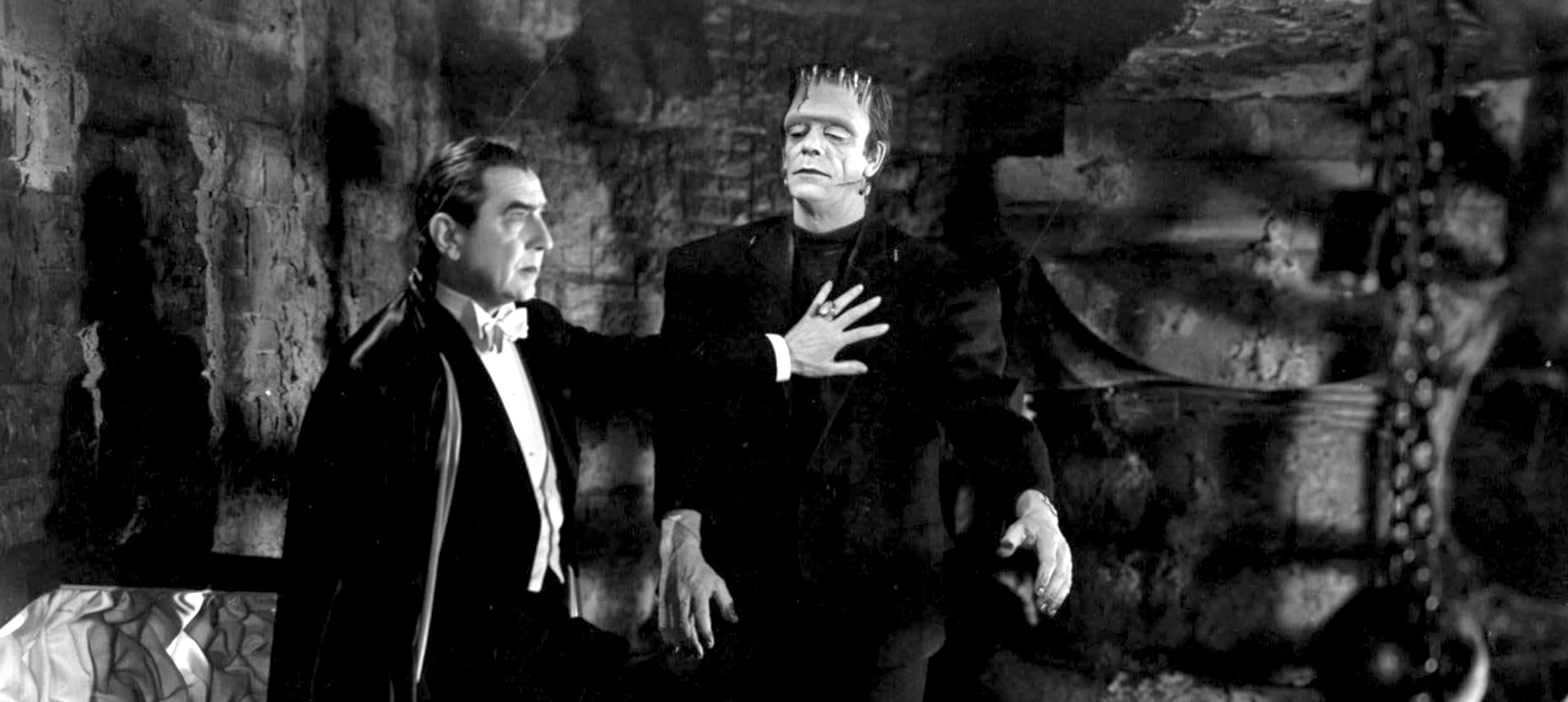
The monsters aren’t made to break character. Frankenstein’s creation is just as Glenn Strange played him before, a hulking, slow-walking automaton. We welcome the Monster talking, even if he only says, “Yes, master!” This movie is apparently Bela Lugosi’s only other ‘official’ appearance as Dracula. The count is very consistent, even if he’s forced to update his cocktail patter. ↑ Lon Chaney Jr. seems to relish the idea of sending up the Wolfman character he originated 8 years before. He had been obliged to reprise him on almost a yearly basis, alternating with Kharis the Mummy. Chaney is an excellent comedy straight man for Lou, whining about the full moon and his terrible curse. We had the film’s most-quoted dialogue memorized before Junior High School … Chaney chooses to read his lines a teensy bit like his Lenny from Of Mice and Men:
Larry Talbot:
You’ll think I’m crazy, but in half-an-hour the moon will rise and I’ll turn into a wolf.
Wilbur Grey:
You and 20 million other guys!
Photos make it look as if ‘the boys’ and Lon Chaney Jr. hit it off well. We like to think they were considerate when Chaney was working in that uncomfortable makeup. When Glenn Strange didn’t feel well, Chaney volunteered to take his place as the monster for a day, putting on the makeup and everything. The actor could have been after some extra pay, but the story that has been carried down is that Lon was a good sport about it and offered to help out. [I’m almost afraid to listen to the full commentaries, to have my illusions shattered.]
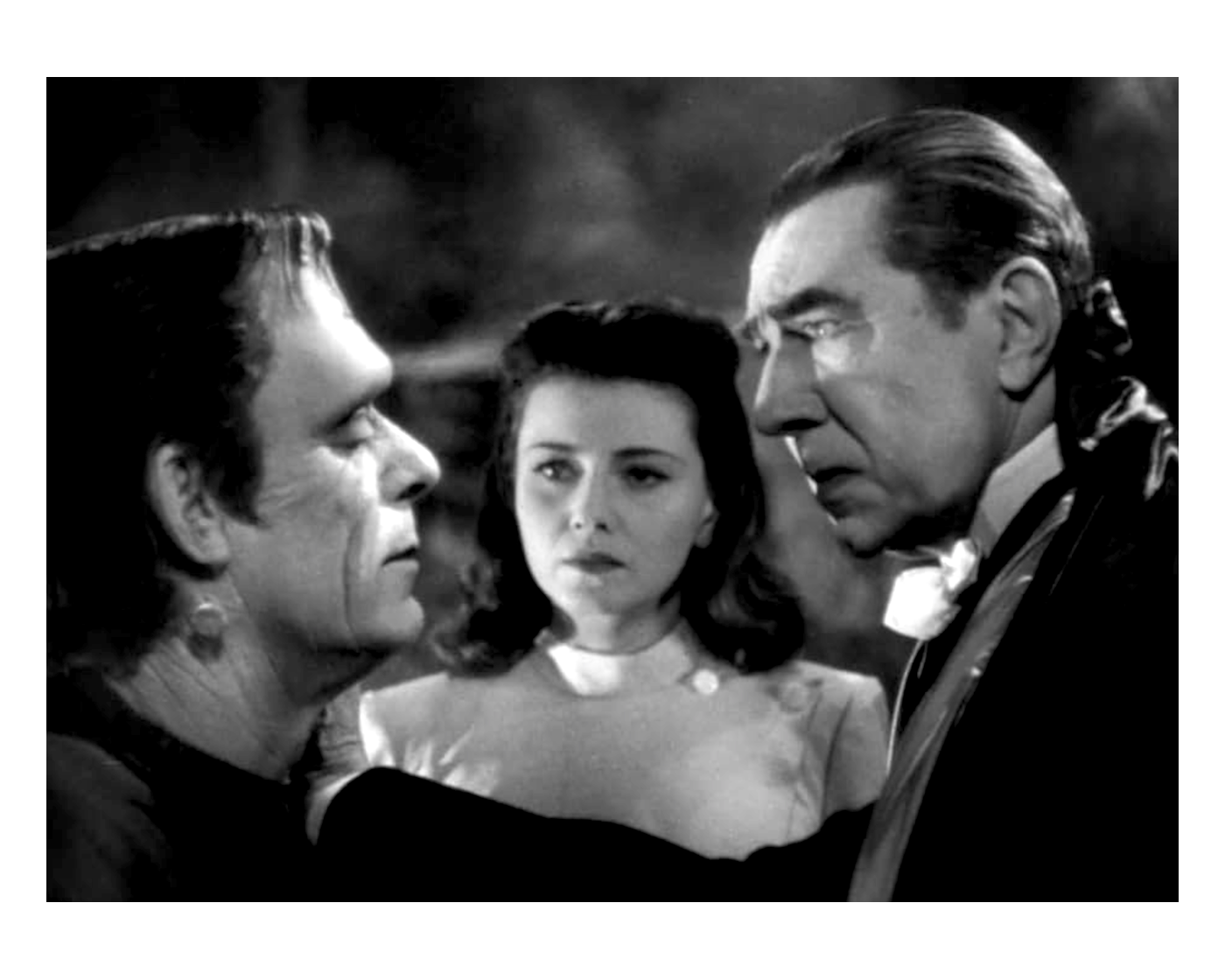
Bela Lugosi is in fine form; after all those Monogram-level cheapies he must have felt happy to be back at Universal in a featured role. We were disappointed when his one appearance in a Val Lewton movie was barely more than a bit role. Lugosi gives us several demonstrations of his contortionist ‘Dracula hand gestures.’ Helped by Martin Landau’s explanation of ‘Hungarian hands’ in Tim Burton’s Ed Wood movie, these scenes now elicit audience applause.
Actually, Meet Frankenstein gives Bela his most stellar showcase since his great character turns as the hunchbacked Ygor. He has more good dialogue and displays plenty of action vitality for the conclusion. He certainly doesn’t look frail or fuzzy-minded. Unlike some of his Monogram losers, he keeps his dignity 100%. Film history sees the show as a curtain call for Bela’s horror career. After this came the slippery slope of Mother Riley, Sammy Petrillo and Ed Wood Jr..
Four years previous, Universal had made the interesting choice of John Carradine to play Dracula in its ‘House of..’ monster rallies. Had Bela Lugosi not been cast because Universal considered him a low-rent Poverty Row actor? According to Gregory Mank, Bela was back East at the time of House of Frankenstein, touring in the stage play Arsenic and Old Lace. For Meet Frankenstein, we would like to think that Bud and Lou asked to work with the real-deal Dracula, not a substitute.
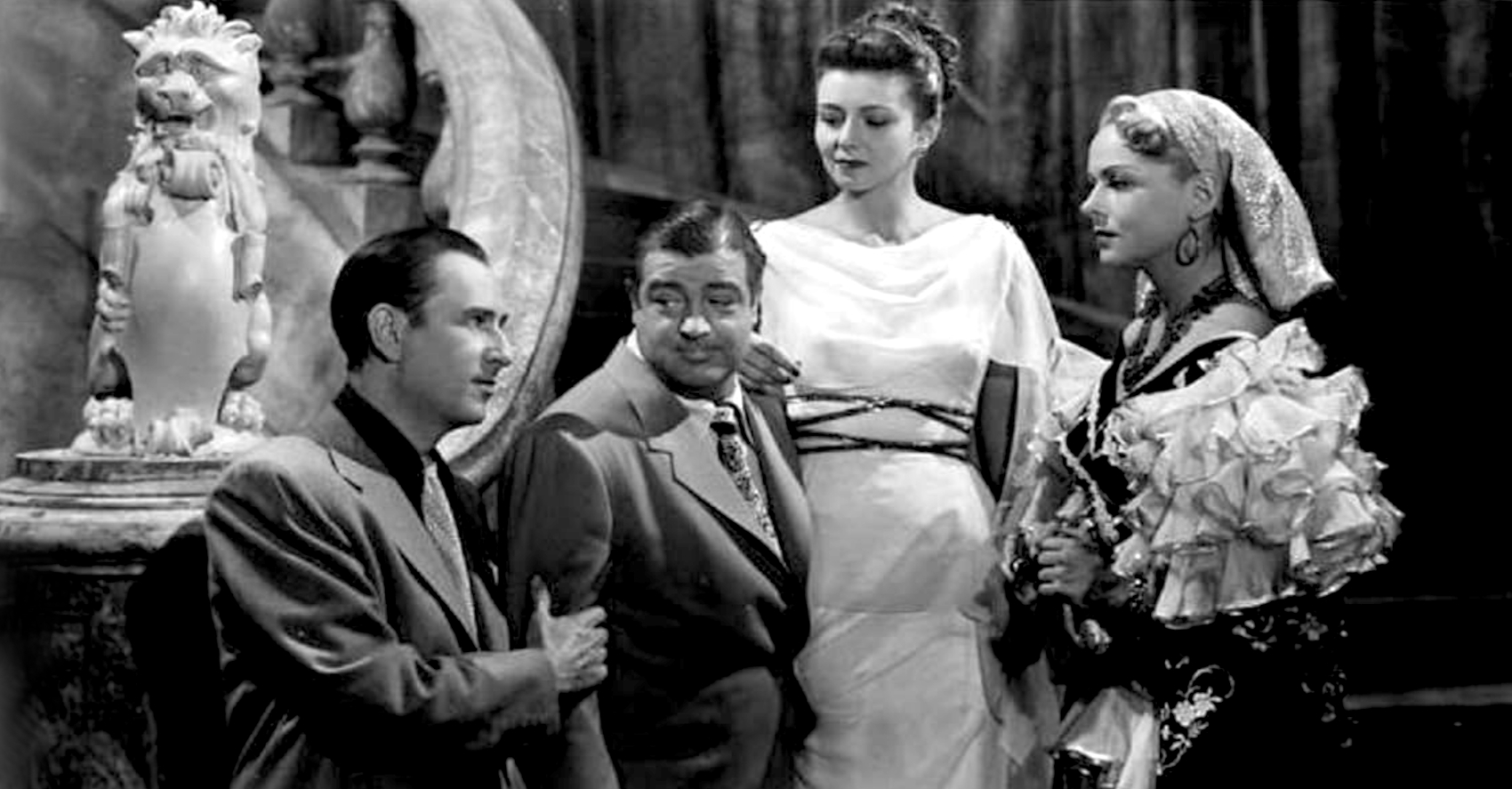
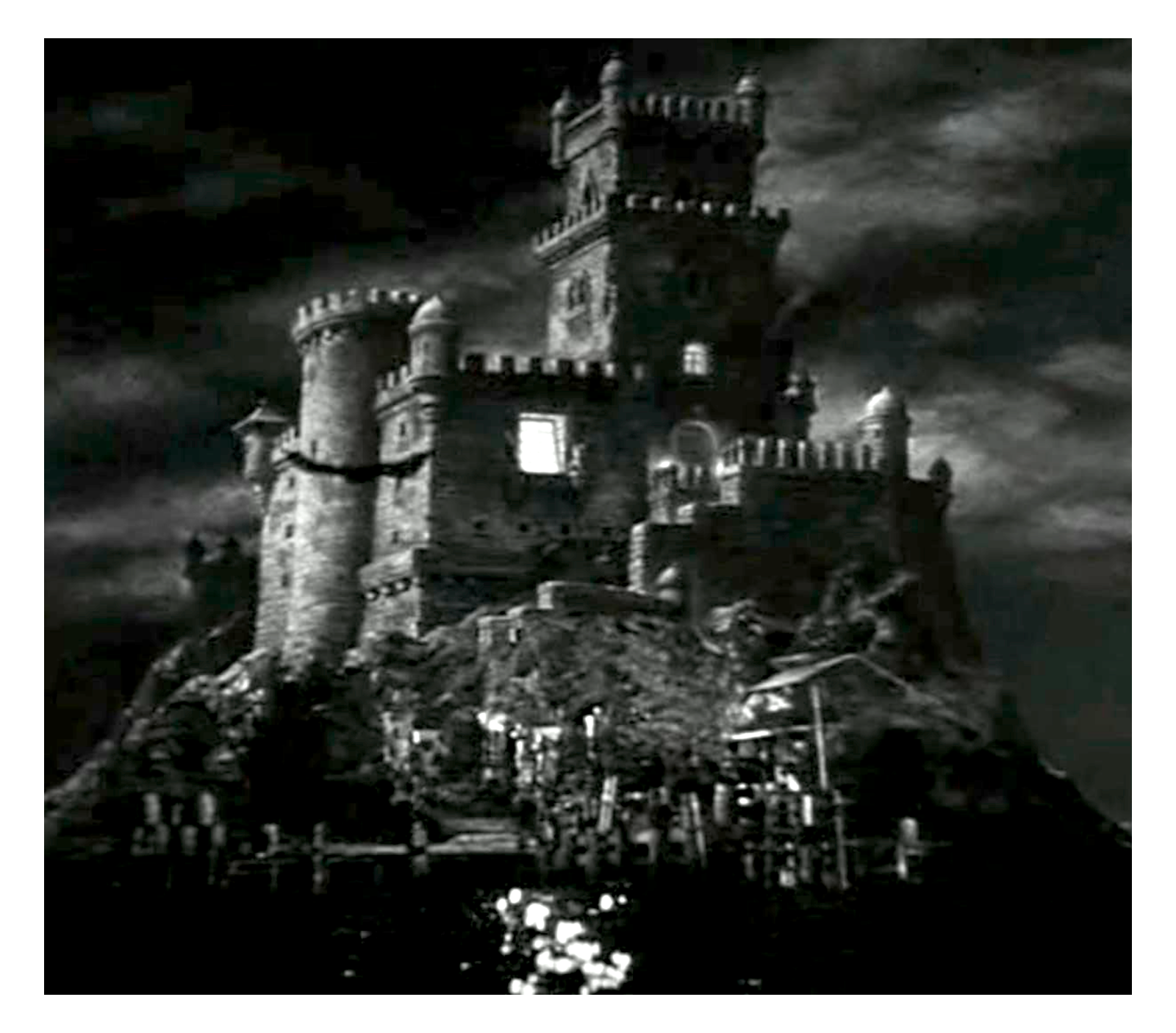
The all-star horror comedy has great forward momentum, and gets into its excitement groove on the day of the costume party. The ‘date nite’ nonsense is pretty funny, what with the alluring mad doctor Sandra Mornay (Lenore Aubert) and the special investigator Joan Raymond (Jane Randolph) both behaving all lovey-dovey with the foolish Wilbur. Things also start cooking out at the island, with brain transplants and Dracula’s crackpot notion to conquer the world with an ‘improved’ Frankenstein Monster who will obey his will. Boat trips to and from the island, the various hypnotic trances, escapes, recaptures — they’re beautifully timed to launch a climactic struggle for control of the mad lab. Poor Wilbur finds himself strapped to a gurney, being fought over by Dracula and The Wolf Man.
Finding the right ‘pitch’ for Horror Comedy.
This comedy ‘plays it straight,’ something that cannot be said for Mel Brooks’ Young Frankenstein. That show is endearing in its own way, yet its stars can be painfully self-indulgent — the real subject of scene after scene is unrestrained mugging for the camera. Brooks is reverently faithful to the look of Universal’s originals, but the Anything Goes approach allows his comic personalities to lean over the footlights and communicate directly with the audience. It’s one big aside, saying, ‘we’re really having fun here.’
At the other end of the cinematic spectrum is The Fearless Vampire Killers. Roman Polanski’s mostly references classic European horror cinema. His storyline is lifted from a Hammer film, but he fills the show with homages to silent horror classics — connections that would have made sense only to very dedicated horror fans. Since some of the humor is broad slapstick, audiences didn’t understand Polanski’s overriding mood of failure and desolation. When people expressed no love for The Fearless Vampire Killers, at least three times I’ve heard them say that Polanski simply tried and failed to be as funny as Meet Frankenstein.

The final act of Meet Frankenstein couldn’t be bettered. The blocking continuity for the castle chase is superb, from lab to hallway and chamber to chamber. The breakneck action finds the right level of chaos, but with enough leeway to let Wilbur persist in being idiotic. He takes command of the Monster by doing an imitation of Dracula, but immediately blows it by dropping out of character. In 4K, we get a closer look when Wilbur pulls the tablecloth out from under the candelabra … and can see that the gag is cheated!
As Meet Frankenstein wasn’t designed as a kiddie show, it hasn’t been fully sanitized for violence. Wilbur and Chick’s panic over the monsters never becomes a full-on joke, not after we’ve seen a gratuitous murder — the Monster hurls a woman right through the castle tower’s skylight window. We know that it’s a hundred-foot drop to the rocks below.
(Spoiler) The finale is no less violent than Uni horror’s ‘straight’ franchise entries. The Monster is trapped on a burning dock; the convincing angle showing him engulfed in flames might employ a clever puppet-mannequin. The shared exit of Dracula and The Wolfman involves an impressive stunt combined with a good optical effect. It has style and class to spare, and bestows great nobility onto Larry Talbot. Cue big cheers at the matinee: we kids loved spectacular heroic sacrifices.

A carbon copy of that particular noble sacrifice showed up in an odd place 25 years later — it’s repeated almost exactly at the conclusion of William Friedkin’s The Exorcist. The plunge also uses a window but ends on a long set of steps, with the Devil substituting for Dracula and a priest for the Wolfman. When the people that dissed Fearless Vampire Killers also praised The Exorcist, it was fun to point out how the prestigious Friedkin film had ripped off Abbott and Costello.
Of course, there’s one more horror superstar to look for in Meet Frankenstein … Vincent Price. He’s the first bit of playground trivia we learned about the show; if you don’t know the connection, please turn in your official Monster Kid badge and go back to social media.
Abbott and Costello Meet Frankenstein is now considered something of a children’s film, and a good point of entry to learn about movie monsters as exciting, mildly scary fun. A big part of Lou Costello’s stage schtick were his ‘big baby’ line readings. His characters frequently act innocent and infantile, a gimmick that kids love. A couple of his later pictures were pitched directly at smaller children. He was wholly infantile as the title character in his self-produced Jack and the Beanstalk, an early TV memory. Now knowing something about Lou’s love of kids and his tragic family life, we think that he could have found a post-Bud Abbott career as a children’s entertainer.
There is no lack of perfectly timed moments in Meet Frankenstein, both comic and scary-lite. Lou Costello’s most sublime bit of ‘infantilism’ happens when Wilbur obeys Dracula’s hypnotic command to let his brain be harvested for the Monster. Wilbur begins to sleep-walk back toward the castle … and then breaks into a happy skip-prance step, like an idiotic Little Red Riding Hood. That one gets us every time.

“Lon Chaney Jr. seems to relish the idea of sending up the Wolfman character he originated 8 years before.”
Chaney is quoted as saying A&C ruined the horror genre on the last page of Denis Gifford’s A Pictorial History of Horror Movies – the same page where Gifford infamously says Hammer has yet to reach Monogram in quality!
A piece of trivia: this was the only movie outside of the original Dracula where Bela Lugosi played his most famous character.
I pair this with ‘The Ghost And Mr.Chicken’ every year for boffo Halloween viewing!
Considering Robert Wise’s promotion to director, mentioned in the 11/25/25 column, that has just become a secret ambition of mine now that I know about it! The Curse of the Cat People was my favorite movie when I was 6 years old (tied with King Kong), and I still love it at age 71.
“When Glenn Strange didn’t feel well”-that’s a understatement for a guy who broke his ankle after throwing the stunt woman thru the window only for her stunt wires to go awry sending her in reverse while the gallant Glenn tried to catch her, tripping over electrical wires or was it a box on the ground, breaking his ankle in those huge boots. Lon Jr volunteered to finish the scene.
“When Glenn Strange didn’t feel well”-that’s a understatement for a guy who broke his ankle after throwing the stunt woman thru the window only for her stunt wires to go awry sending her in reverse while the gallant Glenn tried to catch her, tripping over electrical wires or was it a box on the ground, breaking his ankle in those huge boots. Lon Jr volunteered to finish the scene.