

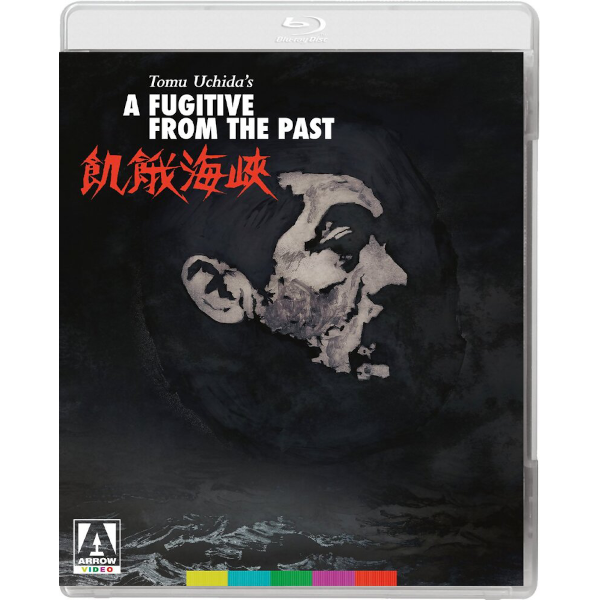

Arrow Video keeps knocking this viewer out with stunningly remastered and beautifully appointed Blu-rays of exciting Japanese classics. Most are little known here, such as the Masumura films, the latest being Irezumi. Adapted from a Japanese best seller, Tomu Uchida’s crime tale is a thriller with elements in common with Akira Kurosawa’s High and Low, Shohei Imamura’s Vengeance is Mine and David Fincher’s Zodiac. It’s different in that it’s also something of a spiritual epic. Murders go unsolved. Ten years later, they haunt the killer and deeply affect the life of the detective who failed to track him down. The crime seems to have sprung naturally from the postwar social crisis. Cultural guilt and religious teachings play a part as well.
1947. An unemployed drifter named Takichi Inukai (Rentarô Mikuni of Harakiri and Vengeance is Mine) falls in with two former prison inmates, who have murdered two people, stolen a fortune, and started a fire to cover their tracks. A big storm is underway. It capsizes a packed ferry to Hokkaido, and the ensuing disaster helps the three criminals to make their escape. Hardworking detective Yumisaka (Junzaburô Ban) partly untangles the puzzle, tracing Inukai’s path across the strait, over a mountain, and to a brothel girl, Yae Sugito (Sachico Hidari of Under the Flag of the Rising Sun). When Yumisaka returns to ask Sugito more questions, he learns that she’s left for Tokyo. Yumisaka risks his career to follow her, but the trail goes cold.

Ten years later Japan has changed quite a bit. A new law closes Tokyo’s brothels. Two more murders seem connected to a rich company owner who has just make a huge donation to charity. A few scraps of evidence are just enough for the Police Chief (Susumu Fujita) and his top detective Ajimura (Ken Takakura) to strongly suspect the executive. But can they prove anything? When they learn about the earlier unsolved case up North, the elderly, impoverished Yumisaka comes to town once more, hoping to finally get his man.
We’re told that the Japanese title of A Fugitive from the Past, Kiga kaikyô is even more accurate, because ‘Straits of Hunger’ refers directly to a source of violent crime in postwar Japan: hundreds of thousands of repatriated soldiers had a difficult time getting back on their feet. A hungry, desperate man like Takichi Inukai might easily take his chance, when confronted with an opportunity to score so much money, all at once.
We join the drama in mid-crime, and then follow Yumisaka’s dogged efforts to discern what happened. We see some of the crime as ‘reconstructed guesses’ — that change as Yumisaka finds more information. Yumisama is like a bloodhound, tracking his quarry across the strait, and up on a mountainside where a fire was seen. He’s obsessed with finding a stolen boat, but also seems acutely aware of the sadness of the crime. His soulful recitation of a Buddhist poem impresses a priest.
Takichi Inukai is a cagey fugitive, very big and unusually strong, with a fortune in cash in his old army knapsack. In his flight Inukai has seen a frightening witch-medium telling fortunes in a shack on the side of a mountain, with a lecture on guilt. As if to rebalance the scale for his crime, Inukai commits a grand act of generosity. But Karma cannot be bought off.

Yae Sugito has sold herself into prostitution to keep her family alive, and can free herself only by paying off a crippling debt. Playing with Inukai and giggling almost like a puppy, she at first seems almost infantile. But Yae has the instincts of her hard upbringing — she knows exactly how to lie to the cops, so as to deflect suspicion.
Ten years later, the well groomed executive Takichi Inukai (below left) now resembles a morph between Toshiro Mifune and England’s Dirk Bogarde. Even when being driven around in a chauffeured car, Inukai carries the hard pragmatism of someone who has to be careful about revealing his past. As Yumisama would agree, Inukai is not evil. He’s completely remade himself, and is doing good in the world. Does that make a difference?
The solid survivor Yae Sugito (below center) is endearing but practical. She seems plump when working in 1947, and more sculpted and refined ten years later, still a prostitute but in a secure and more profitable position. No-one ever knows about the fortune she carries in her belongings. Yae’s gratitute to Inukai is so strong, she’d never think of betraying him, if she ever saw him again. But Karma catches up with both of them, through a newspaper clipping, a toenail that Yae has kept for ten years, and a bag of ashes that detective Yumisaka has safeguarded.

The most original and endearing character is Junzaburô Ban (above right), whose cop Yumisaka is so ethical that he refuses to let his wife buy groceries on the black market. The economy is so bad that frequenting the black market is the only way to get enough food to eat. Yumisama’s earlier work was excellent; a little more luck and he would have had his man. Dismissed from the police force, he’s spent his years as a guard in a reformatory.
The ashes that Yumisama safeguarded end up being thematically central to The Fugitive from the Past. They remind us of a literary precedent: the handful of mud given the spinster Maria in Clay, one of the baleful tales in James Joyce’s short story collection Dubliners. Director Uchida gives them special visual importance — for Inukai, the ashes connect directly to the Buddhist concept of Karma.
For Japanese audiences Junzaburô Ban was surprise casting: we’re told that previous to this picture he worked mostly in comedies. As Toei stars, both he and Ken Takakura receive special billing. In the main titles their names come last, just before the director.

Tomo Uchida copes well with his running time of more than three hours. Unlike some modern crime mysteries A Fugitive from the Past is very easy to follow. Events that initially seem unclear are always explained just a few minutes later. Some deliberate passages emphasize the strategies of the detectives, but an unusual visual is never too far away. To establish Yae Sugito’s new job in Tokyo, a giant crane shot begins on a main street where American soldiers are being solicited by streetwalkers. In one unbroken take we watch as she runs through an entire shanty-town underworld, back to the little bar where she works. The shot is just as effective as Orson Welles’ famous crane at the opening of Touch of Evil.
A Fugitive from the Past has yet another interesting visual angle — it’s filmed in ‘the Toei W106 method,’ a complicated way of giving the show a very gritty, docu-real appearance. It’s essentially B&W 16mm blown up to the 1960s Japanese standard of 35mm ‘scope. We marvel at the image clarity, even though blacks are not always fully black and the grain is unusually high. The entire rain-drenched opening looks like footage shot in a real typhoon. The depth of field is enhanced as well when filming with a spherical lens.The show purposely eschews a slick, attractive appearance: it’s all about faces and real locations. But at all times the ‘you are there’ realism makes a positive impact.

The degraded (is that the right word?) image even helps when Uchida intercuts model work of the capsized Hokkaido Ferry. The 16mm cameramen must have been excellent, for focus and exposure are much more critical with the smaller-gauge film. An obvious benefit is the savings in film stock, but this also means that the whole movie is a 2nd-generation optical enlargement. I hope they hung on to the original 16mm negative.
For the images of ‘theorized’ events — like Inukai’s destroying of a stolen boat — director Uchida goes an extra step, and stylizes the scenes with an effect very similar to Solarization, with dark areas going white, etc.. The abstracted image becomes an excellent storytelling device. Surrealists might object, but it enables us to know when we’re looking at a detective’s imagination-scenarios of possible events. Solarization is also employed for some of Inukai’s subjective, psychological reactions, as when he encounters that witch-like fortune teller on the mountain. His anxiety sometimes triggers the effect as well.
With the world so convincingly established, we concentrate even more strongly on the faces of director Uchida’s characters. The final horror is that Inukai’s worst crime was completely unnecessary. The intuitive Yumisaka knows when to use this information, to bring out the truth.
