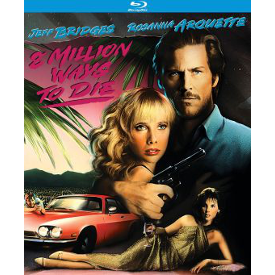

Well, I don’t know if I’ve seen a disc like this one before– a picture that everybody wants to talk about, but that nobody feels like praising. 1986’s 8 Million Ways to Die is an expensive disaster, a victim of too much talent and creative miscommunication. I tend to be a booster of some critically orphaned pictures; for instance I never saw any reason to dislike Coppola’s The Cotton Club, which I think is entertaining — and I hope they someday put together a longer version. 8 Million Ways to Die is the final film of the great talent Hal Ashby, who came up through the editorial ranks, was Norman Jewison’s star ‘hippie’ editor and then shone as one of the brightest directors of the 1970s. But as the wise man said, that (the ’70s) was then, and this (the ’80s) is now. The ill fated 8 Million was always in the hands of Mark Damon’s PSO company, which had no intention of letting a ‘different’ director do his thing. Ashby was a mellow genius who could charm a marvelous movie out of a difficult talent like Peter Sellers. Damon did odd things, like tell interviewers that he had directed his scenes in the old horror picture House of Usher, not Roger Corman.
Let’s call this a workflow conflict. Damon and Ashby put the movie through three or four very expensive rewrites, the kind where writer #3’s main contribution is to undo the work of writer #2. It made no difference that names like Oliver Stone and Robert Towne were involved, because Hal Ashby’s response was to start winging scenes on the set, just to see where things would go. We’re told that actors Jeff Bridges and Andy Garcia improvised much of the second half of the picture. The final film doesn’t reflect a great deal of control by the esteemed director; after all that writing, it’s practically shapeless. Although there may indeed be eight million stories in The Naked City, there can’t be more than two or three movies where Jeff Bridges doesn’t shine. This is one of them.
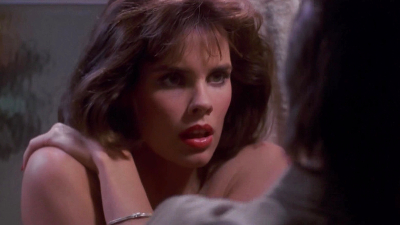
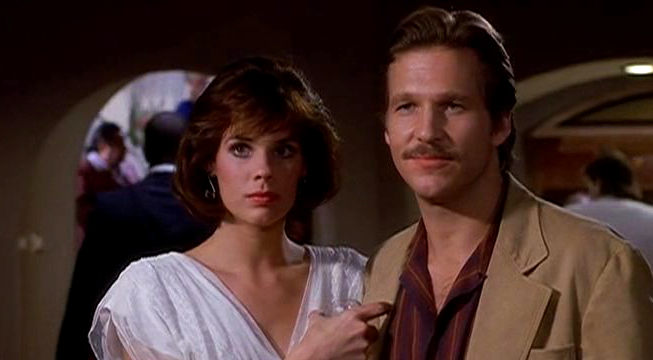
Alcoholic L.A. County Sheriff’s investigator Matt Scudder (Jeff Bridges) goes into total collapse mode after shooting a suspect and being tossed from the force. He loses his house, wife and daughter. A referral at an AA meeting tosses him into the middle of a major crime situation. A high class prostitute named Sunny (Alexandra Paul) desperately wants help; Scudder thinks it’s because she wants to escape a millionaire pimp, Chance (Randy Brooks), who keeps live-in girls at his fabulous Bel-Air gambling club / private residence. Tragedy strikes before Scudder can put Sunny on a plane to safety, at which point he discovers that she was carrying a fortune in cash. By talking with Chance and another hooker, Sarah (Rosanna Arquette), Scudder realizes that Sunny was really trying to get free of Angel Maldonado (Andy Garcia), a drug lord with a swank lifestyle, who lives in a mansion patterned after the work of Antonio Gaudí. Chance owns a string of grocery stores, and Sunny has been helping to place Angel’s cronies in stock room jobs, so as to facilitate the mass importation of cocaine. Scudder intends to square himself with the Sheriffs by catching Angel for them, and he even enlists Chance to help. But the vulnerable Sarah is caught in the middle — how can Scudder prevent her from becoming the next victim?

All movies don’t need to be tightly scripted, but crime thrillers need a compelling chain of incident with at least a little credibility. 8 Million begins in standard fashion, and introduces two interesting characters (Chance’s call girls Sunny and Sarah) amid a lot of cliché males, including Jeff Bridges’ Cop With A Problem. Although the movie is bookended with Alcoholics Anonymous scenes, we never feel that Scudder is a strong character. He throws away a loving wife and daughter, which puts him in red ink from the start. His relapses seem a convenience for the plot. When Scudder almost goes for a bottle before the final scenes, we don’t really believe what we see. We’ve seen it better in eight million other movies and TV shows.
The movie comes to a stop after the murder of Sunny, and from then on all we really get are lame confrontations between Angel and Scudder, face-to-face haggling, macho posturing and toothless threats. Nothing feels like it was written by a writer, celebrated or no. Why Angel for a moment lets Chance keep breathing is a mystery. Why Chance cooperates with Scudder isn’t credible either. We’re perplexed by Chance’s reasons that he doesn’t consider himself a pimp — his girls are the prostitution equivalent of independent contractors, I suppose. Angel can somehow let hundreds of pounds of cocaine languish in a supermarket stockroom, and doesn’t care that so many people know about it.

Scudder takes Sarah under his wing. She regularly sleeps with very frightening men for money, but we’re assured that she’s really a sweet innocent under the hard exterior of a call girl. I can see Oliver Stone selling that kind of nonsense, but Robert Towne? Alexandra Paul’s Sunny is much more believable as a suicidal lost soul coming apart at the seams. She fronts a fantastic ‘happy’ act as the Party Girl to end all party girls.
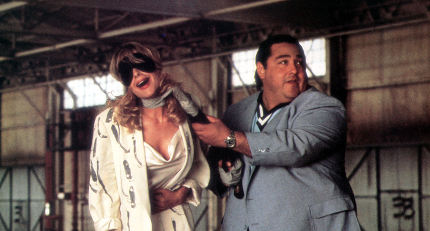
Scudder and Angel circle and snap and wave their oooxxxooo Guild cards in each other’s faces not once (by the Coliseum), not twice (in the Gaudí house) but three times, culminating in a (yawn) stand-off in a big dockside warehouse. Thugs put a gun to Sarah’s head, and Scudder counters by threatening to burn up all the cocaine. Off to one side is Chance, making his own threats. Four or five Sheriff’s deputies are hiding in the rafters. Gee, does anybody really think this situation can end in anything but a bloodbath? Do you think that the lawmen would put themselves in the middle of such a shootout, outnumbered and outflanked, for $285 dollars a week? How are they going to explain that a pimp and his gunman were ‘on their side?’ Hal Ashby’s brilliant skills — coaxing the best out of actors in giddy, difficult-to-sustain stories — cannot do a thing with this surpassingly bad scene.
8 Million then proceeds to an equally dumb coda, where Scudder and Sarah return to the one locale where they’re guaranteed to encounter the one person they fear the most. Did someone think that staging a second shoot-out on a replica of Angels’ Flight was a great idea? I guess the scene might have some charm, if the movie were made by ambitious guys right out of film school, eager to have fun with show-off style tricks. What we’ve got are a lot of fine actors treading water in a movie that was Produced To Death.
Information about the production gleaned from Kino’s extras helps to understand what happened. The producers fired Ashby after the shoot, effectively taking the editorial away from the acknowledged best editor in the business. We’re told that Ashby’s intention was to work magic in the cutting room, reshaping the show into a first-person experience from the POV of a recovering alcoholic. That sounds okay, but it would be a miracle if it could improve the thriller aspects. We’re also told that the replacement editor tended to use ‘bad’ warm-up takes where the actors were encouraged to go overboard. That particular story was more credibly used to defend Arthur Penn’s The Chase — instead of Brando and Penn’s approved takes, producer Sam Spiegel had his editors choose the ‘safety’ shots where Brando played in a relative monotone (or so Penn claimed).

I don’t think it’s entirely fair to say that the fault lies entirely with the producers. Ashby entered into a deal where he shouldn’t have expected to be treated as anything but talent for hire. For whatever reason he allowed the show to be delayed by 14 weeks. Was that to nail down a script? One actor said it was never finished, and Ashby (reportedly) improvised much of it anyway. The producers always had a hard delivery date. When they deducted the delay time from the post-production, the fur flew and Ashby was shown the exit. This has always been the operative norm in the business. It doesn’t matter who the director is, the company is in charge. Corporations won’t allow most talent to make themselves irreplaceable.
I watched 8 Million Ways to Die expecting to have some fun with favorite actors, and there is quite a bit of that. Alexandra Paul is a bright spot, and Bridges and Arquette work up some pretty good scenes. Unfortunately, Andy Garcia’s good efforts just come off as shapeless improvisations, aided by Bridges in less than top form. One of their confrontations ends up being more about Sno-Cones, than anything else. Angel Maldonado’s mannerisms, body language and affected gestures don’t come off well — Garcia looks high and dry, trying to make something out of a weak take on a Reagan-era drug dealer cliché already exhausted (and parodied) by Al Pacino. When Angel and his gang do a round-robin hug & kiss ritual before leaving for a major confrontation, it just plain looks overdone. I’m sorry that Hal Ashby’s career ended like this, with his work edited by others. It’s one of those ’80s disasters that gets chalked up to ‘The Nature of the Business.’
Then again, one scene certainly makes us smile. One of Angel’s thugs sits before an early Apple Computer, the kind that looks like a kitchen toaster with a keyboard attached. And one loose end is really kind of scary. Does anybody worry about those forgotten grocery store stock guys in the refrigerated meat locker? Are they now frozen solid?