


It’s the New Human Condition, folks.
This action ordeal begins with a quote from Herman Hesse’s book, but the specific connection escapes this reviewer. Adilkhan Yerzhanov’s Steppenwolf brings nihilistic post-apocalyptic horror tales up to date: the world no longer needs zombie fantasies or post-nuke excuses to conjure dystopian fantasies of blood and cruelty. There’s nothing fantastic about the ‘modern barbarism’ in Yerzhanov’s picture. With so much absurdly, despairingly evil warfare being waged these days — some of it televised to us nightly — one can’t accuse this Kazakhstani director of obscene exaggeration.
The first connection we make is with George Miller’s Mad Max movies, in particular the first film’s early-stage breakdown of law & order on the highways. This show also expresses the kind of ‘pandemic of violence’ described in Cormac McCarthy’s book Blood Meridian. Our response to the average guns & knives, blood ‘n’ rags potboiler is to find something else to watch. This show is done so well, with such clarity of purpose, that it held us through to the end.

We’re told that movies are booming in Kazakhstan, where director Yerzhanov has a good reputation for comedies, too. He directs this Genre Action film in a way that makes almost every new shot unpredictable. The pace is not always pell-mell — little pauses crop up when characters aren’t sure what to do next. There is little conventional action cutting, as Yerzhanov shoots masters that don’t use conventional cutaway shots. We get the gist of what’s going on even as sundry details are skipped over … things are so grisly, we feel relieved that we’re not forced to see everything that happens just off camera.
The body count rises quickly; the nervous ‘present tense’ narrative compels our close attention. There are no comic-book characters sporting kinky costumes, no exaggerated vehicles or weapons. The most we see on that score are a couple of characters that wear cowboy hats. Our Cop ‘hero’ sometimes wears heart-shaped plastic ‘Lolita’ sunglasses, bright red.

The Cop With No Name.
Isolated towns are scattered on a rugged plain where some kind of (war / civil disruption / vacuum of law) is in effect. The official police are outmatched by the heavily armed and organized militia of a vice lord called Taha. The police are no less barbaric. The (unnamed) Cop (Berik Aytzhanov) is an ex-policeman kept alive by his former comrades as an ‘interrogation specialist’: he mutilate-tortures detainees to extract information. The Cop is just as ruthless as most of these desperate men, but he has a weird sense of humor, an ironic detachment that saves him now and then. The Cop also has a latent soft spot for useless ideas like goodness and decency … very latent.
The Cop has his own personal mission of revenge in mind, but he also elects to take on the problem of Tamara, a traumatized woman who staggers about in a disoriented, incoherent funk. Tamara must be asked a question 5 times before she can sputter out an answer. Her son Timka has disappeared, and she entreats The Cop to get him back somehow. In one sense Steppenwolf is a bit like Fellini’s La Strada: a feeble-minded woman accompanies a very brutal man on the road.

That springboard launches this very odd couple into an extended road movie, changing vehicles and picking up individuals that might know where Timka can be found. The Cop cons some rogue cops into thinking there will be a money payoff when Timka is found. He also brings along makes a prisoner of Max, Timka’s father and possibly Tamara’s pimp. The Cop uses and kills people so casually, that we wonder why he’s going to the trouble of bringing Tamara along. He shows no interest in sexually molesting her.
Many genre action movies stumble with awkward ‘character exposition’ scenes in which people explain themselves. Steppenwolf has no exposition dumps, but it does observe The Cop’s mindset, letting us guess some of his moves. He carries on a running debate with himself, over the idea that ‘goodness’ is both unnecessary and dangerous to survival. Since he’s hard-pressed to let anyone he meets survive, we’re eager to find out how his relationship with Tamara will work out.

We can see ‘intelligent design’ in Steppenwolf from the very first shot. The cinematography is really something, with the stark & ragged plains made to look attractive when filmed at different times of day. One scene is foggy and a night scene gives us a glow over a hilltop that must have been captured in low light conditions. Yerzhanov’s style is refreshingly free of affectation, save for his repeated use of a classic John Ford composition. Anybody who’s seen the big western classics will recognize these angles.
The director’s shot choice feels natural. Nothing he films is conventional coverage. Some shots make us think about things we don’t see, like a trucking shot along a line of police officers washing blood from their riot shields: what kind of massacre occurred just before? The feeling of immenent doom is so strong, we wonder if the director will pull some sneaky narrative trick on us. At one point The Cop and Tamara run a gauntlet of gunfire that looks unsurvivable. Is the movie going to pull the rug out from under us, like an Ambrose Bierce story?
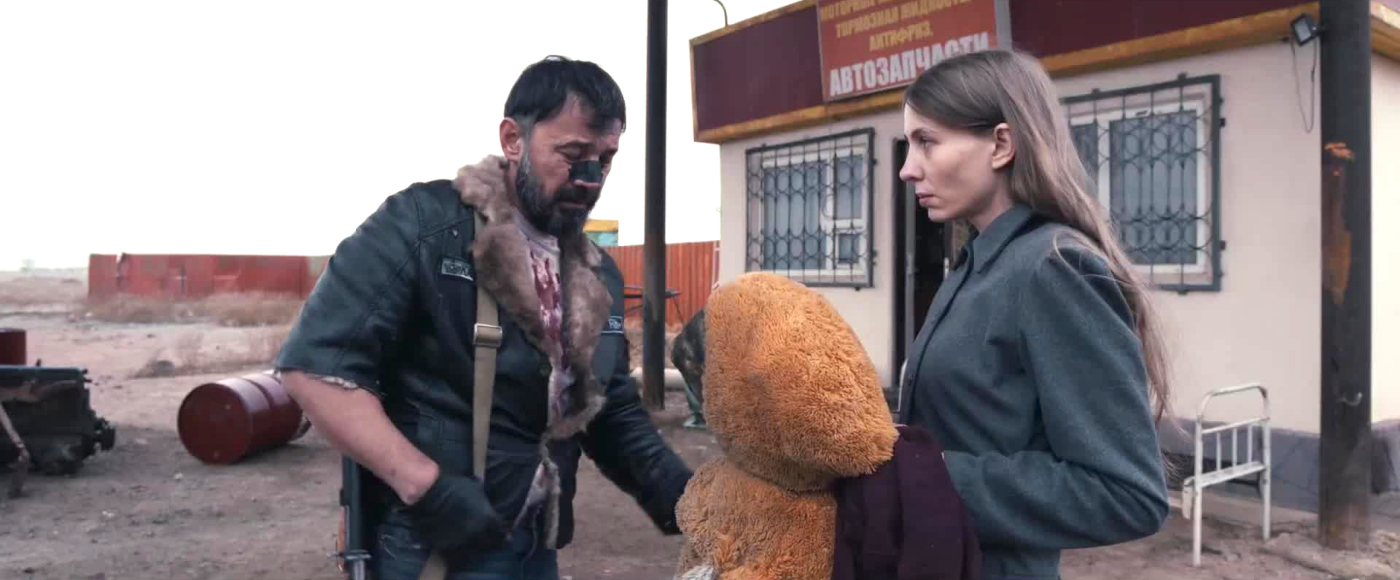
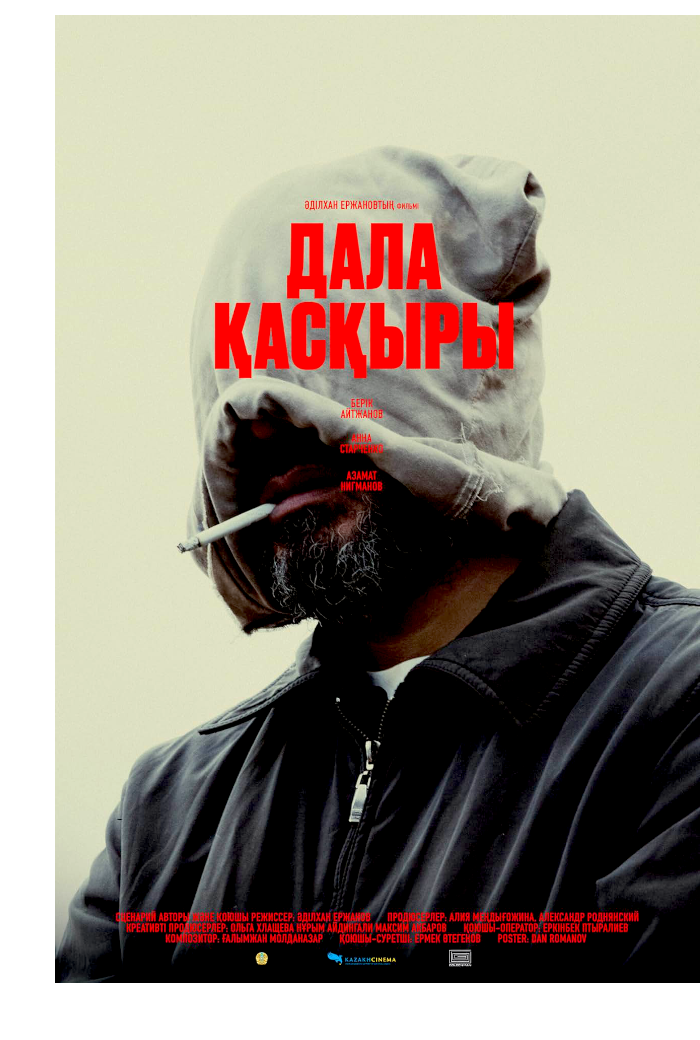
The show has mixes realism with a slightly abstract quality that keeps us on a razor edge. The characterizations are what makes it all work. Everybody we meet is crazy, overwhelmed by a plague of unending violence that’s impossible to avoid.
Berik Aytzhanov and Anna Starchenko are unconventionally attractive. Tamara never doffs her great-coat or her head scarf. The Cop reverts to dance steps at times, as if to relieve the tension. His insistent vulgar humor must be his a way of confirming that he’s still alive. Tamara takes a lot of physical abuse from The Cop, who keeps expecting her to ‘snap out’ of her addled state. She responds to slaps and punches with weakly positive, submissive smiles.
But there is a character arc that we won’t detail — promises are made, and Tamara does become mentally stronger. Almost as in a Godard film, The Cop must coach her to re-learn the simple concept of saying ‘No.’
The violence is pretty hairy, but most of the actual carnage is kept just off-screen. The prolific Adilkhan Yerzhanov is described by writer Redmond Bacon as ‘making westerns with an Islamic feeling.’ Included on Arrow’s limited edition disc is an entire second feature, his 2022 release Goliath. It also takes place in a ‘lawless, post-Soviet world with Russian rule replaced by gangs.’ Bacon sees Yerzhanov as adopting qualities of Sergio Leone — long pauses and men in close-up.
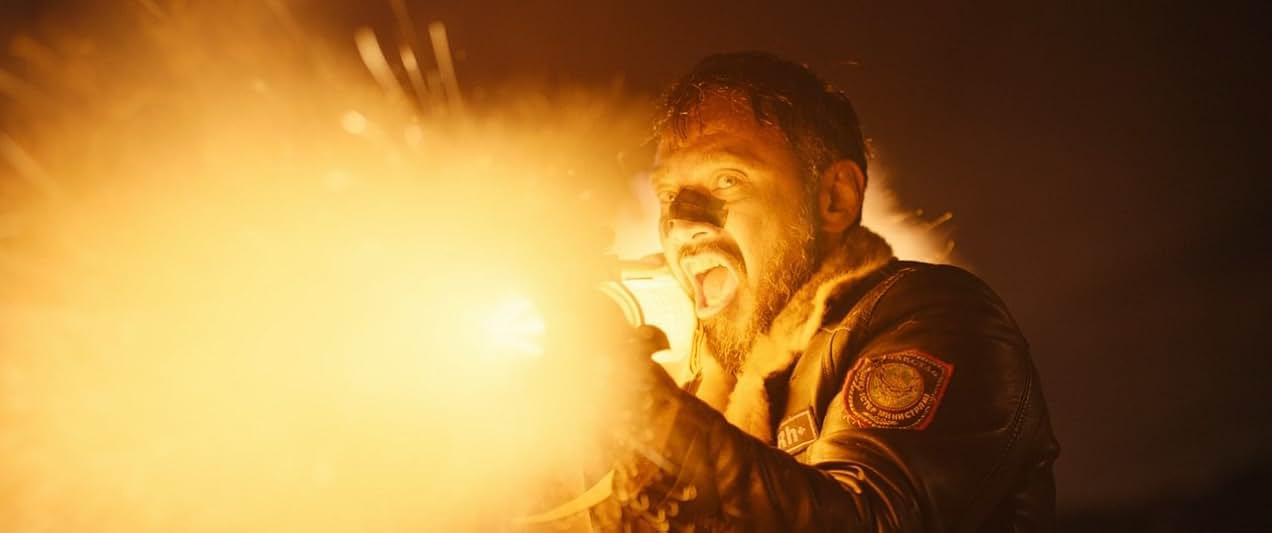
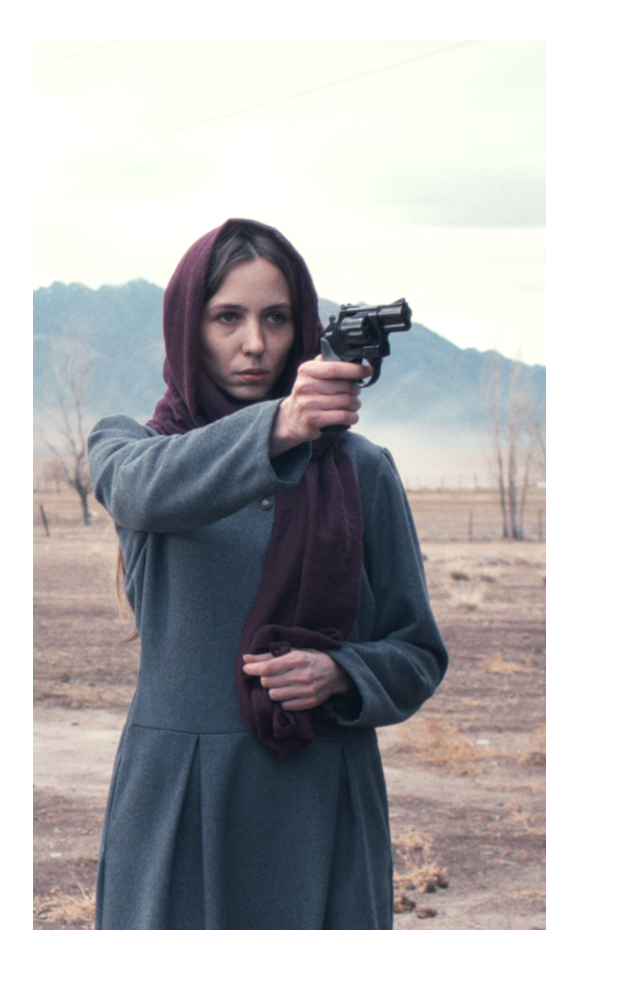
” first connection we make is with George Romero’s Mad Max movies” – I think you mean George Miller, not Romero…
Ha! Thanks, Bill !