
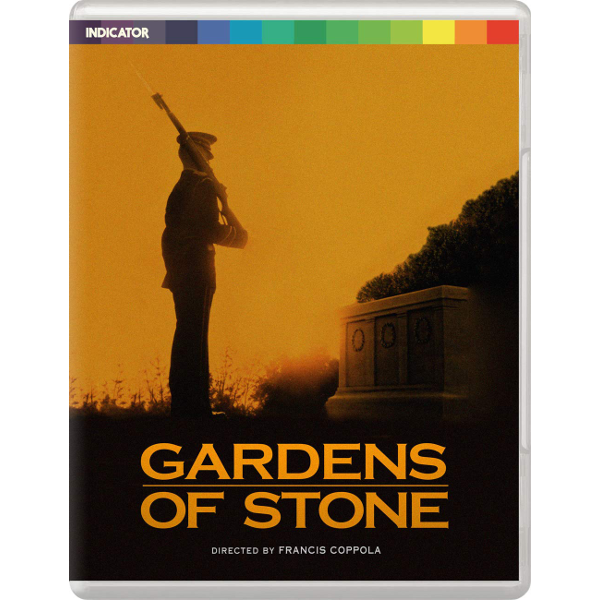

Let’s make a feel-good movie about the Dead of War! I don’t think anybody’s fully succeeded on that score, but Francis Ford Coppola came the closest. Historically speaking, the subject is more suited to other moods, such as the outrage horror of Abel Gance, and a satiric shout of outrage horror-comedy By Joe Dante. Coppola’s ‘impersonal’ 1987 picture is set in a graveyard, but it overflows with honest humanist sentiment.

The critical sniping at the writer-director Coppola likely began with some of his correspondence during the long gestation for Apocalypse Now, in which he came off as arrogant and imperious; it was an image problem plain and simple. To rebuild his career bankability Coppola spent the 1980s making more commercial projects, but always with a personal touch. I watched parts of One from the Heart in production at Zoetrope and was impressed by the circus/campus atmosphere in that out-of-control studio. I thought The Cotton Club was terrific (where’s that extended version?) and was charmed by Peggy Sue Got Married even as critics complained that Coppola had sold out (to what, the gods of great entertainment?).
Everybody pretty much skipped the next year’s Gardens of Stone, a movie that, no matter how one pitched it, was about a graveyard in the shadow of Vietnam. But the beautifully produced, directed and performed picture became a fixture on cable TV. Now out in the flattering format of widescreen Blu-ray, Coppola’s revisit of the Vietnam years plays as an admirable achievement. Back from several years off the screen, star James Caan charms completely in a portrait of everyday life in the military, without negative bias.
The spit-and-polish soldiers of Ft. Meyer are a ceremonial guard charged with servicing Arlington National Cemetery, where the dead from Vietnam arrive so fast, as many as fifteen formal funerals are held in a single day. Sgt. Clell Hazard, ‘Goody’ Nelson and Homer Thomas (James Caan, James Earl Jones & Dean Stockwell) are the company leaders. Sgts. Slasher Williams and Flanagan (Dick Anthony Williams & Laurence Fishburne) lay down the law in the barracks, while the company clerks Pete Deveber and Lt. Weber (Elias Koteas & Sam Bottoms) push paper in the front office. Clell wants to go to Ft. Benning to teach the green recruits prepare green recruits on the way to war, but Homer Thomas won’t give him a transfer. Happily, Clell begins a relationship with a writer for the Washington Post, Samantha Davis (Anjelica Huston). This cheers his best buddy Goody, enabling dinner foursomes with Goody’s wife Betty Rae (Lonette McKee).

Into the unit comes soldier Jackie Willow (D.B. Sweeney), who all see as a worthy addition to the unit. Willow is not only perfectly spotless in his duties, he volunteers to help the less-apt pupil Wildman (Casey Siemaszko) get his act together. As if that’s not enough, Goody and Clell knew Jackie Willow’s old man, now retired. Jackie re-contacts an old girlfriend, Rachel (Mary Stuart Masterson), and the older men do what they can to help him succeed. But Jackie has other plans as well — he fervently wants to be transferred to active Vietnam combat duty. The officers understand his patriotic ambition. They don’t believe in the war, but they do believe in the Army.
Gardens of Stone takes an interesting look at a ceremonial unit that exists to look good while honoring the Army’s war dead, sometimes wearing uniforms from the Revolutionary War. The irony is that most of the soldiers in the unit joined up to fight, not to pose as what Clell Hazard calls toy soldiers. In its basics Gardens is a reboot of the basic Mister Roberts formula: motivated soldiers ache for combat duty. Clell is reprimanded for expressing his negative opinion that the war has no clear goal, and is un-winnable. Our best men are likely to be the ones first sacrificed.
But Coppola’s movie is about personalities — it’s a light drama among some highly fun company. It’s a much more mellow experience than the usual soldier’s barracks movie, and light-years removed from the oppressive Full Metal Jacket. Inspections are rigid but human — the screaming Slasher Williams can show mercy. The top kick Goody, after dishing out obscene insults, doesn’t mind when Jackie Willow responds with a smart retort. After-hours problems such as bar fights are taken in stride. Everyone has their quirks in this command, but the unit hangs together well, even the image-conscious commander Homer Thomas.

Things become complicated when Clell courts Samantha Davis, a neighbor in his apartment building. In 99% of service dramas and comedies, rough-tough military heroes behave like total jerks yet inexplicably attract women anyway… I call it the Tom Cruise syndrome. Clell is a sincere charmer who treats his date with respect and consideration (remember them?). It’s not a case of learned good manners, just decent natural charm. Goody and Clell take turns being naughty-cute, and Samantha and Betty Rae rib them about their political opinions. By the time this foursome is sitting around a dinner table trading jokes and gossip, we don’t want the movie to end.
I don’t think I’ve seen James Caan this likable before or since — he’s not called upon to ooze testosterone or snarl at anybody. The movie dispenses with the Vietnam issue at a reception when a drunken journalist taunts Clell with the ‘baby killer’ line of anti-war insults and gets punched out for it. We expect fireworks but none ensues, even though Clell is in a dress uniform — the punch-ee later apologizes even though he’s been sent to the emergency room. Amusingly, we immediately recognize him as Bill Graham, the impresario of the Fillmore West who played the Playboy PR man in Apocalypse.

This is the big launch role for D.B. Sweeney, and he’s quite good as a young man who knows what he wants and has his act together. Jackie Willow was tricked by a false invite to West Point (an interesting sidebar issue) but is determined to achieve a stellar military career by climbing through the enlisted ranks. The officers and NCOs can’t help but admire him. Sweeney and Mary Stuart Masterson make a cute and deserving couple. The ‘Mister Roberts’ formula puts a damper on the romance from the beginning: Gardens of Stone has only one direction to go, and that’s tragedy. Saying so is no spoiler because the film starts as a flashback from the funeral of a ‘special’ soldier.
Frankly, following through on the tragic curve wasn’t really necessary — if the show had a happier ending, I don’t believe the movie’s spirit would have been betrayed. ‘See Vietnam and Die’ was the sad story for tens of thousands, but how many millions served? Feel sorry for the poor draftees, although many enlistees and even officers likely served due to other kinds of pressure.

The scenes of ceremonial ritual are quite beautiful, topping John Ford’s ‘Marching is Holy’ vision of West Point in The Long Gray Line. But Gardens of Stone is still a downer set in a graveyard. Coppola’s soldiers are idealists, both the young and the more experienced. Of course we honor them. And I appreciate a film about the daily lives of servicemen, that isn’t a ‘heroic’ action story.
The joking moments between Caan and Jones and the fun conversations at the dinner table have a vitality rare in movies about soldiers; screenwriter Ronald Bass reportedly won jobs on the basis of his excellent, believable dialogue. The acting ensemble wins us over in Gardens of Stone — it’s not often that one sees a show and thinks, I wish these people were my neighbors.

