
A solid hit late last June, George Miller’s Mad Max: Fury Road more than satisfied action fans everywhere, easily convincing audiences the world over that the ultimate in ultra-violent smash-bang kinetics had been reached. Viewers go to car races to see crashes, and to movies to see things blow up. Old George Méliès figured that one out as soon as he turned a camera crank.

Two genres have stayed viable since the late 1970s, the zombie tale and the post-apocalyptic survival nightmare. Each speaks to an increasingly nervous culture, where many wonder when it will become their turn to join the living dead (the unemployed and homeless) or see civilization overturned (the middle class eliminated). The genres appeal for multiple reasons starting with the fact that they can seem apolitical. Miller’s original Mad Max is an unabashed road rage epic capitalizing on comic book extremes and insane car stunts. The violence quotient was so advanced for its year (1979) that I dubbed it “an exploitation movie sent back in a time machine from 1995.”
Bolstered with a bigger budget and the work of an apparently suicidal Australian stunt driving team, 1982’s The Road Warrior took our breath away. Good taste? Conventional plotting? Miller’s Aussie carnage machine made what the Italians were doing seem by comparison wimpy and slipshod. The Road Warrior made us smile, with speeches that belonged in cartoon dialogue balloons: “All hail the Ayatollah of Rock and Rollah!” It also rubbed our noses in the J. G. Ballard-ian observation that somewhere deep inside, we want to see people ground up under the wheels of semi-trucks, or smashed to flinders in hairy-beyond-description head-on collisions. If you’d like a cursory diagnosis of our shared psychosis look up the word, ‘symphorophilia.’ And then there’s the old gag from Von Stroheim’s Greed, where somebody is handcuffed to a dead body, or to a car about to explode. Was that a recurring dream for Mr. Miller? It shows up in one form or another in all four Max Rockatansky movies to date.
Tom Hardy isn’t as beautiful as was the young Gibson, but his take on the traumatized ex- outback motor pursuit policemen is pointedly more sentimental. He’s even more haunted by the wives and children he couldn’t save in the horrible past. Fury Road barely touches on Max’s character, but when it does he seems a genuine softie at heart. Nope, we’re more likely to ponder director George Miller’s impressive lasting power. He was in his late thirties when filming the first Mad Max. That was a full 35 years ago yet his franchise never faded in the cultural memory. The Road Warrior has never been topped, has never been rendered obsolete, until now.

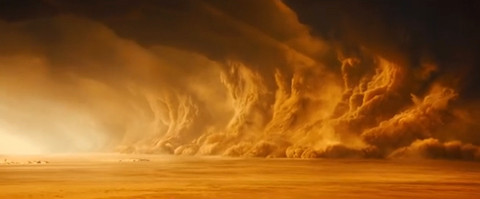
The full-bore graphic novel dynamics of Fury Road are not complicated. It’s the visuals that are complex. I have to say that I’m waiting to see if the present Marvel superhero craze is bottoming out. We’ve come a long way from the delicate artistry of Danger: Diabolik and its embrace of comic art dynamism. Fury Road is from a new era, when as much brainpower, talent and resources go into making a single fantasy movie as running a small nation. I guess the Great Outback of Australia wasn’t great enough (or was too expensive?) for George Miller, but circling the globe to film in Namibia was. It’s Sands of the Kalahari time — and not your typical tourist destination.
“It’s all action” everybody says, and it’s almost true. With so little dialogue Fury Road translates readily into any language or culture, and can play wherever local governments don’t consider it indecent. In form it’s a hybrid of John Ford’s Stagecoach — you know, a chase — or perhaps Buster Keaton’s The General, in which the chase from A to B is followed by a return chase from B back to A. In the not-too-distant future Humungous is Out and Immortan Joe is In. Ruling from an oasis in the middle of a vast desert, Immortan (Hugh Keays-Byrne, the “Toecutter” of the first Mad Max) is the High Muckety-Muck of a grotesquely brutal dictatorship. He metes out water to a miserable rabble, and keeps a harem of breeder females for his own pleasure.
He commands an army of body-painted fanatics that vie for the privilege of dying for their leader, and entering Valhalla. Immortan’s many children include quite a few mutations, and few citizens are without some form of tumors or scarring — surely a hand-me-down from forgotten nuclear wars? Rogue individualist Max Rockatansky (Tom Hardy) is hunted down, captured and used as a ‘blood bag’ in case his type-O is needed. Or does his owner drink his blood as a dietary supplement? Max finds himself strapped to the front of a war vehicle, part of an armada dispatched to gather ‘guzzoline’ from Gas Town and ammo from the Bullet Farm. The convoy’s main vehicle is a tanker truck driven by Immortan Joe’s top lieutenant, female warrior Imperator Furiosa (Charlize Theron). Although equipped with an artificial forearm, the fierce Furiosa is a ruthless killer par excellence.

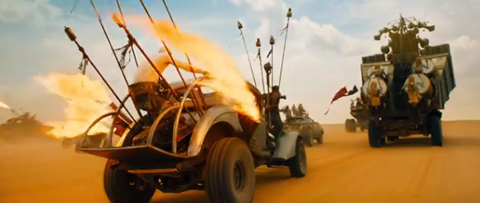
The fun begins in earnest when it’s revealed that Furiosa has chosen this run to defy Immortan, to make a break for the border. Her destination is a hoped-for paradise, ‘The Green Place of Many Mothers.’ Her escort vehicles are unaware that Furiosa has smuggled out Immortan’s royal harem, including the pregnant beauty Angaharad (Rosie Huntington-Whiteley). But the fugitives find unexpected help. Two individualists throw in their lot with Furiosa’s breakout bid — the escaped Max, and Nux (Nicholas Hoult), a white-painted War Boy who is also a talented Rev Head (mechanic). With Immortan’s motorized legions in pursuit the chase proceeds through strange and hostile desert landscapes. The horde uses fanatic, suicidal tactics, swinging atop tall poles to bomb or board the tanker truck. When inspiration strikes, his elite War Boys sacrifice themselves to show their team spirit.
Fury Road gets the audience’s attention fast. It makes good on the promise of action in its first ninety seconds and from there forward ups the ante for fantastic world-making in three-minute increments. It’s warrior chic all the way, a survivalist future art-directed up the ying-yang. Even minor characters sport custom scavenger fashions, designer tattoos and primitive beauty scarring patterns. Chrome plating is peachy-keen in this culture. Immortan’s amped-up maniac War Boys spray their mouths with silver paint, cry out for their friends to ‘witness’ their sacrifice, and then commit some grotty form of moving-vehicle hara-kiri. The ragged edges of this world never get in the way — where is there enough stability to allow anybody to refine the ‘guzzoline’ and manufacture the ammo? Where are the replacement speed shop parts coming from — even the rubber in the engine belts?
For that matter, where did Imperator Furiosa’s cybernetic forearm come from? Fury Road carries out the late Raymond Durgnat’s observation that fantasies about ancient lost worlds – Atlantis, the Lost Continent, Atragon — invariably conceive of primitive societies that possess advanced technology.
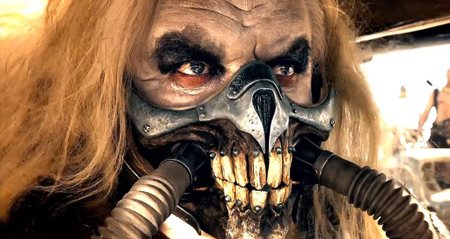
The fugitive harem girls are fleeing a life of rape by the monstrous Immortan, a guy whose face would make Humungous faint from fright. His grimace-mask (is it a breathing apparatus, as with Darth Vader?) gives him the grinning goblin-freak appeal of an Ed ‘Big Daddy’ Roth design from back in the 1960s. He also looks like a perversion of cartoon character Donald Duck, when in ‘evil’ mode and sporting a mouthful of demented human teeth. Garbed in filmy white ‘nothing’ garments, I can’t help but imagine that the women are the same nubile teenagers that disappeared on a Picnic at Hanging Rock, and have picked a really bad era in which to return from the eighth dimension. Don’t worry, Miller and company’s vulnerable ladies are as susceptible to violent death as anyone else in the movie. The Road Warrior featured a slick blonde Amazon fighter who carried an invisible sign reading, “Will survive to kiss Mel Gibson at the climax.” Miller showed his mastery of narrative surprise with that one.

The mechanized mayhem wrought by Miller’s stunt specialists experts gives us action scenes of impressive complexity and impact. Nothing superhuman happens. All the principals have limitless energy and stamina, considering that all we see anybody eating in the three-day ordeal is one lizard and a stinkbug. (And lucky to get ’em, we wuz…) To an older viewer it’s almost exhausting to watch. But I can say with confidence that at anywhere from age 12 to 30, one viewing of Fury Road would have inspired a major adrenalin rush.
MMFR goes a long way toward overcoming my curmudgeonly resistance to CGI. The whole point of old action movies with gee-whiz heroes like Buster Keaton and Burt Lancaster was that sometimes we could see that they were really doing it. I just saw a scene from Apache in which Lancaster jumps off a rock that must be 12 or 15 feet high, as high as a roof. He hits the ground like his legs were made of spring steel. There’s no sign of a trick springboard underneath him, either. I at first thought that Fury Road would be the usual BS computer job with digitally animated pixel-people doing the stunts. Frankly, they could use a title up front to say that no CGI figures took the place of stunt men. What we see shows the kind of inventiveness and daredevil nerve that would make Jackie Chan applaud. At one point a trio of motorcycles are vaulting high into the sky. Furiosa shoots them down like they were clay pigeons on a skeet range. I was always told that Steve McQueen could have jumped that second border fence in The Great Escape, but only now do I believe it. The bikes really are leaping that high.

Yes, everybody’s got safety wires and special protective rigs, later erased in digital cleanup. All kinds of mechanical ‘extras’ are eliminated in post, and original backgrounds are routinely replaced with CG environments, adding dust, exploding car parts, and dead bodies. But when somebody leaps between vehicles, swings on a pole or overturns a vehicle, it really happened on the set. Safety wires, baloney. The filming process must have been one potentially murderous stunt after another, for months on end.
Yep, we get two hours of solid action. Tom Hardy is better than okay. Charlize Theron’s character is an equal opportunity survivalist warrior, the most take-charge female on screen since Ridley’s Ripley. The action peaks in neat crescendos of mayhem. It’s all too artfully arranged to be simple action porn, the kind that usually pays off in gore. The movie even has enough ‘couth to leave some killing off-screen, as when Max fades into the fog to ambush some pursuers. One nice sequence has Max’s eardrums blasted by an explosion, leaving both him and the soundtrack muted and muffled for a few minutes, including the music score. As in a silent movie, we suddenly find ourselves appreciating the naked rhythms of the cutting.
It’s easy to ignore some of the dialogue. People don’t speak much, and when they do we get grating homilies about ‘seeds of hope’ versus ‘seeds of death’: you know, ‘plant’ a bullet-seed and something dies. Another plum example: “Who killed the world?” Then there’s Max’s ten-dollar mouthful, “‘We might be able to come across some kind of redemption.” Oh the humanity.
Taking point position as the film’s tough guy heroine, Imperator Furiosa is given a variation on the classic Mel Gibson line: “You wanna get through this? Do as I say.” However, the dialogue with new-age survivalist- jargon is priceless. Even the harem babes dish it out: “He’s a crazy smeg who eats schlanger!”
Does anybody really remember the stinker Waterworld, or the even stinkier stinker The Postman? George Miller is a man of many talents. His Fury Road may not be great art — or maybe it is — but it’s guaranteed to get your blood moving.
Corrections courtesy Gary Teetzel.