


The 3-D Film Archive stays faithful to its vow to revive every theatrical 3-D feature it can, and their list of achievements is impressive. Their medium is Blu-ray 3-D, an amazing home video format that needs to be fully revived. Manufacturers have discontinued monitors but projection systems still use ‘active’ Blu-ray 3-D. The specialists at the 3-D film archive have often had to rescue shows with big problems, but just this month they debuted Money from Home, a full-on Technicolor 3-D picture preserved in perfect condition.
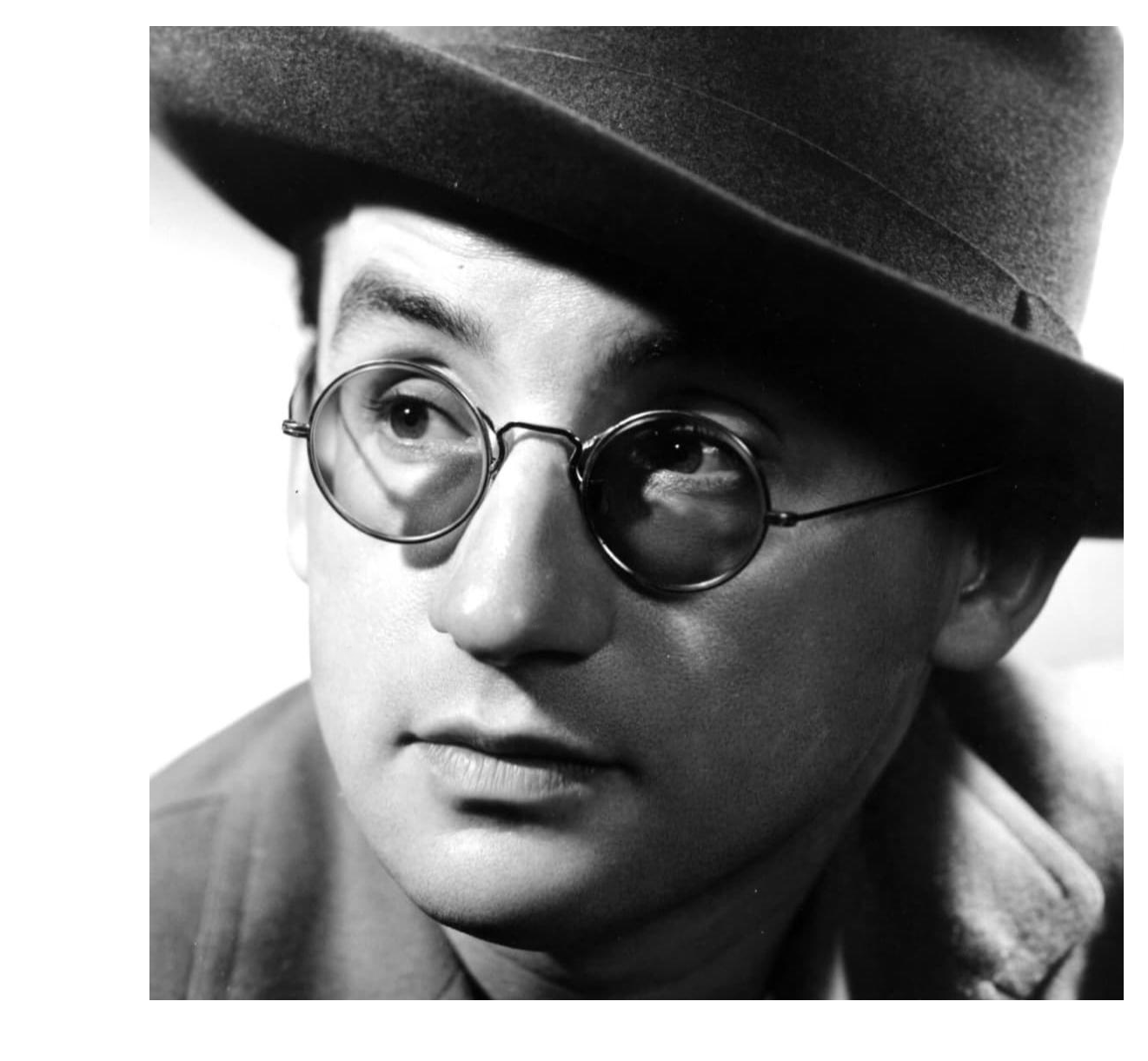
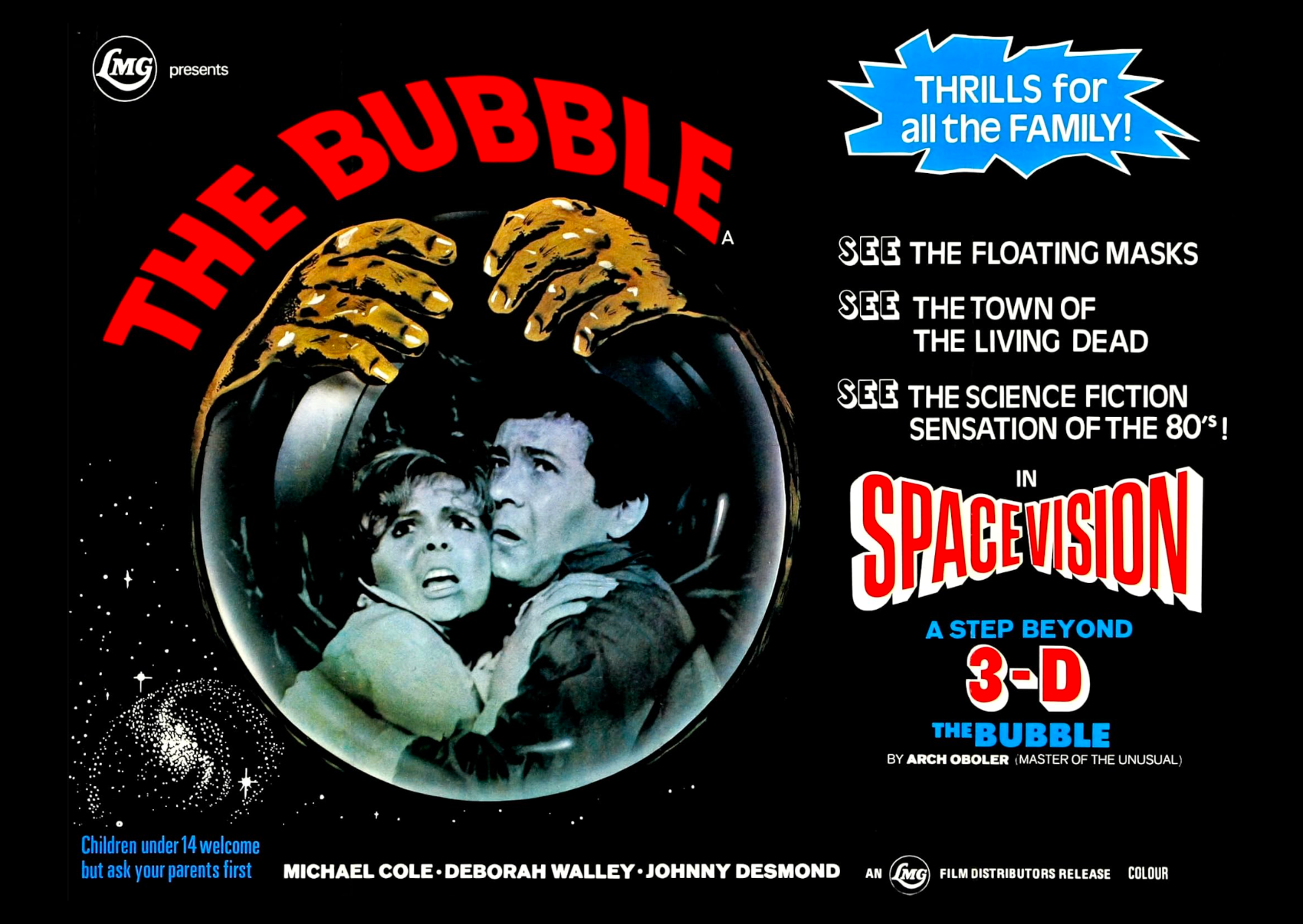
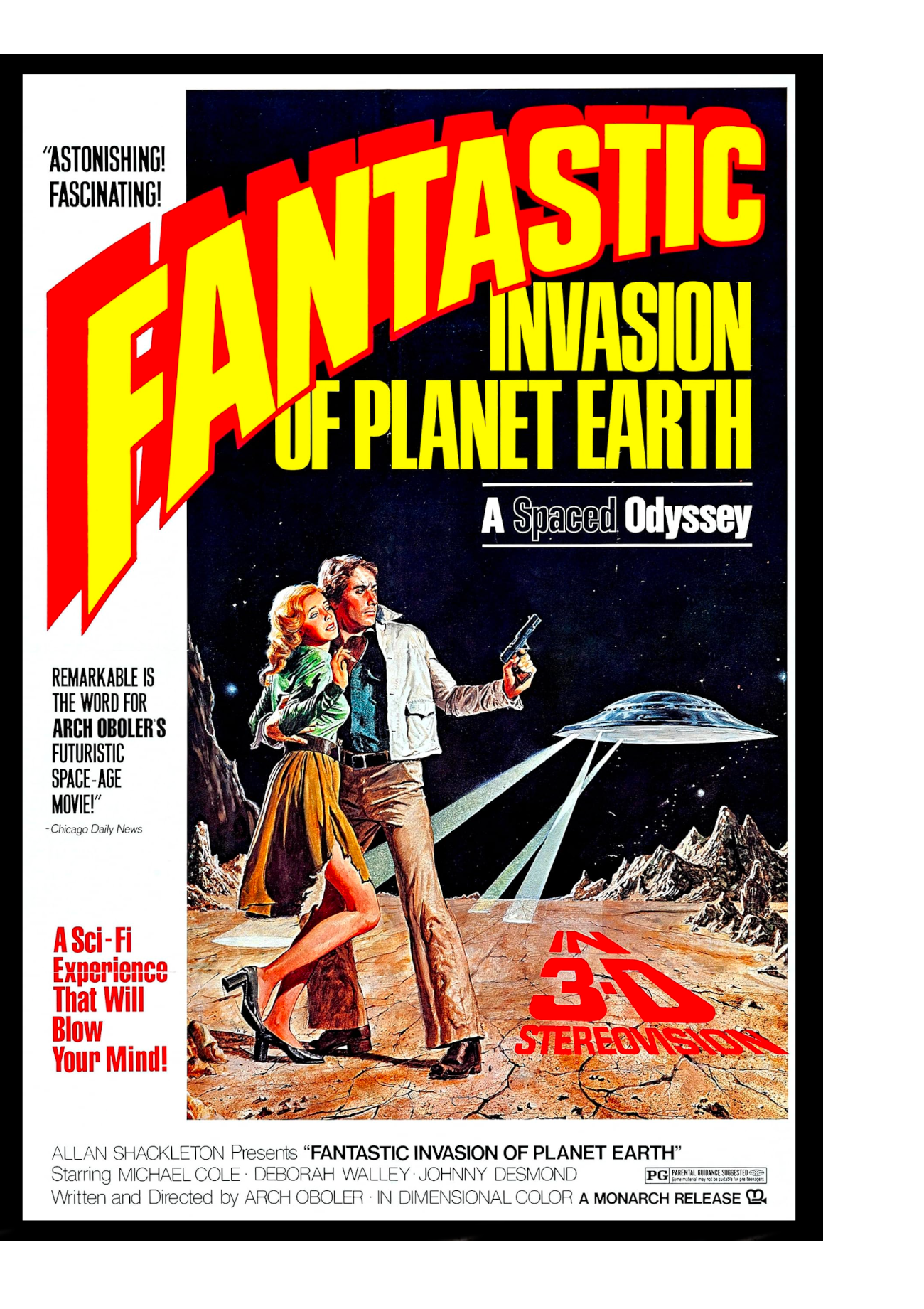
The initiator of the 1950’s 3-D boom was ex-radio legend Arch Oboler. The archive has fully restored Oboler’s Bwana Devil, the movie that ignited the craze. Thirteen years and not a lot of success later, Oboler again tried to conquer the film industry with a mysterious feature entitled The Bubble. The Sci-fi film did not launch another 3-D craze, but it did keep the format alive. Oboler’s real achievement was Space-Vision, which simplified the 3-D process for both filming and projection. Instead of using two parallel film strips, Space-Vision recorded both 3-D eye-views on one negative, eliminating alignment problems.
The premiere of The Bubble is listed as late 1966. In Los Angeles it was still playing in March, the same week that Gordon Douglas’ In Like Flint made its debut. I remember because I was visiting an Aunt in Torrance, saw the big ads side by side in the paper and tried to decide which movie to see. The Bubble’s ad was unusual. It promised a Science-Fiction masterpiece ‘beyond my imagination,’ but it also sounded like a stage show or magic act. Did I get to see it? No. The only 3-D most of us 1960s know were our View-Master stereovision viewers with images from Batman and Voyage to the Bottom of the Sea.
The Sci-Fi Fantasy
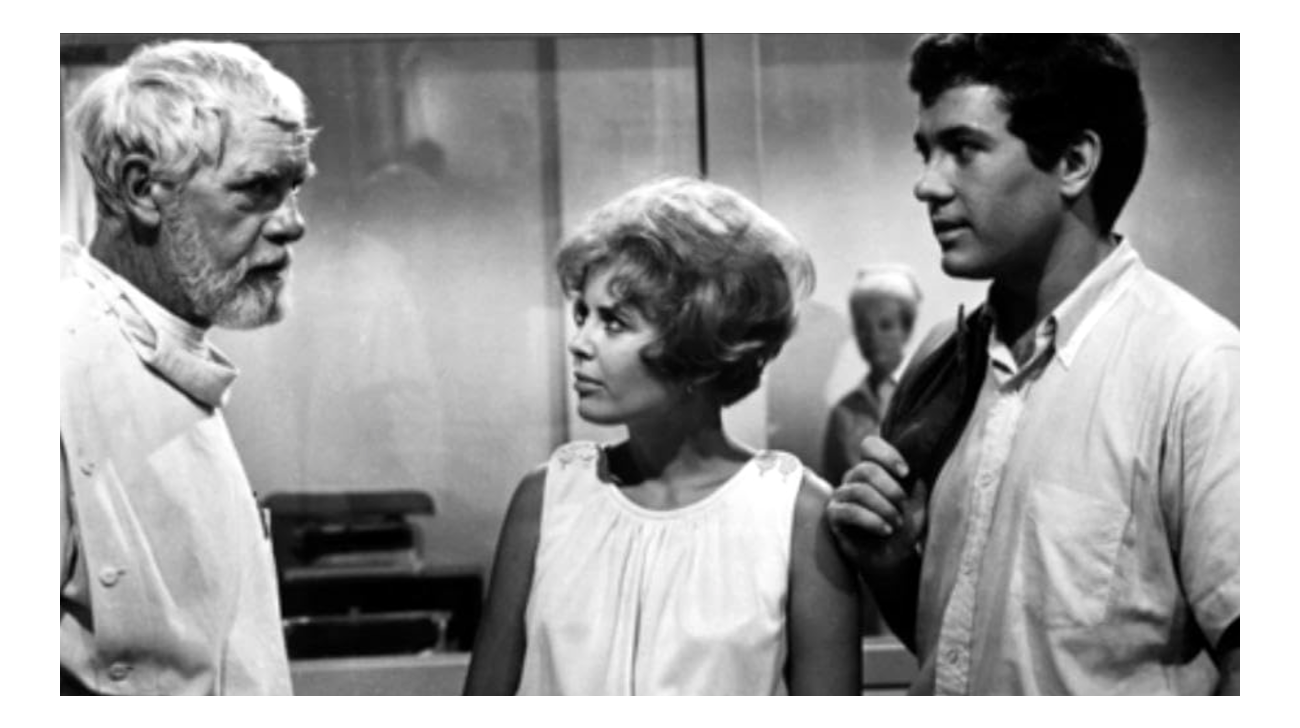
A synopsis of The Bubble resembles an episode of The Twilight Zone. His small plane caught in a freak storm, pilot Tony (Johnny Desmond) must land as soon as possible, as his passenger Catherine (Deborah Walley) is pregnant and in advanced labor. Husband Mark (top-billed Michael Cole of TV’s The Mod Squad) is relieved to get Cathy down and her baby delivered, but the town they’ve landed in is crazy. Random buildings and objects from all over the world are jumbled together. The few people on the street wear odd costumes and bumble about, making repetitive motions and speaking repetitive phrases. Nobody will acknowledge the newcomers’ presence or answer a question. Tony and Mark find a weird structure called a ‘Station’, which on the outside looks like an African termite colony. Inside is a machine that puts hallucinations in Mark’s mind. The zombified population doesn’t eat. They instead visit the strange machine to be ‘recharged,’ and emerge renewed as passive automatons.
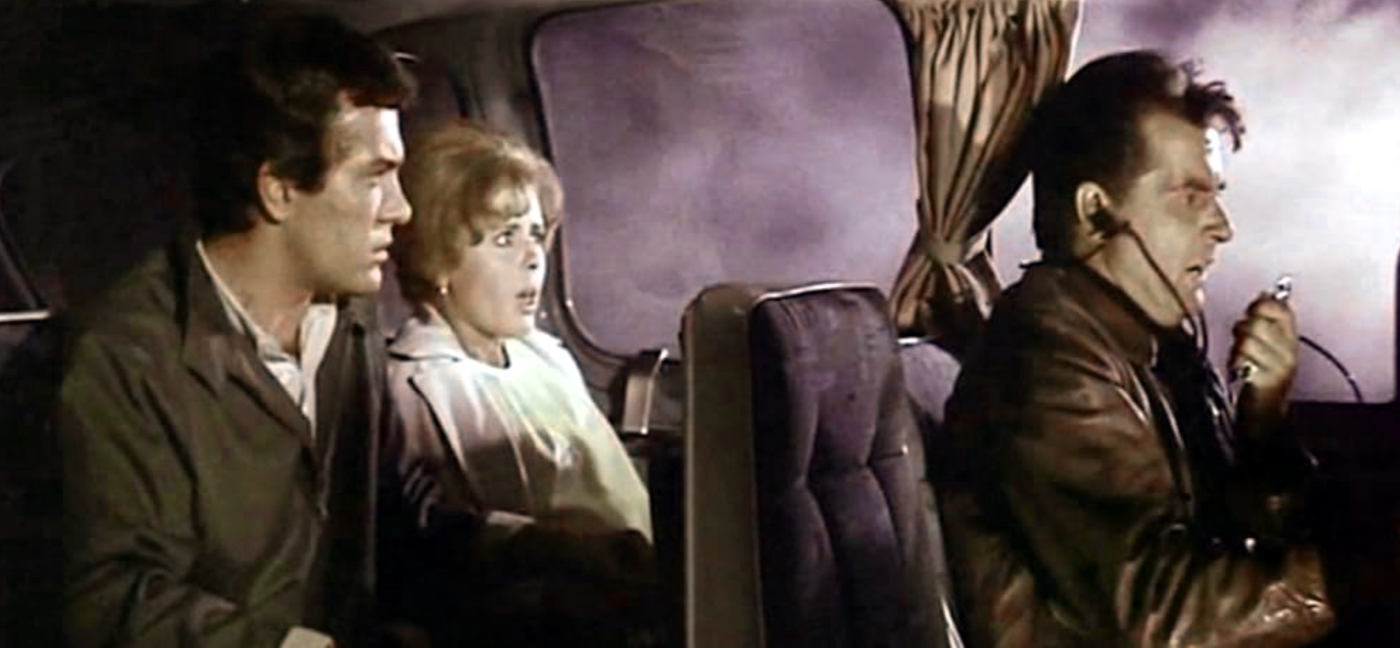
Tony and Mark then discover that, not far out of town, a giant glass dome encloses the entire area like a fishbowl. The sun above is distorted in the glass. The ‘prisoners’ become convinced that they are being observed from above. When ‘the entity above’ sees something it doesn’t like, it reaches down and destroys it. Seemingly at random, individuals are levitated up out of the dome, never to return. Mark decides that a tunnel under the dome wall is their best move. Hugging her baby, Catherine spends some time in denial before joining Mark in an effort to escape.
What we’ve got here is a prime example of Sci-fi fantasy’s recurring dramatic turnip, an allegorical fable that is supposed to tell us important truths about our world. The cockeyed setup inside the dome is similar to stories about scientists that create their own microscopic worlds in a lab, and then watch as the tiny human populations repeat mankind’s mistakes. I’ve heard several radio shows with the theme. I believe that both Science Fiction Theater and The Outer Limits have episodes with a similar story.
Arch Oboler’s story toys with the idea of a filmmaker as God … an opinion that he sometimes seems to have had of himself. This unknown Entity Above sets the stage and makes the rules. When Arch made his best movie FIVE back in 1950, he was obsessed with independence and control. He had Frank Lloyd Wright design a progressive house in a remote corner of Malibu. When four USC graduates arrived to help Oboler make his movie, they found him co-habiting with two subservient women. He expected his film crew to treat him as the Genius In Authority.
The world imagined for The Bubble isn’t particularly interesting, but it is fairly consistent. The ‘bubble God’ — or ‘Oboler’ — appears to toy with his amusing human specimens. They can’t be allowed free will, which is why they go through programmed motions … the showgirl, the bartender, the circus performers. Their mental programming must be renewed at a place called the ‘Station.’ Does Oboler’s Station enforce mind control, as might a political ideology or (gasp) religion? Oboler missed a bet – he should have ended the film with a tilt up to reveal a giant kid with a magnifying glass, studying his little collection under a glass dome.
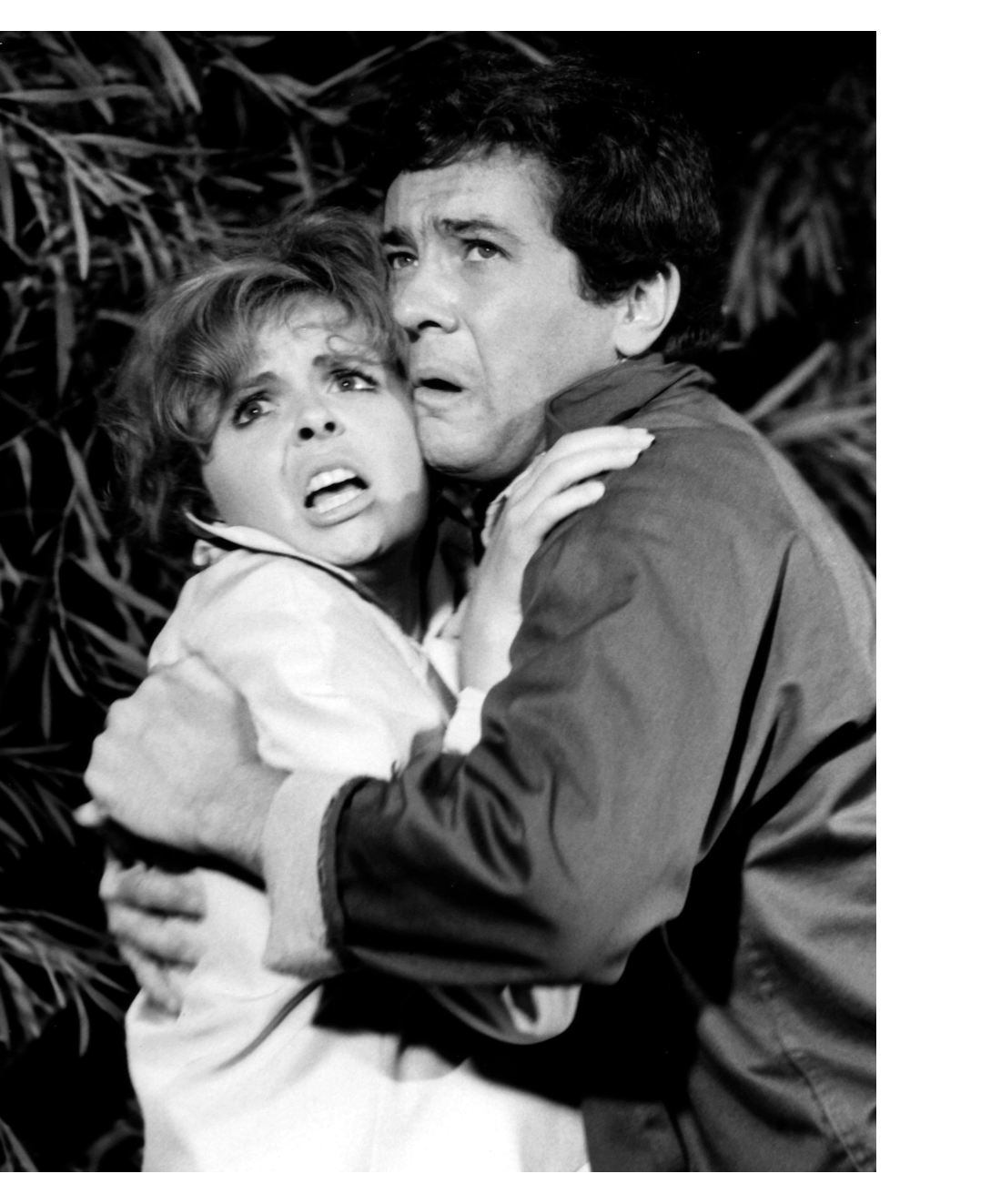
Arch Oboler had a reputation as a master scenarist yet put little effort into his storyline. The writing overall is slack, leaving the actors to their own devices in a story with little forward motion. Tony and Mark are convinced that they’ve been shanghaied to some bizarre dimension beyond space and time, yet they take it all far too casually. They begin to perceive a pattern only after a full half-hour observing citizens acting like lobotomized wind-up toys. In keeping with Oboler’s old school gender values, Catherine is mainly a focus of emotions. That Mark is willing to leave her and the baby alone under these conditions just seems wrong.
The details are more than a little shaggy. If everybody they meet is so zonked-out and nonfunctional, how does the medical clinic function? Oboler doesn’t connect the incidents into a storyline, and we spend most of the movie impatient for the characters to do something.
The heroes eventually decide that the unseen ‘entity in charge’ is collecting things — odd buildings, amusement park rides. He plays with his captive humans — a newsvendor, an old woman, a doorman — as if the Bubble Dome were a Dickian game of Perky Pat. Knowing the way Arch made movies, we have the feeling that he assembled a nonsense ‘bubble world’ of incongruous structures by contracting with a large properties company that rented ready-made sets and props for movies. The basic site was probably an old west movie town, the kind with modular ‘buildings’ that could be arranged by dragging them around with a tractor.
This explains why the Dome Town in the bubble looks like a movie studio junk yard. Oboler probably decided that he couldn’t afford to illuminate the large area for night, for his cameraman to add mysterious expressionistic lighting. We instead see Dome Town only in broad daylight, where it looks exactly like what it is, a random collection of fake movie settings. They do manage a nice touch here and there. When our heroes take a ride in their jeep, a surreal touch is provided by a row of Grecian statues lining a dirt road. Another positive set detail is a building that sits atop a flattened tree trunk. The ‘entity above’ has plunked the building down, like Dorothy’s house in Munchkinland.

A 3-D breakthrough covers a lot of sins.
The Bubble is a picture for 3-D historians, genre completists and fans of freakish film fare. In other words, it is an underachieving Science Fiction spectacle, but with exceptionally good 3-D. In Space-Vision, each normal 35mm frame is divided in half laterally, stacking a left eye and right eye image one on top of the other. Besides remaining in alignment, the colors on each image will be a match, even if the print fades a bit. The film negative area is smaller than Naturalvision so the image has more granularity. But the registration and 3-D effects are exemplary.
Adapting theaters to show standard 3-D entailed some hefty technical problems; some theaters may never have projected it properly. A typical theater would re-jigger its two projectors, used for changeovers, to project the left and right eye prints. How many theaters difficulty aligning their projectors? What if the projection lenses were not a perfect match? Space-Vision needs only one projector. The two images are locked together on a single film print, just as they were recorded during filming. With only one projector to finesse, the alignment variables are reduced to simple adjustments on the Space-Vision prism device.
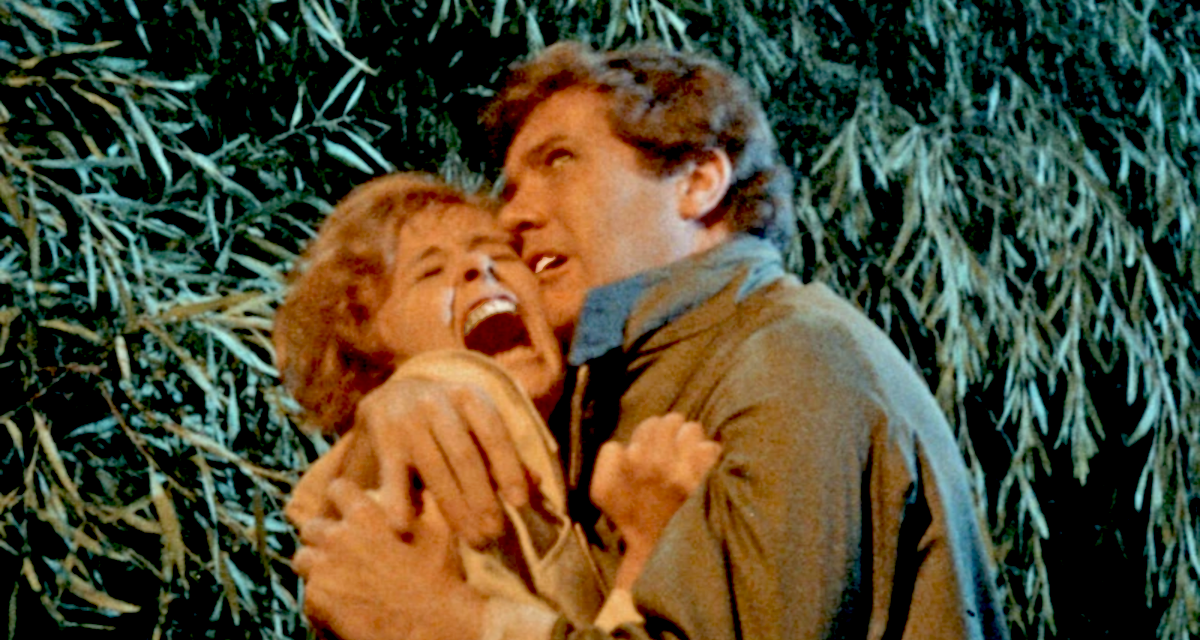
The 3-D for The Bubble is surprisingly clear and stable. Space-Vision does something we don’t often see in the older studio 3-D efforts: Oboler occasionally has an actor shove something at the camera, as Three Stooges were always doing. When an object gets closer, it appears to cross onto our side of the film screen. Added to the depth effect behind the screen, objects appear to project in front of the screen.
Some of the best 3-D is simply shots from a car moving slowly through the village. The ‘alien hallucination’ floats a number of brightly painted rubber Halloween masks — I think I recognize the ‘skeleton head’ mask.
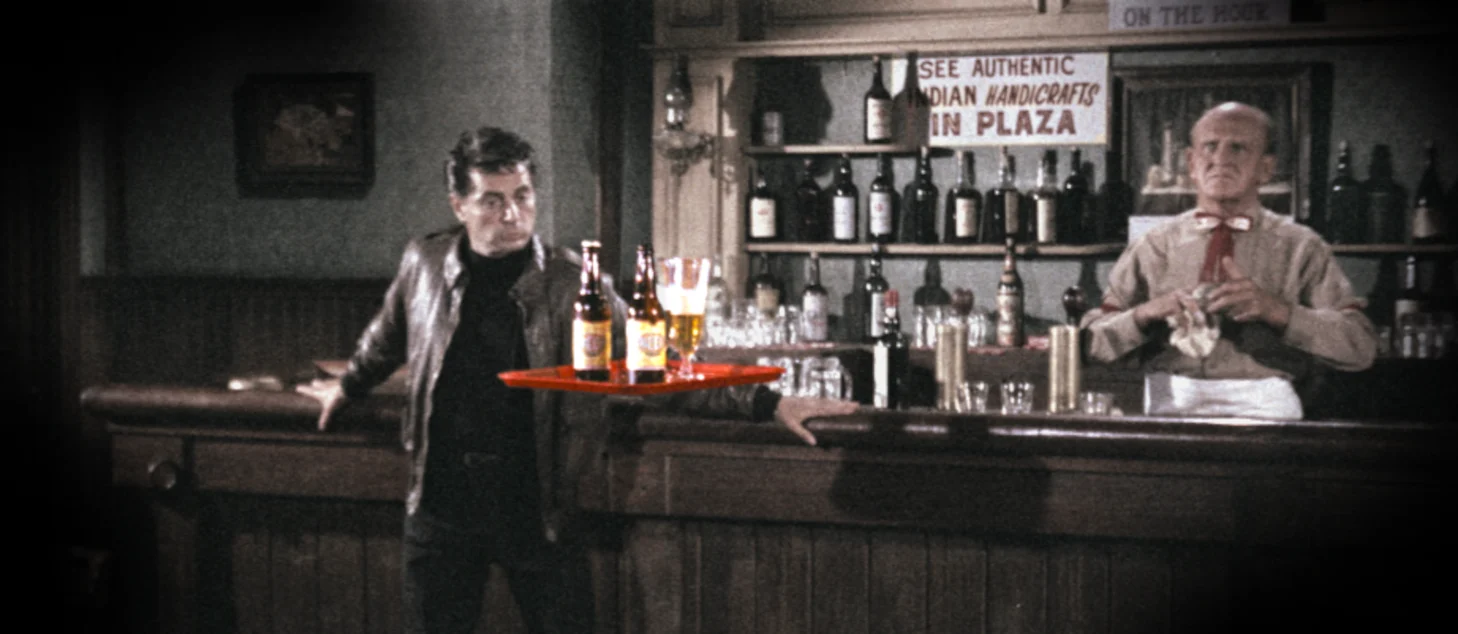
The 3-D effect most often mentioned is a simple shot of a tray with a beer bottle floating toward the camera. As is the case with most everything good in the movie, it’s not something that contributes to the story or the characters. The whole movie is like that. As a 3-D sideshow The Bubble is a definite historical curiosity and its resurrection is an impressive technical feat.
Glenn, thank you for your review!
The 1972 Spacevision footage you refer to was taken right outside Herron Optical in Long Beach, California. Bernier was possibly testing low-light capabilities on the third or fourth Trioptiscopes that were built. (There were only a total of four made, all with the same specs.) Herron was the go-to supplier of prisms, both for the Trioptiscope camera lens and for the Spacevision projection kits. Herron saw a lot of Bernier in those days: Oboler’s DOMO ARIGATO was already in the can, while Andrew Braunsberg and company were gearing up to make FLESH FOR FRANKENSTEIN in just a few months. And at that time, in late 1972 and early ’73, it was starting to look like 3-D across the industry might have an ascendant future.
Now, speaking respectfully, I think my commentary segment for THE BUBBLE on Blu-ray is more than a mere technical discourse. My talk covers some of the early history of Spacevision, describes the distribution history of THE BUBBLE, and puts both the process and the film in historical context among 3-D releases during the 1970s.
In the months since that commentary was recorded, I have learned much more information about Col. Bernier and Spacevision, all of which will be included in my forthcoming book, CLOSE ENOUGH TO TOUCH: 3-D COMES TO HOLLYWOOD. And, like you, I am very eager to get my hands on my friend Matt Rovner’s Arch Oboler book in due time. Matt’s research and insights are amazing, and Mr. O was a true American original.
Interested readers are invited to check out my essay on Spacevision at Film Atlas:
https://www.filmatlas.com/entry/231
My colleagues at Film Atlas and I have done and continue to do all we can to communicate the history and technical features of all motion picture processes, including sound, color, widescreen and 3-D. Come for Spacevision… and stay for the rest of this fascinating cinematic smorgasbord!
Thanks for alk you do, Glenn.
Just saw the film on MST3K, and it was hilarious!