
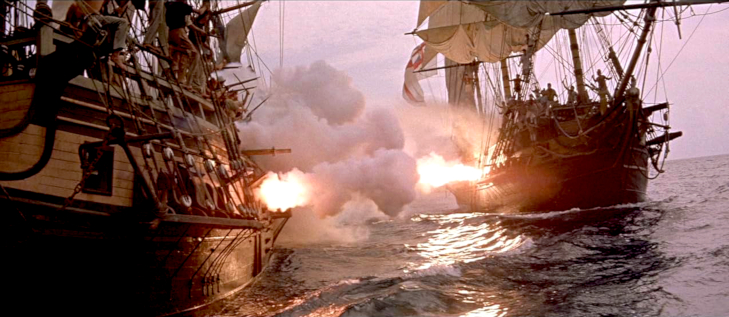


Powerhouse indicator picks up on a big-scale naval epic that holds together extremely well. Decent entries in the genre are not that common; the latest really good period seagoing show Master and Commander: The Far Side of the World is over twenty years old.
Who doesn’t like a seagoing war story?
Historically speaking, we once had the Gable, Brando and Gibson versions of Mutiny on the Bounty, a handful of Errol Flynn pictures, and Warners’ Captain Horatio Hornblower. Then in 1962 came both Peter Ustinov’s prestigious Billy Budd and this handsome John Brabourne production, H.M.S Defiant aka Damn the Defiant!

Filmed in England and at the Spanish port of Alicante, H.M.S Defiant is producer John Brabourne’s follow-up to his successful WW2 naval battle saga Sink the Bismarck! The producer regrouped much of the creative team from that 20th Fox show: top Brit director Lewis Gilbert (Carve Her Name with Pride), screenwriter Edmund H. North (The Day the Earth Stood Still), cinematographer Christopher Challis (Battle of the River Plate), editor Peter Hunt (Dr. No), composer Clifton Parker (Night of the Demon), art director Arthur Lawson (The Red Shoes), and miniature effects whiz Howard Lydecker (Fair Wind to Java).
Columbia’s involvement insured that Brit talent ‘owing’ the studio a performance could be tapped to fulfill contractual obligations. This could account for Oscar-winner Alec Guinness being approached for the picture. He and Anthony Quayle reportedly filmed Defiant during a hiatus in the years-long schedule for David Lean’s Lawrence of Arabia.
Guinness insisted that Dirk Bogarde be hired, clearly wanting to play opposite a worthy actor. Guinness later thought the film unworthy of his talents, which seems odd — H.M.S Defiant compares very well with some of the actor’s non-David Lean assignments of the ‘sixties.
For attention to everyday detail on one of Her Majesty’s warships, only Billy Budd and the much-later Master and Commander are as noteworthy. Good use is made of a functioning seagoing vessel, and more than half of the show is filmed out in the weather. Maybe Steven Spielberg should have relocated his shoot for Jaws to Defiant’s location of Alicante, Spain. The weather certainly seems more cooperative than Cape Cod.
It’s the late 1790s, and Captain Crawford (Alec Guinness) is pleased to have a new ship — H.M.S. Defiant — and a new mission. He meets with Admiral Jackson (Walter Fitzgerald), bids adieu to his wife (Joy Shelton) and takes his 12 year-old son David (Harvey Robinson) in tow to serve as a midshipman. At sea they can no longer interact as father and son. Crawford’s executive officer Lieutenant Scott-Padget (Dirk Bogarde) forms a Press Gang to obtain needed sailor recruits, legally kidnapping men from dockside pubs (The Press Gang doesn’t wear masks or carry ID).
Crawford and Scott-Padget soon clash. It’s not a casual dispute. The well-connected Scott-Padget repeatedly oversteps his authority. He undercuts the Captain’s orders, ignoring those don’t suit him. He’s also a sadist, and looking for opportunities to have crewmen flogged.

When the frustrated Crawford tries to discipline his Lieutenant, Scott-Padget turns treacherous. He entreats the Senior Midshipman Kilpatrick (Nigel Stock of The Great Escape) to frame young David Crawford for petty infractions, so as to justify daily whippings. The boy is soon in terrible physical shape. Rules at sea are so rigid that Crawford cannot intervene. He doesn’t know what to do with Scott-Padget — the man questions and resists his every decision.
The crew is aware of it too. Sailors Vizard, Grimshaw and Evans (Anthony Quayle, Brian Phelan, Tom Bell) are organizing a protest to coincide with a wider seamen’s strike originating at the port of Spithead, a legitimate, much-needed petition against cruelties and injustice in The Queen’s Navy. The command conflict aboard Defiant plays into their fury, what with Kilpatrick, serving as Scott-Padget’s lackey, serving the sailors worm-infested meat, Potemkin– style.

The interplay with the historical Spithead Strike is well done. English film companies didn’t commonly make ‘unconstructive’ movies about military mutinies, and this one is handled with kid gloves. The Queen’s Navy isn’t bad, and sadists like Scott-Padget are isolated rotten apples. The rebels prove themselves worthy sailors, and most of the Navy brass shows paternal wisdom.
It’s the old Narrative Sidestep.
Both this movie and Billy Budd dramatize the mutiny issue, and then use enemy action to make it a lesser priority. Peter Ustinov’s epic admits that the British sailors hate their officers only a little less than the French. This picture picture ends with a compromise that doesn’t speak well for the esteemed writers Edmund H. North & Nigel Kneale. A mutiny does take place, and by military rule all of the mutineers would be hanged. But ‘gallant action’ heals all wounds. The battle conveniently eliminates both Captain Crawford’s nemesis and the head mutineer, closing the books and allowing the mutiny to be forgiven and forgotten. That doesn’t sound like Her Majesty’s Navy of the time, before or after the Spithead strike.

Guinness and especially Bogarde are excellent in their roles; Guinness may have disliked the finished film because Bogarde’s part was better. The dramatic conflict ultimately lacks a satisfactory conclusion — we want and expect a decisive Crawford vs. Scott-Padget showdown, that never comes to pass. Dirk Bogarde waxes psychotic as Scott-Padget, but remains an irredeemable villain without nuance. Robert Ryan in Billy Budd is more fearsome, and elicits some Sympathy for The Devil as well.
The production has a real ‘they don’t make them like this any more’ quality. A few weak matte paintings show up but the overall impression is of realism and authenticity. Much of what we see was filmed on actual boat decks with a real ocean beyond, and no pleasure boats or oil derricks on the horizon. A matching Defiant mockup must have been constructed on a sound stage too, for night scenes; the audio dubbing is so good that we can’t tell when dialogue lines have been replaced.

The legendary miniatures expert Howard Lydecker was fresh from Republic Pictures when Brabourne engaged him to create the superlative WW2 battle scenes in Sink the Bismarck! He took full charge of the Defiant’s model work. The angles chosen seldom betray their scale — only a few water splashes sometimes give it away. The ship models must have been enormous. They fire cannons, take explosions and suffer damage in a believable manner. Models intercut with full-sized ship mockups, just like in the old Errol Flynn pictures. The production cuts no corners.
Actor-spotters will like this picture. Three of the principal crew look so much alike that we can’t readily tell them apart — even watching with an IMDB cast list, at one point I thought the wrong man had been flogged. Meanwhile, we enjoy the familiar Maurice Denham (The Purple Plain) as the alcoholic doctor, Murray Melvin (A Taste of Honey) as a law student swept up by the press gang, and Victor Maddern (Seven Days to Noon) as a decent-minded crewman.
Some familiar names got past us. Ray Brooks, the star of The Knack …. and How to Get It is said to be among the crewmen.
H.M.S Defiant may have displeased viewers that wanted Alec Guinness to contribute another sensational, game-changing performance. I prefer the dependable, stable Captain Crawford to the actor’s ethnic impersonations for David Lean — an Arab, a Bolshevik, an Indian intellectual. For movie fans that love big-scale non-CGI action and that care about historical accuracy, this epic more than satisfies.


The first part of the movie has an extremely old-fashioned feel – more like something that was made in 1932 than 1962. Once the action moves out to sea, however, this mostly dissipates. Before the voyage everyone tells Crawford that Scott-Padget is nothing but trouble, but the captain takes a more measured view and vows to make his own judgement. This kind of “enlightened” thinking is usually rewarded but here Crawford learns to his chagrin that he should’ve listened to the prevailing opinion.
I defy anyone to sit through this.
Well Glenn Erickson has sat through it. So have I. We both thought it was very good.
I’m so happy for you.