


This one won’t go away — years later it lingers in the mind like a peaceful dream. Wim Wenders approach to the ‘film blanc’ is overwhelmingly humanistic. We immediately embrace his premise — if the world did operate this way, existence could be divine. If only.
Back in 1988 this was the picture to woo general audiences into the realm of art-movie nirvana. The audiences we shared it were captivated, and soaked up Wenders’ and his co-writer Handke’s fantasy like eager children. Even in blue-ish tinged B&W, the screen gave off a warm glow — the moment of an ethereal angel suddenly experiencing the jolt of being ALIVE, was met with delighted laughter.
Wim Wenders’ luminous, lyrical fairy tale Wings of Desire 4K is stylized to present 1987 Berlin as a sad city divided by an oppressive wall — who knew that that barrier would fall in less than two years? “Heaven over Berlin” reaches back to classic German Expressionism for its effects yet projects a very modern surface. It became one of the most popular foreign films of the 1980s, confirming director Wenders’ place in the league of great world filmmakers.
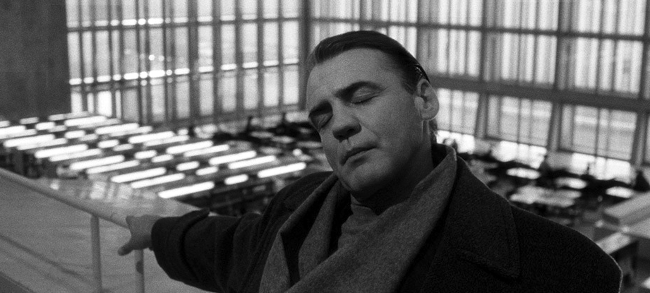
A show about meditating souls is a joyful meditation for its audience. The citizens of the gloomy West German capital worry in silence about their families and responsibilities, unaware that a host of invisible guardian angels is keeping silent watch over them. These quiet, thoughtful figures gravitate toward souls in distress, soothing them with their invisible touch. The angels are in awe of the human spirit; every so often one desires to be alive so much that they cast off their superhuman status and transition to the ‘real’ world. Melancholy angel Damiel (Bruno Ganz) falls in love with a beautiful trapeze artist, Marion (Solveig Dommartin) and takes the plunge into mortality. Watched over by his comrade Cassiel (Otto Sander), Damiel experiences the taste of food and the chill of the cold. He receives special tips from another former angel, actor Peter Falk (Peter Falk), who is shooting a movie in Berlin. Marion’s circus has disbanded, forcing the no-longer-omniscient Damiel to search the city for her.
O save us from our darkest fears.
The Wim Wenders film achieves a contemplative tone difficult to describe. The angels that wander the Berlin thoroughfares and loiter in its public places are glimpsed with wings only once or twice. Invisible, they listen to the living with sympathetic eyes and ears. All thoughts are audible in the angels’ world, filling trains and street corners with inner voices looking for answers. The angels come close when they’re needed, comforting those who suffer. Although they can’t change reality, the Angels can raise the spiritual morale of those they touch. We feel a profound uplift when Damiel brings a glimmer of hope to a discouraged man on a train.
These phantoms appear to be God’s Lonely Men (and women). They loiter in public, hovering about awaiting opportunities to connect with our spiritual selves. Damiel attends to a victim of a traffic accident who sits dying by the curbside. The man is beginning to perceive the afterlife and is vaguely aware of Damiel’s presence. Likewise, innocent children can see the angels, and accept them for what they are. A child points to a winged angel standing atop a tall building, but his parents pay no attention.

The film’s realistic surface offsets its fanciful central conceit. The angels perceive Berlin in bleak B&W. A very real library interior is a favorite angel hangout, implying that people are more spiritually receptive when reading. Damiel and Cassiel are intrigued by Homer (Curt Bois), a retiree they find meditating over old books. They listen as Homer describes the pre-war Berlin, before the bombs; he’s a relic of a past that will disappear when he dies. To the angels humans are special and precious, to be envied: we know the miracle of being alive. They study us as if hoping to discover our secret.
(Science fiction provides a literal parallel to Wings of Desire in Arthur C. Clarke’s novel Childhood’s End. An alien super-race comes to Earth not to conquer, but to study us, for we humans possess something they do not: consciousnesses that can proceed to a new level of existence, i.e., immortal souls.)
Wenders and Peter Handke employ the cruel barrier of the Berlin Wall as a metaphor for the alienation and loneliness of humankind. The other-dimensional Damiel and Cassiel can of course pass through the wall, and stroll invisible and unharmed in the no-man’s land sown with land mines and overseen by machine guns. The political power of these images in 1988 was tremendous — the wall is a malign curse, a political obscenity.

When the film was new we never guessed that the Berlin Wall would be history in just two years’ time. Wings of Desire is a key film about what the division really meant. Wenders’ followup feature Faraway, So Close is a joyous elaboration on this story, but set as it is in a reunited but undecided Germany, it has political complications that unbalance the first film’s simple setup. Its new fallen angel, for instance, develops an alcohol problem.
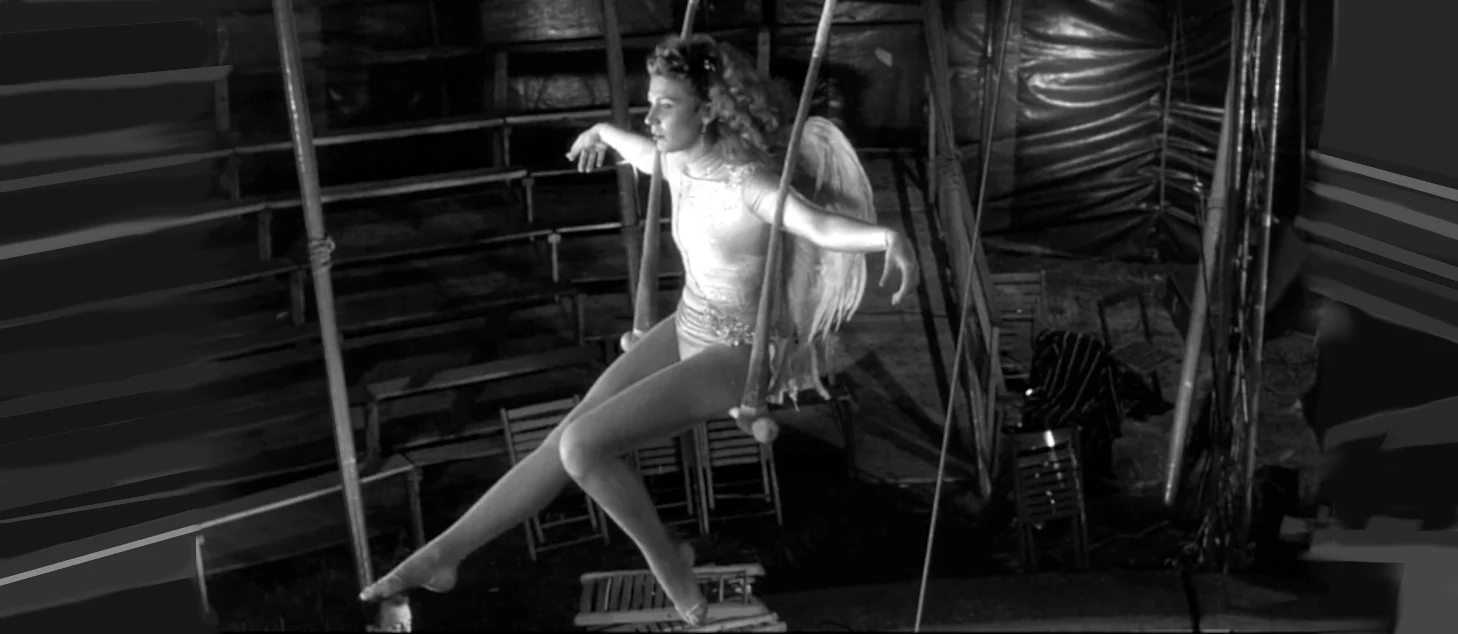
Wings of Desire’s emotions become personal through Damiel’s love for Marion, the beautiful trapeze artist. He watches her rehearse in the modest little circus tent, and perform for a children’s matinee. If one isn’t already completely charmed the circus scene will do the trick. Its tent-ful of little tots, unspoiled by video games or reality TV, reacts with sheer delight to the antics of the spirited performers. They accept the actors’ attention and love without reservation. The kids get to join in the fun, batting balloons and playing with the clowns and the cat lady. It’s a moment of humble rapture.
The show has a special B&W surface sheen that we’re told was achieved through special filter tricks, producing a result reminiscent of film stock from the silent era — ‘orthochromatic’ perhaps? The moody monochrome look has a special kind of cold shimmer. Damiel’s “intimations of mortality” are accompanied by short cuts to bright color — the way we normal humans perceive the world. This taste of life convinces Damiel to forgo his immortality in favor of the short span of one mortal lifetime as a living person.

What could be better than a film that makes one feel ALIVE?
The formerly serene spirit Damiel is suddenly reborn into the world he only thought he knew. He now has need of words. He asks strangers the colors of things and sticks his nose in a cup to smell the coffee. Damiel learns what being cold is like and how frustrating it is to be hindered by things like chain-link fences. We want to clap as he discovers, one after another, the marvels of human living. After an hour of teaching us to appreciate the spiritual, Wings of Desire rejoices in the miracles of everyday reality.
Peter Falk’s ex-angel introduces an additional element of amusement. We listen to the actor’s thoughts as he sketches extras or observes preparations in a concrete bunker being used as a movie set. Falk teases Damiel about his new status, assuring him that the real fun will be discovering life for himself. For Damiel, this means tracking down the missing Marion. The circus has left town, and he can only hope he’ll find her in the street, or at a concert. When Damiel does find Marion, how will he declare himself?
Wenders receives excellent creative input from the legendary Henri Alekan, the cinematographer of Jean Cocteau’s Beauty and the Beast. The film’s visuals shift from silvery God’s Eye aerial views to the dim rooms and streets of the city below. Jürgen Knieper’s music is dominated by soulful violins and cellos. The circus orchestra and the droning Rock music of Nick Cave provide a good contrast, but the string passages establish the ethereal atmosphere. Wenders would make brilliant use of similar music, and a dozen disparate pop songs, in the science fiction epic that Wings of Desire made possible, Until the End of the World.

Thanks a lot for a great review, as always of your standard. I recalled one of your best, Until The End of The World, decades ago before the release of a 5 hours director’s Cut. I like Wings of Desire and almost all of Wenders’ films. But I happen to love Faraway, So Close! much more. Do you happen to know whether the Criterion or US company will release it on Blu-ray or 4K? I have noticed the German disc and The UK one in Wenders’ Supreme Curzon box-set. But what about the US territory? My DVD is fine but I would love to get upgrade so much.