

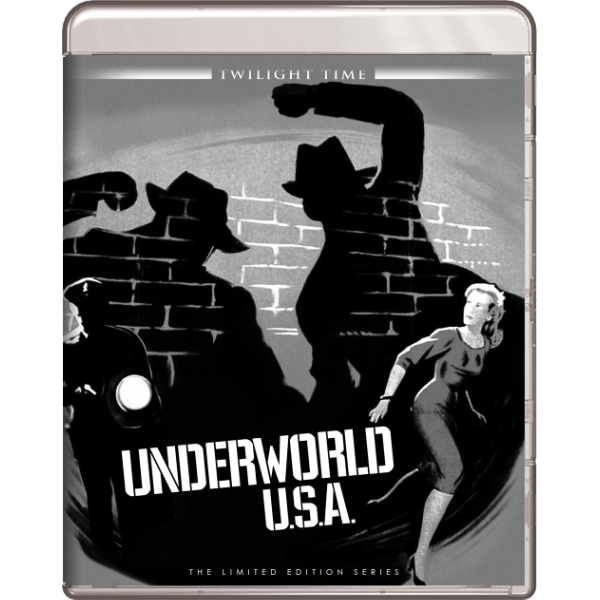
Samuel Fuller’s successes with distributor-producer Robert Lippert won him several good years working at Fox, and enjoying an excellent relationship with studio head Darryl Zanuck. But when Zanuck stepped down Fuller had to make do with less support for the pictures he produced under his Globe Enterprises banner. Fox distributed two more of his pictures, and then he moved on to RKO. As the 1950s wound down he did some TV work while taking on a two-picture deal at Columbia. Twilight Time gave us the first Fuller/Columbia effort The Crimson Kimono last July. Now it follows up with the second, an ambitious crime picture that presents a raw ‘vision’ of the workings of the syndicate in America.
In Underworld U.S.A. Sam Fuller goes all out with his signature “shocking exposé” filmmaking style, the mode that made him so popular with the French New Wave. The tabloid-in-motion gangster mini-epic is loaded with shouting newspaper headlines, shock cuts, grotesque killers and an obsessive hero. Fueled by cinematic blood & thunder, the one-man crusade against organized crime was filmed on a minuscule budget, yet has a polished look that can be attributed to Fuller’s focused direction. One senses that it was written and filmed in a creative frenzy.
Sam Fuller’s movie is a cartoonish but absorbing revenge tale, the story of a second-generation gangster told almost in the style of a ’30s Warners picture. Young punk Tolly Devlin (as an adult, Cliff Robertson) sees his father murdered on the same night that he receives a Cain- like scar over his right eye. Watched over by the worldly-wise Sandy (Beatrice Kay), Tolly graduates from reform school to prison. He emerges from behind bars with the knowledge he wants, the identities of the men that killed his father. Tolly ignores Sandy’s advice and joins the mob to exact his revenge. He learns the ropes from a hit man, Gus (Richard Rust). Tolly saves the life of Cuddles (Dolores Dorn), a prostitute marked for death by the mob, but then callously uses her to further his goals. There’s no mercy in this line of work. Gus doesn’t bat an eye when the big boss Earl Connors (Robert Emhardt) orders him to murder a little girl. Teaming up as a double agent for District Attorney John Driscoll (Larry Gates), Tolly manipulates both sides to turn the mob against itself.

Fuller doesn’t waste time with niceties. The fat cat lifestyle of the vice lords is presented in comic book terms. The corpulent mob villain Connors orders his crimes and killings while relaxing at the side of an Olympic pool. The ‘shocking’ details of the drug trade are not seen, but only covered in dialogue. The mob uses coffee shops as heroin distribution centers. As if Jack Webb had been consulted for police details, the bad guys are heard discussing the need to push more drugs to schoolchildren.
All of this dialogue is delivered expertly, but none of it can be called subtle. Half of it is blank exposition for the benefit of the audience, with cops and crooks explaining things that everyone present already knows. Characters also have a bad habit of verbalizing their past histories, present anxieties and future hopes in clean, concise paragraphs, as if their bio-descriptions had been rephrased into dialogue balloons. When Fuller breaks from this pattern — as when Tolly hears Cuddles’ voice out of nowhere, talking about death — his words come to life. The French filmmaker Jean-Pierre Melville made a career out of shooting Fuller-like crime stories, but removing all but the most essential dialogue. In 1960, Fuller knew that Hollywood studios required movies in which everybody talks, that could play like radio shows.
Fuller’s characterization shorthand can be terribly simplistic. The criminal evil in the story is constantly being contrasted with a ‘healthy’ interest in children. Gus kills a little girl, but the hooker Cuddles dreams of a child of her own. Even a couple of the gangsters talk about family values. But Fuller insists on making the art direction reinforce the theme — the childless and regretful Sandy maintains what looks like an altar to infants in the corner of her living room, with stuffed toys and pictures of Gerber poster babies. When Cuddles talks of her maternal ambitions, one of these baby photos crowds the image, as if saying, ‘see, this is what she wants and needs.’ The scenes are like newspaper pages, with special chosen graphics to sell the message. One one level it makes sense — you could show the movie silent to an audience of Aborigines, and they’d likely intuit what Cuddles was talking about.

Fuller blocks his compositions the way an editor blocks out a page of newsprint, as when he fits that photo of a baby strategically between Tolly and Cuddles. The director’s personal references are present as well. Prominent signage for ‘The Big Red One’ is visible at Army recruiting stands and in the office of the D.A..
Fuller’s tabloid sensibility went against the current trend of docu naturalism. He would later push his brand of exaggerated sensationalism even further, stabbing at audiences with outrageous situations, no matter how incredible or simplistic. Shock Corridor and The Naked Kiss frequently go off the deep end. Audiences have always convulsed with laughter at the Corridors scene where Peter Breck is attacked by “Nymphos!” Sex perversion against children is presented with the bizarre verbal image of the ‘naked kiss,’ the kiss of a (gasp) sex pervert.
Underworld U.S.A. simply bears down harder on the ruthlessness of mob violence. Gus and Tolly up the ante on the kinds of cold-blooded murders depicted in earlier mob epics like The Enforcer, New York Confidential and Murder by Contract. Our vengeance-sworn Tolly Devlin is successful at his mission because he has cut himself free of human feelings. He delights in setting up his mob targets to be shot or burned alive. He callously uses the prostitute Cuddles (Dolores Dorn), and laughs in her face when she expresses a desire for a real life with a husband and children.
Even when he wasn’t making a war film, Sam Fuller related his dramatic conflicts to combat. Underworld compares the business of organized crime directly to warfare. The D.A. is a fighting man fond of puffing on a Fuller-esque cigar. The crime boss Connors accepts that there will always be ‘traitors’ in his organization going over to the cops, just as he uses informants within law enforcement. It’s a constant struggle, and Connors is fighting a war of attrition. He believes that as long as he keeps up his public relations smokescreen of showy charity giving, the syndicate won’t be stopped.

When comeuppance time rolls around, we have the classic gangster situation — fate catches up with Tolly because he lets his guard down for a moment, and follows a ‘weak’ human motivation. By the time Tolly learns to appreciate Cuddles, it’s far too late for atonement. Fuller finishes with an in-our-faces visual that critics would later use to describe his entire filmic philosophy. A crude optical zoom pushes in on Tolly’s clenched fist, the semi-legendary ‘cinema fist’ associated with Sam Fuller’s personal style.
Cinematographer Hal Mohr is likely Fuller’s key player in achieving Underworld U.S.A.‘s enhanced impact; the modestly budgeted film can boast superior imagery. The mob’s glass and steel offices say ‘big business’ so we take for granted that Earl Connors really has a nationwide network at his fingertips. Mohr’s work is also much more flattering to the actors than was Sam Leavitt’s less polished work on The Crimson Kimono. Some of Dolores Dorn’s close-ups are breathtakingly beautiful.
Even if prompted by budget concerns, the semi-minimalist look that the French critics so praised becomes a conscious style. It’s a backlot movie, without the docu-realism of setups filmed on busy streets. The film’s key scenes are staged in a tiny standing alley set, probably seen on TV ten times a week. Mob boss Earl Conners’ fancy pool has the look of a public facility: did Fuller rent it from the local Y.M.C.A.?

Can we assume that Fuller’s cast wasn’t expensive? After his credited feature debut in Picnic Cliff Robertson drifted back to special guest starring status on TV shows. His star wouldn’t rise again until he portrayed John F. Kennedy in 1963’s PT 109. As fitting the film’s over-literalism in details, the actor overworks Tolly’s facial sneers and lip-curls. He becomes the ‘low class’ Tolly Devlin in the same way that he’d painfully overplay ‘retarded’ nine years later for his (unaccountable) Oscar win in Charly.
The capable Dolores Dorn is one of several actresses that shone in Sam Fuller movies of the time — she and Victoria Shaw apparently were Columbia contractees simply working out their assignments. Dorn actually makes the thin character of Cuddles appealing. She has to play a prostitute but can’t be shown plying her trade, so Fuller instead shows her nibbling the neck of a whisky bottle in a suggestive manner. Paul Dubov, Gerald Milton and Neyle Morrow were Fuller ‘regulars’ who showed up in several of his pictures.
Beatrice Kay’s Sandy could have come right out of 1939’s The Roaring Twenties — playing the Gladys George role, she looks just like an aged Sylvia Sidney. The wild card actor is Richard Rust, an interesting personality with a hit-and-miss career that started at Columbia. His other notable genre and cult appearances were in Budd Boetticher’s Comanche Station, William Castle’s Homicidal and Dennis Hopper’s The Last Movie.

Underworld U.S.A. isn’t the most subtle of gangland pictures to herald the emergence of organized crime as something too big to be rooted out by a few determined cops. A more convincing view of impersonal, implacable gangland villainy could be found in Phil Karlson’s insightful The Brothers Rico, which compellingly reveals organized crime’s inversion of human values. Fuller’s picture takes for granted the idea that the system is so soaked in corruption that nothing could expunge it completely. More radical crime films even suggested (gasp!) that the line between organized crime and legitimate business had been erased.
Perhaps for the last time in American films, this gangland saga shows a solitary avenger as capable of destroying the mob on his own. Future one-man crusades in serious crime pix (think Don Siegel and John Boorman) end up like that of Tolly Devlin, but without putting a permanent dent in ‘the organization.’ The smarter independents, like Siegel’s Charley Varrick, merely try to outfox the system while protecting their own hides. From the ’60s on, organized crime will be depicted as being Too Big To Fail. Like other big players in the American Economy, it is immune to the loss of a few executives.
