
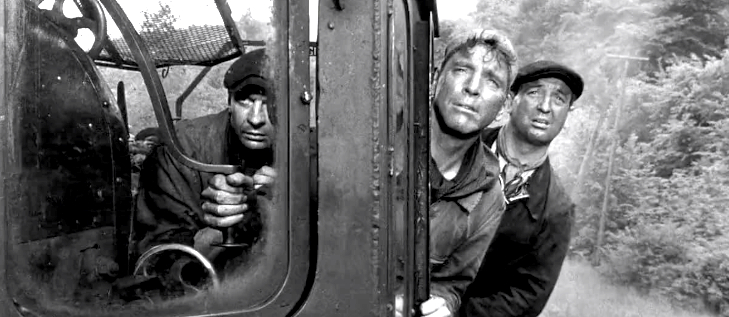
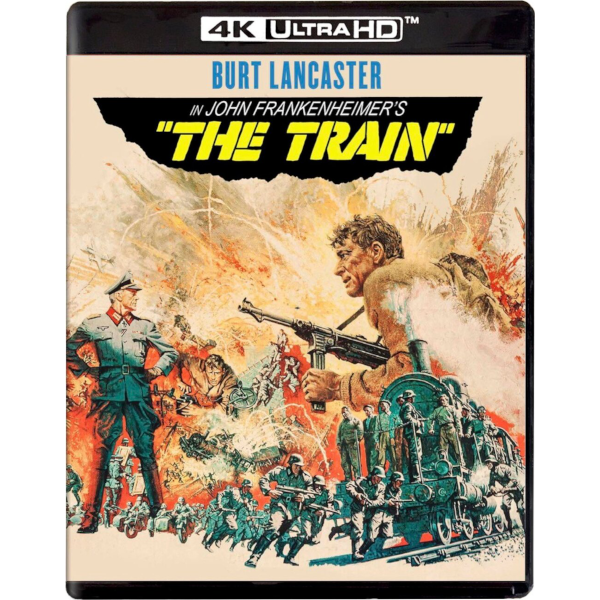

Here’s a B&W feature that really pops in 4K Ultra-HD — John Frankenheimer’s The Train always looked good in every video format, but the new 4K remaster could fool us into thinking it was filmed in 65mm.
The movie never gets old; I could watch it once a year. We appreciate Frankenheimer’s Grand Prix as a major technical achievement, but the organization and filmmaking precision on view here is sensational. The railroad and military hardware is 100% real, something that CGI-jaded moviegoers appreciate more than ever. Good performances abet a tale of wartime sabotage, and the suspense is top-level. A hundred tons of French steam locomotives and running stock are shot at, burned, blown up and smashed to smithereens. Oh, the movie’s about saving French art treasures, too.
After conquering live television and scoring with a pair of cerebral political thrillers, John Frankenheimer turned his talents to large-scale technical challenges. He inherited the job of directing The Train after the powerful star Burt Lancaster jettisoned his first director, Arthur Penn. Frankenheimer’s penultimate movie filmed in B&W is even more physically complex and realistic than Grand Prix, recreating wartime Paris. Few optical effects and no models were employed. Trains are shot up, bombed, sabotaged and crashed together in hair-raising action scenes; the biggest scenes were filmed with multiple cameras.
We’re told that one misjudged train impact wiped out all but one of the unmanned cameras positioned to film it. It’s one of the best shots in the movie — hundreds of tons of iron and metal fly at the camera, coming to rest with a spinning train wheel suspended in the air just inches from the lens. On-set footage from the mishap can be seen in a promotional film, included on Kino’s disc.

In August of 1944 Paris is only days from being liberated. The occupying Germans are evacuating as fast as they can. Staff Officer Von Waldheim (Paul Scofield of Carve Her Name with Pride) has been ‘safeguarding’ a horde of museum art treasures and now puts together a special train to spirit them all to Germany. Museum directress Mlle Villard (Suzanne Flon of Mr. Arkadin) begs the French railroader Labiche (Burt Lancaster) to use the resistance underground to save France’s national treasures. The sabotage starts small, but Labiche and his comrades are soon putting their lives in direct jeopardy. Train men Jacques, Pesquet and Didont (Jacques Marin, Charles Millot & Albert Rémy) do the wrecking. Patriots that aid them risk being shot as well, like innkeeper Christine (Jeanne Moreau). Elderly engineer Papa Boule (Michel Simon) sabotages one locomotive by blocking an oil line with a franc coin.
Von Waldheim commandeers another train, but more sabotage action requires German engineer Herren (Wolfgang Priess) to work around the clock. Labiche and his associates finally pull of a grand deception, fooling the Germans into thinking the art train is en route to Germany. By changing the signage at half a dozen rail stations, Labich instead re-routes it right back to Paris, to keep a date with a massive planned sabotage pile-up with two other locomotives.
Ever been around real trains? They’re no place to play.

The Train is one of the best-looking B&W action films ever — the lens choices of Frankenheimer’s two lighting cameramen put us in the middle of all that railway hardware. There are few ‘easy’ shots and no cheats — even incidental scenes coordinate activity on a grand scale. The average WW2 film can afford a few trucks and vintage personnel vehicles, but The Train uses massive cannons and armored train locomotives as incidental set dressing. We stop looking for production shortcuts after we see Burt Lancaster personally cast and install an iron part for a locomotive right before our eyes. Giant rail cranes lift entire locomotives from wrecked tracks and set them down as if they were toys. Actor Albert Rémy climbs between cars on a moving train, and it’s all real.
Maybe moviemaking was cheaper in 1964 but this production skimps on nothing. Arthur Penn wanted a film about the value of art; Frankenheimer expanded the film into an action spectacle. When the weather turned bad, he was able to shut down the first unit for weeks. Nobody has that kid of luxury now.
The Train doesn’t try to dazzle us with fast cutting or trick camerawork. We instead marvel at Frankenheimer’s precise direction in scenes of chaotic activity — packing paintings, responding to an air raid, rushing to repair a train wreck. Watch your average Spielberg or Lucas ‘epic’ and you’ll see the same ‘assistant director 101’ traffic patterns employed to keep the extras milling about — ‘cross left, cross right, stop, turn, look at your watch, etc.’ In this show everyone on screen looks like he lives there. The production value is all on screen.

Shooting films with trains can’t be rushed: getting a locomotive back to ‘start’ position doesn’t happen instantaneously. An involved mastershot in The Train may initiate with a detail (a small fire), tilt up to show an activity in the rail yard, and then truck and crane to follow some characters. The precision really makes a difference. In the film’s very first shot, a group of cars appears in the distance on the exact frame that a camera move ends on some Germans at a machine-gun post. Video assist did not yet exist; all the action was coordinated with walkie-talkies and signal flags. In one shot, a crane-mounted camera (with its operators) glides smoothly across the path of an oncoming locomotive, at the risk of being smashed to bits.
How did John Frankenheimer get permission to destroy so much railroad hardware? We’re told that the French rail industry was standardizing the gauge of its system, and allowed the producer to purchase and wreck all the old-gauge trains he wanted. The Train also demolished a rail yard slated for replacement with more modern facilities. Real dynamite was used for many of the bomb explosions. In the air raid scene real buildings are blasted to bits, and tons of earth are tossed into the air.

The movie’s cat-and-mouse conflict eventually boils down to a duel between Von Waldheim’s art thief and Labiche’s saboteur. Burt Lancaster proves that he is still a physical dynamo at age fifty. Unbroken action shots show Burt performing impressive feats without a stunt double or resorting to camera tricks. Everything he does is believable, logical and often truly graceful. When Lancaster hurt his foot (not while filming), the script was changed to have Labiche be shot, to justify his limp.
The Train doesn’t try to shoehorn a conventional romance into an all-male combat story. Star Jeanne Moreau makes a positive impression, even if Lancaster’s Labiche hasn’t got time for her to do much more than make eyes at him. We’re also impressed that the movie doesn’t suffer for being all performed in English. We only really notice when the utterly French Michel Simon is robbed of his authentic voice and language. ↓ We wonder if MGM once had full audio masters for The Train in French and German … wouldn’t it be nice to create a multi-lingual version with subtitles? Simon’s aged face looks like a melted pumpkin, yet he’d keep making movies for ten more years.

The movie of course honors the role of France’s rail workers in the resistance effort. United by profession, they fared better than other groups divided by internal politics and betrayed by collaborators. France’s own film masterpiece on the subject is René Clément’s docu-drama La Bataille Du Rail (Battle of the Rails), a similar action film without an art theft angle, filmed on real locations just after the liberation. But the Nazis did steal a lot of French art in its four years of Occupation, and an attempt was made in the final weeks to send an entire train shipment to Germany. It was stopped with bureaucratic red tape, not sabotage.
The advertising’s explosive graphic collage sells the film as Big Action with a Hollywood’s most virile action star. But Frankenheimer doesn’t downplay the national pride angle inherent in the struggle to purloin France’s art heritage. It ends in a cold equation that weighs the value of France’s treasure against human lives. Frankenheimer dwells on shots alternating thirty dead Frenchmen with dozens of crates market ‘Corot,’ ‘Matisse’ etc. Has something been accomplished or is the slaughter just more madness? The Train wisely leaves the debate at a visual level. It’s an unacknowledged masterpiece.
We wonder if Buster Keaton had a chance to see and enjoy The Train? He’s perhaps the only filmmaker before this who was given as much freedom to ‘play toy trains for real.’ Keaton’s The General would make a great double bill with this movie — The Train even uses Keaton’s ‘double back’ action structure.
Here’s Brian Trenchard-Smith on The Train:


A first rate cinema masterpiece! This film puts to shame many of the so called event movies currently being shown.
Can’t top Glenn’s coverage except to say that as far as I’m concerned THE TRAIN
is Frankenheimer’s last masterpiece.
That’s debatable, as is everything, but what a decade: Birdman of Alcatraz, Manchurian Candidate, Seven Days in May, The Train, Seconds and Grand Prix. Those are difficult to top. As for later years – I need me a bit of Ronin pretty frequently.
Ronin is pretty brilliant
A fine review, Glenn. A great movie.