



Producer Philip D’Antoni gave escapist crime pix a big shot in the arm with 1968’s Bullitt, a detective-vs-the-mob story that pared dialogue to a minimum, gave Steve McQueen a definitive role and upped the ante for the violent car chase as a spectator sport. The French Connection is a distinctive William Friedkin picture, that repeated producer D’Antoni’s trick of opening up the third act with a major car chase. Not as well known as those films is The Seven-Ups, one of the most polished and entertaining crime-action flicks of the early 1970s. It’s a consistently convincing, gritty little drama, and in terms of credibility its central car chase is the best of the three.
NYPD detective Buddy Manucci (Roy Scheider) runs the ‘Seven-Ups,’ a special five-man detail that uses clever means to bust crimes that draw serious prison sentences of seven years and higher. Buddy’s showboat methods work well until some unheard-of kidnappings go down: big-time gangsters are being tapped for ransom. The department’s politicos are too hasty to suspect that the Seven-Ups are behind the shakedowns. Buddy learns nothing from his main snitch and childhood pal Vito Lucia (Tony Lo Bianco), an undertaker for the mob. As it turns out, the brazen thugs Moon and Bo (Richard Lynch and Bill Hickman) are behind the extortion scheme. They continue to terrorize the racketeers, who are also convinced that crooked cops are doing the kidnapping.
The Seven-Ups is a high achiever among a slew of gritty cop shows from the first half of the 1970s: Badge 373, The Taking of Pelham One Two Three, The Friends of Eddie Coyle, Across 110th Street. It’s Roy Scheider’s first starring role, a major step upward from playing Gene Hackman’s pal in The French Connection. The screenplay is a very smart construction. Writers Albert Ruben and Alexander Jacobs begin without the usual exposition before, during and after the initial action scenes. They introduce the Seven-Ups without even telling us that they’re policemen, as they bust a smuggling operation based out of a Manhattan antiques store. Scheider impersonates a rich patron, and another team member pretends to be a water delivery man. Then they start tearing up the place, like Laurel & Hardy.
That pattern is repeated through the first half of the film. New characters and elements are introduced without explanation, but in the next scene we find out who they were and what was going on. The narrative tactic keeps us on our toes without becoming a frustrating experience; it also establishes the Seven-Ups as highly creative in their operating procedures.
Scheider’s Buddy Manucci does his best to figure out what’s happening in the mob, but his snitch Vito isn’t much help. The key mobsters tailed by the special unit seem to disappear, one after another. Then Manucci observes with his own eyes the kidnapping of a crooked bail bondsman, by men claiming to be cops. The only way to find out what’s going on is to put pressure on the mobsters, in person . . . which further convinces the underworld that they’re the ones doing the kidnapping.

The Seven-Ups launches into and sustains its high-powered action with only a couple of breaks for obligatory scenes of disapproving superiors. No home life is depicted for any of the cops, and no sexy girl friends await them in moody nightclubs. Only a few years before that aspect was essential: Bullitt and Madigan focused strongly on a frustrated wife and an uncomprehending girlfriend. The absence of conventional distractions allows us to concentrate on the action on the street, with dogged cops, panicked criminals and an elite shakedown team that makes clever use of badges and a cooperative car wash.
Perhaps influenced by The Godfather, the show gives us an intimate look at The Mafia as an interconnected group that pretend to be ‘modest’ businessmen. These hoods look ordinary until one realizes that a guy with, say, a chain of restaurants likely acquired them one by one using mob coercion and intimidation. The middle-level crooks panic when they think that rogue cops are kidnapping their members for ransom. The old guys are scared to death to be snatched right off the street.
The show is an excellent antidote for the cops in today’s STUPID TV crime shows, that flirt with each other between action scenes, while ‘magic computers’ supply them with instant accurate information on their foes, including detailed, error-free back stories. In the more recognizable Real World of The Seven-Ups neither the crooks nor Manucci’s team have a clue as to what’s really going on. The uncertainty leads to marvelously confused, realistic action scenes. A tense situation builds when Seven-Up Ansel (Ken Kercheval) goes undercover as a chauffeur at a mob funeral. Everything goes wrong and he gets caught wearing a wire. Ansel’s teammates don’t understand when he suddenly disappears from the funeral procession; they track him down to a parking garage run by a slimy character played by Joe Spinell (The Godfather, Taxi Driver). An unexpected shoot-out ensues, which launches the no-limits car chase through the city streets.

As is pointed out in a short subject included on the disc, producer-director D’Antoni’s main action collaborator is Bill Hickman, a auto stuntman and actor easily recognized as the driver of the Green muscle car that does battle with Steve McQueen’s GT Mustang in Bullitt. Dig deeper and you’ll find that twenty years earlier Hickman was James Dean’s partner in his extracurricular road racing. When Dean killed himself in a smash-up en route to a race, Hickman was following him in a support vehicle.
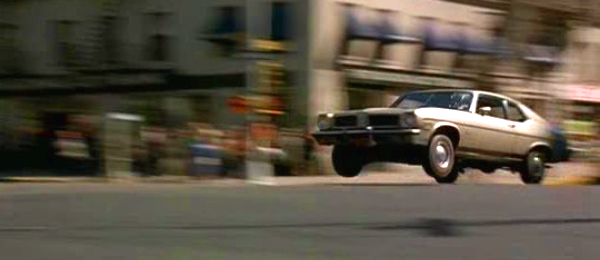
Does the Seven-Ups automobile pursuit best the legendary one in Bullitt? We were shocked in 1968 to see cars really racing flat-out on the streets of San Francisco. Some viewers realized that doing so required a secure lock-down of two or three city blocks at a time, but the novelty of the crazy chase likely fooled some audiences into thinking that D’Antoni and McQueen just rolled cameras and went wild. The The Seven-Ups auto chase isn’t as flamboyant as the ones in the earlier, more celebrated D’Antoni pictures, but it is perhaps the most convincing. Chasing the kidnappers, Scheider’s car goes much faster than anyone would dare on city streets. Several cars are sideswiped on the way out of town while the crooks manage to crash a roadblock and sucker a cop car into running itself off the road. As in Bullitt the pursuit ends out on the open highway, with an unforgettably graphic finish. It’s all the more shocking when we learn that a stunt driver was in Scheider’s car throughout the sequence, even in the final shot.

The car crash aftermath demonstrates the vulnerability of Buddy Manucci, who is in no way a Dirty Harry of Manhattan. Yet we easily accept the Seven-Ups’ lawless vigilante methods, after the opposition kills one of their members. Ordered to stand down, the team instead goes wild to break the case. They threaten Joe Spinnell’s lowlife with torture and invade a mobster’s bedroom to threaten he and his wife with guns. Unlike Dirty Harry, the script doesn’t preach that the law’s hands are tied. Although cop movies since The French Connection have championed police lawlessness to win audience approval, it’s still dead wrong … if one thinks of the crimes and suffering abetted or committed by the charismatic cops in L.A. Confidential, they all belong behind bars, especially the ‘heroes.’
The Seven-Ups eventually turns on the outcome of a single betrayal, with just enough male bonding angst to make its tough-guy finish an appropriate epitaph for the bad guy. D’Antoni’s dramatic blocking makes this dramatic finish really stick in the memory.
The books say that the early ’70s cop cycle burned out when people got sick of seeing grainy location movies with too much violence and not enough story. Blaxploitation crime pictures also warped the genre away from realism into different forms of fantasy — with interchangeable poster art showing tough guy heroes holding guns. I like to think, however, that Steven Spielberg was the one to announce the end of the ’70s cop film (and the beginning of the high-concept adventure thriller) in Jaws. Roy Scheider’s new character could almost be Buddy Manucci, two years later. He’s now an ex- NY cop who’s opted to quit the mean streets to police a quiet tourist hamlet in Massachusetts. His expertise with thugs and street crooks is of little use out on the open ocean. Menaced with a giant shark cruising past his boat, Scheider loads his trusty .357 magnum and empties it into the monster’s head. Every shot hits, but to no effect. It’s the ’70s equivalent of “I guess we aren’t in Kansas anymore.” Gritty cop thrills did a fade-out from American screens, to be supplanted replaced by fanciful monsters, ghosts and aliens.

