

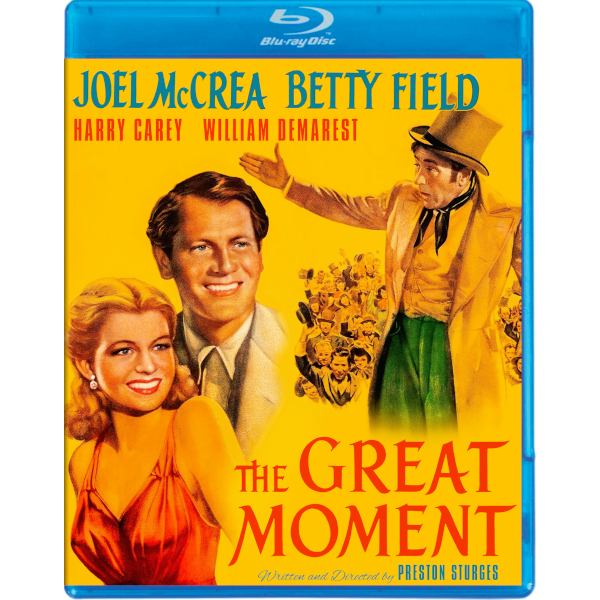

The fine writer-director Preston Sturges directed seven hits for Paramount and then left in the kind of rush that can only be explained by a colossal ‘clash of creative interests.’ Much has been written about the struggle between Sturges and the front office, espeicially producer Buddy G. DeSylva. The parting was in no way amicable. His last-released picture was the one solitary non-performer after four years of nothing but success.
All of Sturges comedies were creative and original, consistently hilarious audience-pleasers. They also became more daring in their humor, interweaving occasional sexual subtext with such finesse, the censors couldn’t object. Then came his The Miracle of Morgan’s Creek, an hilarious comedy that appeared to break two, maybe three Production Code commandments. We’re told that a re-shoot or two were required to please the Catholic Legion of Decency. Critic James Agee couldn’t explain what had happened:
“… the Hays office has been either hypnotized into a liberality for which it should be thanked, or has been raped in its sleep.”
Upscale critics could be stingy with praise for Sturges’ comedies, and even his booster Agee complained about out-of-control slapstick and excess sentimentality. Considering how riotously entertaining these films were, even Agee comes off as too picky.
Sturges’ final Paramount release The Great Moment became a much bigger thorn in the studio’s side, especially because it came at a time of bad studio politics. It was shelved for almost two years, and after Sturges left Paramount it was recut without his involvement or approval. The biggest comedy hit-maker of the war years never regained his impressive box office magic. He signed his name to four more films, but of them only Fox’s Unfaithfully Yours can compare to his Paramount gems.

Jump ahead to the early 1970s. When the fledgling UCLA Film Archive got started and studio prints from Fox and Paramount began to arrive, lecturers like Robert Epstein were able to program entire classes around directors. One of the most popular was for Preston Sturges. We saw all eight of his comedies in succession, preceded, I think, by something he wrote. All were in perfect nitrate prints; all were uproariously popular save for The Great Moment, a poorly organized comedy that mixed in unexpected, mawkish bits of seriousness. Although it has funny bits and fine performances from Sturges’ established stock company — Julius Tannen, Torben Meyer, Thurston Hall, J. Farrell MacDonald, Sig Arno, Al Bridge, Robert Greig, Esther Howard, Frank Moran — the movie has not the clarity of theme nor the flawless pace at which Sturges excelled.
At the time we were told that the film was ‘troubled,’ but we didn’t know that what we were seeing was a studio chop-job. We didn’t know that the original title was “Triumph Over Pain.” I still find the film’s sentimental finish very moving — I always identify with Joel McCrea — but audiences didn’t make the connections because Paramount removed them.
The basic story of The Great Moment doesn’t sound like promising comedy material, but Sturges wanted to leverage laughs to push forward a very serious theme. It’s the true account of W.T.G. Morton, a 19th century dentist who developed a practical anaesthetic. Politics and prejudice in the medical establishment prevented Morton from profiting from his work, or even getting credit for it. Normally, the subject of pain and the dentist’s chair was only seen in broad slapstick comedy and W.C. Fields short subjects. The only movie I know where historical anaesthesia is central to the storyline is a much later English horror film with the lurid title Corridors of Blood. And Sturges thought to make this into a comedy, in 1942?

The Great Moment was meant to pioneer in Black Comedy territory. That form presumes a thoughtful and sophisticated audience, so Sturges was taking a big risk from the get-go. Instead of making another ditzy farce for the studio, Sturges thought to do something different, in a deeper, more resonant serio-comic style. His original shooting script * has been published so we can read and understand what he was aiming for. The cynical, mocking narrator on the very first page reminds us very much of Mark Twain’s A Pen Warmed-up in Hell writings, the late-career political letters and essays exposing what Twain saw as society’s brutal hypocrisy. “Triumph Over Pain” opens with a narration that takes a tone of aggrieved disdain for humanity, presumably including the audience:
“A clear, pleasant voice says the following:”
“One of the most charming characteristics of Homo Sapiens, the wise guy on your right, is the consistency with which hi has stoned, crucified, burned at the stake, and otherwise rid himself of those who consecrated their lives to his further comfort and wellbeing so that all his strength and cunning might be preserved for the erection of ever larger monuments, memorial shafts, triumphal arches, pyramids and obelisks to the eternal glory of generals on horseback, tyrants, usurpers, dictators, politicians an other heroes who led him, usually from the rear, to dismemberment and death.”
“We bring you the story of the Boston dentist who gave you ether. Before whom in all time surgery was agony. Since whom Science has control of pain. It is almost needless to tell you that this man, whose contribution to human welfare is unparalled in the history of the world, was himself ridiculed, burned in effigy, ruined and eventually driven to despair and death by the beneficiaries of his revelation.”

Thus the story of W.T.G. Morton is told at a caustic distance. Played by that pillar of ethics Joel McCrea, Morton suffers the slings and arrows of small-mindedness and snob prejudice. Unable to afford a full medical college, Morton becomes a dentist with a side interest in the problem of relieving pain. He goes through various methods before settling on his concoction ‘ether,’ and when it seems to work he looks forward to contributing to the well-being of his fellow man. He also hopes to stop struggling with his personal finances. He is instead ridculed and denounced, demonized and marginalized as a dangerous kook. Much of the resistance is just bureaucratic stupidity, but a lot comes from the insular medical profession, which will not countenance ‘improvements’ from outside the closed ranks of established doctors. Make that ‘pig-headed conservative’ doctors with the polticial power to punish Morton for meddling in their private domain.
Morton’s progress is told in series of often hilarious slapstick scenes of the ‘sore tooth’ variety, given a terrific spin by Sturges’ most consistently gifted character actor, William Demarest. These are interspersed with his difficulties fighting the establishment while his patient wife Elizabeth tries to support him. Morton does have a few good men in his corner, such as a professor (Harry Carey) who tries to help promote the progressive methods. But Morton is repeatedly blocked by medical authorities and politicians, and branded as a faker and charlatan.
The final straw is that, when Morton’s methods do gain traction and begin to find acceptance, the same authorities conspire to deprive him of credit for and ownership of his invention. The last scene may seem thin to some, but it’s a perfect example of a humble man sacrificing himself to ‘do the right thing.’ It’s almost a Christ parable — you offer salvation and the world makes you suffer for your efforts.
Frankly, the movie’s concern for issues like The Public Wefare and The Public Health feels far more moving now then when I saw it in film school. Back then we’d all agree that anaesthetics are a humane miracle and that poor Morton got a raw deal . . . but it was too easy to see him as an exceptional case. How many times have we heard the story of Jonas Salk’s open gifting of his discovery Penicillin to the world, no strings attached? A skilled debator could make Morton out to be some kind of selfish profiteer. But in today’s pandemic, when hundreds of thousands of doctors and medical personnel are knocking themselves out to save lives, only to be obstructed by asinine disinformation, contemptuous denials and even death threats, The Great Moment feels more relevant than ever.
Knowledge of Sturges’ intentions and the script’s more caustic, pointed satire makes The Great Moment a much stronger experience. The writer-director was attempting to stretch the boundaries of comedy entertainment. It wasn’t as if cynical ‘black’ humor didn’t exist in 1942 — the public loves all kinds of edgy material. Given Sturges’ overall brilliance, it’s hard to believe that the show wasn’t effective — the problem was likely a creative-political clash between a self-confident artist and a studio that didn’t like a message movie in place of an easily-sold hit comedy. We’re told that his angry disputes with the studio were so acute, that the mutilation of The Great Moment could have been done partly out of personal spite.
The Great Moment shapes up as a ‘what might have been’ cinematic tragedy likely to be appreciated only by dedicated fans of Preston Sturges — it’s difficult to reconcile the man’s incredibly productive string of brilliant films, with what happened to him later. The fact that he partnered with Howard Hughes explains the colossal disaster of his next filmic enterprise. There are a number of standout movie tragedies, orphaned films that instantly grow in importance, when one learns of their bad fortune. The Great Moment may have been a classic ahead of its time.
