

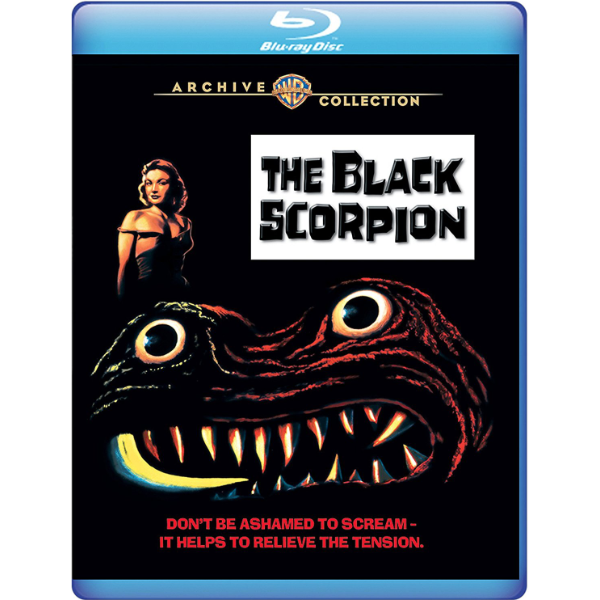

The ’50s big-bug monster show The Black Scorpion now gets its moment of glory. First things first — this new scan of The Black Scorpion betters anything I’ve seen of this key stop-motion monster romp, including earlier discs from Warners. Different, improved elements have been sourced. I’ll explain more below.

Standing in line behind top rank monster movies like Them! are the also-ran titles such as this offering from the producers of Ray Harryhausen’s The Beast from 20,000 Fathoms. Leaning heavily on the earlier hits, the makers of The Black Scorpion whipped up a derivative thriller to compete with other insect horrors in the Big Bug Year 1957: The Deadly Mantis (May 26), Beginning of the End (June 28), and Scorpion (October 11).
Of the three pictures Scorpion has by far the most effective and exciting special effects. The rampaging giant arachnids are scary, nightmarish things that only a zoologist could love. They skitter along quickly, like real scorpions, with nervous, chopstick claws that snatch up victims as if they were grains of rice. The great Willis O’Brien’s epic special effects go a long way toward redeeming the weak script. Some editorial decisions don’t help either. Every animation shot that can be recycled, is repeated, some several times. Intercut with them is a foolish-looking puppet-head scorpion that screams at the camera every six seconds or so. The show is one of O’Brien’s last efforts, with most of the actual animation done by his unheralded assistant Pete Peterson.

The film’s first half hour feels like padding. Violent volcanic eruptions lay waste to a vast area of rural Mexico. Smoke billows as a portentous voiceover warns that nature is on the rampage. Geologists Hank Scott (Richard Denning) and Artur Ramos (Carlos Rivas) interrupt their researches to help with the local relief efforts as best they can, and meet the beautiful cattlewoman Teresa Alvarez (Mara Corday), dueña of Rancho Miraflores. Released from volcanic vents in the Earth, giant scorpions terrorize the already panicky campesinos. Our two heroes spearhead the scientific investigation with the Mexican authorities. A crane lowers them into a deep fissure to find out what other horrors are hidden below.
The Beast from 20,000 Fathoms producers Dietz and Melford, having lost the services of Ray Harryhausen to Columbia’s Charles H. Schneer, must have been directed to the only other ace stop motion animators at work in Hollywood. Frustrated in his attempts to repeat the success of King Kong, Willis O’Brien’s personal fantasy projects time and again fell prey to abusive producers. Obie’s name might end up on the credits for the sake of status, as happened with 1960’s The Lost World, but few producers let him make a real creative contribution. One of them snuck away to Tokyo with his story about a monster called Prometheus, which eventually became King Kong vs. Godzilla. Another project was split in two, with each half produced in Mexico as The Brave One and The Beast of Hollow Mountain. The latter film used weak stop-motion work done by other animators.

The Black Scorpion was filmed in Mexico as well, but not as a co-production. Legend has it that the effects were performed in tiny studios rented by Pete Peterson and Willis O’Brien, and even in their garages at home.
The story of The Black Scorpion is a rehash of the four or five ‘big monster attack’ films then on the books. The acting is decent, except for an incredibly annoying Kid who tags along to plague the heroes, whining at the top of his lungs: “I want to hee-lp yew!” He’s played by Mario Navarro, and if you need another excuse to dislike him, he was also one of the brats that got Charles Bronson shot dead in The Magnificent Seven.
Veteran director Edward Ludwig knows where to put a camera but the performances still seem by-the-numbers. Richard Denning and Mara Corday make an effort in romantic scenes, to no avail — we can only imagine that the lovely Ms. Corday is thinking, ‘well, this guy’s much better than John Agar.’ The kissing couple only keeps the audience from what it came to see — giant rampaging scorpions.
Not helping is a script that delays the entrance of the scorpions for a full half-hour, as crowds of anonymous refugees flee from volcano eruptions. Not until a ‘normal’ scorpion freed from an ancient piece of amber turns out to be alive, do the big monsters even make an appearance. The rest of the dramatic scenes are just place holders between the four Big Bug set pieces.
An attack on a ranch has some effective moments and good animation, especially the opening when a monster gobbles up two telephone linemen. Next comes an exciting journey into a subterranean nest of slimy-crawly arachnids, which can be considered either a repeat of the Kong spider pit, or a dry-land version of the diving bell scene from Harryhausen’s The Beast. Living in the caverns are strange prehistoric worm-things and a trap-door spider that pursues the little stowaway Mario Navarro. To our dismay, the damn kid escapes.

The great third act opener is a chilling midnight attack on a passenger train. A scorpion big enough to derail a locomotive straddles the tracks like a toreador facing off against a bull. This variation on the famous El-train wreck in King Kong has a nightmarish tinge: the scurrying scorpions use their claws like chopsticks, and snap up hapless survivors as if they were grains of rice. A scorpion holds one squirming man up to the moonlight before chowing down on him, an horrific variation on the New York cop who becomes a breakfast snack for the producers’ The Beast.
The finale in a Mexico City stadium pulls out all the stops. Having thoughtfully killed all the other scorpion monsters, the surviving giant battles trucks, tanks and helicopters. The camera movement in this scene is superb, panning and tilting with the action. The animation is ambitious and grandiose, with as many as three scorpions on screen at a time, moving their 24 legs and six claws in staccato steps. The scorpion and the armored vehicles are in constant motion, with superimposed explosions working as well. It must have been a major stop-motion headache, and our admiration for key technician Pete Peterson is made greater by the knowledge that he was said to suffer from arthritis. You can bet that later stop-motion animators studied this sequence closely.

Real scorpions are lightning-quick, aggressive horrors, and The Black Scorpion exploits them fairly well. The ugly bugs seem angry and ferocious, but they just don’t have personalities. Making matters worse is the ridiculous big rubber scorpion face that is thrust at us drooling and screaming in dozens of unwelcome cuts, not for a moment matching anything in the animation. Its hairy mouth looks like the grille of a 1953 Corvette. Did the time and money run out? It is sad to think of O’Brien and Peterson being forced to intercut the insert puppet with their otherwise excellent effects shots.
There’s a lot of stop-motion in the movie. The editors multiply the monster footage by recycling shots as optical blowups. It doesn’t take a sharp eye to see the same identical action recurring only a few seconds later, only larger and more grainy. The same superimposed explosions are repeated, suggesting that they were animated onto the original camera negative. One shot of a trio of scorpions exiting a cave is repeated six or seven times, in two different scenes.
Contemporary reviewers of The Black Scorpion were fairly kind. Daily Variety admitted that it ‘manages some high degree of excitement and a chilling windup’ and that the special effects ‘are particularly well-handled.’ But they also called it ‘haphazardly put together,’ and faulted a tedious first half. The reviewers also complained about the print being so dark that drive-in movie patrons might not be able to see what’s going on. The movie does have its share of dark night scenes, but the HD transfer lessens the gloom, pulling extra detail out of Lionel Lindon’s B&W photography.

Richard Denning is a solid hero-type; actors in his bracket couldn’t afford to turn down assignments that promised top billing. Mara Corday elevated every movie she appeared in and is still a ’50s fave genre actress. She must have been thoroughly discouraged after this unrewarding show and the embarrassing The Giant Claw. That epic about a flying super-turkey is less impressive than the average birthday piñata. And it came out just a season before Scorpion in July of 1957, possibly making our dream girl Mara the most-abused contract player of the decade.
Carlos Rivas is a likeable sidekick, and the Mexican professors and military men are portrayed with respect. Except, that is, for a poor dope who picks up an electrified harpoon while the circuit is still closed. As for young Mario Navarro, you just want to hit the brat with a shovel: “I want to hee-elp yew!” – – – CLANG!
Here's Joe Dante on O'Brien's stop-motion thriller:


