
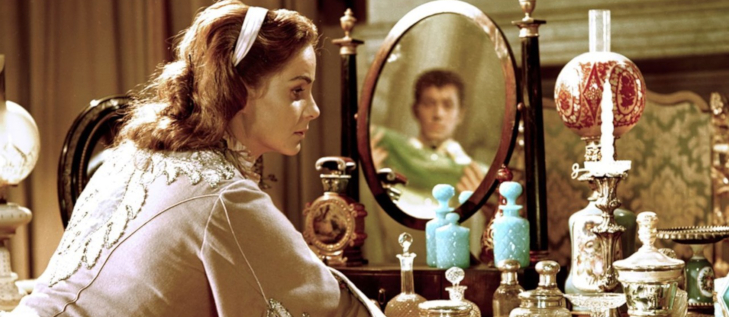


In the early 1960s the Italian company Titanus produced Luchino Visconti’s The Leopard, a massive epic aimed to crack the American market in a big way. Even though it starred Burt Lancaster, the huge production saw little U.S. distribution. Ten years previous, the film company Lux backed Visconti in a similar go-for-broke gambit. The extremely expensive historical epic Senso also hoped that a big American release would come to the rescue. Visconti engaged two actors with notable Hollywood profiles, Farley Granger and Alida Valli. Granger was a former Goldwyn contractee, while Valli was known mainly as the star of a hit thriller, The Third Man. But neither was a big marquee name.
By 1954 Italy already considered Luchino Visconti a top talent, a genius who directed operas and had pioneered Italian neorealism. But few of his pictures enjoyed American distribution, even ten years later. His wartime Ossessione, a bootleg version of a James M. Cain book, was legally roadblocked. Although distributed by 20th Fox The Leopard remained all but buried for decades, made available only in wretched dubbed and cut prints. Visconti’s Bellissima and Sandra (La vaghe stella dell’Orsa) have to my knowledge never been restored for a mainstream U.S. disc release. A few years back Arrow gave us an excellent rendering of Le streghe, an omnibus film with an episode by Visconi. For the longest time, the one Visconti movie that seemed to play regularly in revival theaters was Rocco and his Brothers.

The Epic not suitable for American theaters.
American distributors must have thought Senso a bad commercial prospect unsuited to American tastes: too restrained and too involved with Italian historical issues. One would have expected major art-house bookings, but the (sometimes accurate) IMDB says that its American premiere was at the 1957 San Francisco Film Festival. Its official U.S.theatrical release is listed as 1968. Could Visconti’s personal politics have made him a hard sell in the States? Despite being a titled member of the Italian aristocracy, his political affiliation was communist. He was known as ‘The Red Count.’
None of this will matter to viewers of Senso. Visconti altered Camilo Boito’s source story to play against major events of il Risorgimento, the Italian unification and independence movement of the 1860s. Visconti employs the melodramatic aspects of opera as part of his overall style. He begins his film at an elaborate operatic performance, where pro-independence Venetians pamphlet an audience of Austrian officers. The patriots rain nationalist flags down on the audience. The revolutionary Marchese Roberto Ussoni (Massimo Girotti) publicly challenges a proud occupying officer, Lieutenant Franz Mahler (Farley Granger). Ussoni’s cousin the Contessa Livia Serpieri (Alida Valli) fears for Roberto’s life. To protect him, she seeks out Mahler and strikes up a friendship with him. Their meeting unexpectedly turns into an extra-marital affair.
In the midst of politics and war, these lovers are driven by pure lust. Livia stays with Franz until the battlefront reaches the Venice-Verona area, whereupon she returns to the country estate of her husband the Count Serpieri (Heinz Moog). Franz risks his life to join her there. He tells her that he doesn’t want to fight and needs money to bribe a doctor to certify him as unfit for duty. Those admissions fail to cool Livia’s desire. Making her betrayals complete, she gives Franz a fortune that she’s holding for the Italian partisans.

Epic proportions in the service of peripheral context.
Senso is a refined epic ‘in depth.’ The personal stories of the main characters never overpower the historical context. The sets, locations and costumes are consistently stunning, and at all times historically accurate. Visconti even had his designers ignore Technicolor’s ban on pure white, to keep Austrian dress uniforms authentic. Visconti’s impressive opera sequence fills an auditorium’s galleries with finely dressed patrons; he shows Livia and Franz strolling the back streets and canals of Venice at night and in the early hours of the morning.
We witness several large-scale battle scenes, plus a great deal of chaotic action behind the lines as Livia’s coach cuts through the fighting on her way to rejoin Franz in Austria-held Venice. Crowds and mounted troops aren’t used to impress us with the producer’s resources, they’re just there. Without resorting to giant crane shots, Visconti gives the impression that life is going on outside the frame in all directions. The images remind us of classical paintings; we are immersed in a bygone world with its own rules. When Livia roams the sprawling country villa, each room has fresh flowers.
When Luchino Visconti is in this no-limits epic mode, there’s nobody like him. Later filmmakers Francis Coppola, Michael Cimino and Sergio Leone emulated Visconti’s style, but there’s nothing like seeing Senso or Visconti’s even more sprawling The Leopard. These epics weren’t made on anybody’s idea of a budget.

Not exactly an American ideal of a glorious romantic couple.
Farley Granger and Alida Valli were not heavy hitters at the U.S. box office. Audiences hadn’t warmed to Valli’s icy demeanor in Hitchcock’s The Paradine Case, and her particular romantic intensity has little connection with the 1954 definition of sex appeal. Senso is not a romance of noble self-sacrifice. Shielded by her social position, the Countess radiates pride even when walking through trash-strewn streets. That hauteur becomes fascinating when passion transforms her into a reckless lover willing to risk anything. At the mercy of her obsession for the Austrian Franz, Livia betrays her husband, her cousin and her country.
Farley Granger’s American fans would barely recognize him in Senso. He had made his name in movies playing confused young men in need of love and understanding. When playing a morally tainted social climber in Hitchcock’s Strangers on a Train, Granger still came across as a relative innocent. Granger Franz Mahler is showcase officer with a sharp profile and an eye for the ladies — and also a complete louse. He’s the first to talk about honor, yet he joined the army only to partake of the pleasures and privileges afforded a fancy uniform. The last thing he wants is an assignment to a real battle front. To avoid a duel of honor he has Roberto arrested.
Livia is vulnerable to exactly the fantasy that Franz supplies in spades. We see through his fakery long before she does … even Franz’s bunkmates disapprove of his sordid affair. What titled Contessa stoops to seeking out a soldier in his barracks? Livia can misbehave in most any way she desires, and not even her husband will call her on it. Roberto and his associate Luca (Sergio Fantoni) trust her implicitly, but she has no close friends or confidantes. Livia’s servant does her best to protect her mistress, but even she isn’t above stealing spilled gold pieces when Livia goes off the deep end.

Senso doesn’t fit into the commercially accepted romance template for American audiences, mainly because our showcase romantic couple are not at all admirable. Hollywood sentimentality is nowhere to be seen. Livia doesn’t pick up a handful of Verona dirt and make grandstanding speeches about Tomorrow being Another Day, as the orchestra cues the main theme. Instead of gestures of repentance and atonement for crimes of the heart, our lovers act true to their character, eventually throwing their own self-interest aside as well.
Visconti gives the story operatic dimensions — the couple is bigger than life, and capable of calamitous betrayals. Livia begins as a patriot, but once consumed by her amore folle becomes a selfish menace. Franz sees nothing wrong with taking Livia’s money on false pretenses. She may be easily seduced, but she carries a frightening potential for vindictiveness. The payoff is madness and death in no uncertain terms. It’s a director’s triumph and the kind of movie that lasts in the memory, even if we can see why it wouldn’t galvanize a mainstream American audience.
The director did compromise with his producers on one point. He initially wanted to end Senso before its memorable last scene. He was persuaded to add it only after main photography had wrapped; because Farley Granger had already returned to America, his part was played by a double.
Senso wasn’t considered a success, especially not for Ms. Valli. She disappeared from screens for three years, but returned in films by Michelanelo Antonioni, René Clémént and Georges Franju. Farley Granger’s career soon shifted to TV work. Luchino Visconti remained busy in opera but didn’t direct another feature for three years as well. When prepared for export Senso was cut and revoiced, with Tennessee Williams contributing to the English dub dialogue. But in the United States the movie remained almost unknown.


Farley is great in ‘They Call Me Trinity’. Seriously!
Two years after Senso, Farley Granger gave a superb performance in The Girl In The Red Velvet Swing.