
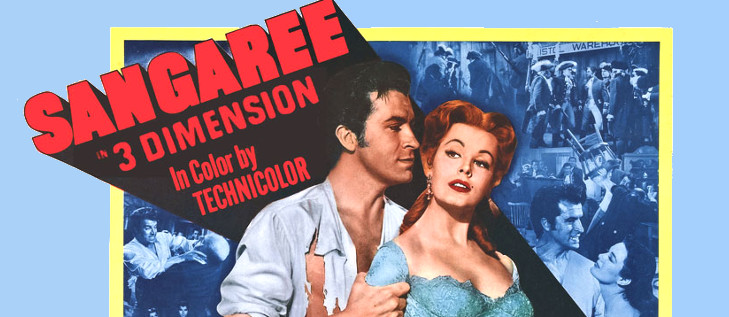


Producers William H. Pine and William C. Thomas turned out profitable Paramount product for fifteen years, although few of their shows were accorded artistic accolades. They mostly stuck to action and costume programmers that could make good use of studio resources — keeping the plant busy, especially in the postwar years when things were slowing down. As observed at Greenbriar Picture Shows, after trying their hand at a single artsy ‘socially conscious’ picture, they did a quick retreat to the matinee status quo.

The Pine-Thomas Sangaree is from a book by best-selling author Frank G. Slaughter, who later penned the source novel for the far different bed-hopping soaper Doctor’s Wives (1971). It’s basically a hot-blood bodice ripper among post-colonial Georgians that wear frilly shirts and 3-pointed hats. Argentinian star Fernando Lamas, who makes his entrance bare-chested, the better to attract the dames. The dame in question is Arlene Dahl, she of the gloriously flaming red hair; her considerable acting range gave her the edge on Rhonda Fleming, who managed a much more active career. Dahl, Lamas and their co-star Tom Drake were first promoted by MGM; Lamas sang and danced in a musical or two. Fernando would eventually marry two of his more notable co-stars, Ms. Dahl and also swimming beauty Esther Williams. Genre fans now revere Arlene’s excellent showing in the much-loved Journey to the Center of the Earth; the inferior follow-up sci-fi adventure The Lost World had a decent part for Fernando.

Sangaree is noted for being one of the initial productions of the 1950s 3-D craze. The January 28, 1953 edition of Variety crowed that “Hollywood is in the midst of its maddest race since the invention of sound, for that new boxoffice dimension — 3-D.” Immediately after a demo of the process, Paramount’s Adolph Zukor ordered Pine-Thomas to jettison ten day’s worth of film and to restart Sangaree in 3-D. The rear-projection specialist Farciot Edouart trotted out a 3-D rig that had been in the camera department since 1937, and ‘Paravision’ was born. According to the 3-D Film Archive, Sangaree was only the 8th studio feature out the gate, early enough to clean up handsomely before the craze began to falter. Although Zukor initially predicted an industry-wide conversion to depth, Pine-Thomas made just two more 3-D pix, Those Redheads from Seattle (already released on 3-D by Kino) and 1954’s Jivaro, which reunites Fernando Lamas, writer David Duncan and director Edward Ludwig, but with the ‘other’ redhead, Rhonda Fleming.
Edward Ludwig and writer David Duncan are billed together on 1957’s The Black Scorpion; Duncan would distinguish himself among fantasy fans with scripts for The Monster that Challenged the World, The Leech Woman and The Time Machine.

Sangaree lands us in Georgia, immediately after Washington’s victory at Yorktown. Since the historical context is covered in just a couple of dialogue lines, it’s likely that some viewers thought the story took place in a country called Sangaree. It’s a tale of political ambition, crooked smuggling and class discrimination in the newly-liberated colony, that still has Tory sympathizers. The dying General Darby turns over management of his plantation Sangaree not to his son Roy (Tom Drake, Meet Me in St. Louis) or his daughter Nancy (Arlene Dahl), but to his former indentured servant Dr. Carlos Morales (Fernando Lamas). Roy happily welcomes Morales, but Nancy instead chooses to put up a legal fight, led by her fiancé Harvey Bristol (John Sutton). Harvey looks down on Carlos’ humble origin and desires the Darby empire for himself. Harvey’s Tory-loving, somewhat suspicious father Dr. Bristol (Francis L. Sullivan, Night and the City) is also a doctor. He seeks to discredit Carlos for believing that The Plague isn’t caused by swamp vapors, but might have something to do with rats. The old doctor doesn’t want the new local government, which Carlos has joined, to snoop around the Bristol warehouses.
Handsome Dr. Morales has a significant impact on the local ladies. To get a true picture of Carlos, the impetuous Nancy disguises herself as a low-born bondswoman. Her ‘Dolly Lake’ practically ends up in a necking party with Morales, on a slow boat to Savannah. At a big welcome party we discover that Roy’s unhappy wife Martha (Patricia Medina, Mr. Arkadin) still has the hots for Carlos. He must fend off both her off and the cold-shoulder insults of the Bristols, father and son. Nancy also reveals her true identity to profess her hatred of Carlos (an opinion he’ll soon correct). Added to that conflict is the threat of The Plague, the unmasking of some villains, and Nancy’s association with the suspected pirate and smuggler Felix Pagnol (Charles Korvin, Berlin Express), a slick foreigner who doesn’t reveal his true motives.

A Spanish origin explains Carlos Morales’ accent, but the (historically accurate) lack of Yankee jingoism in far-flung Georgia means that viewers will have to pay close attention to the story. Although Georgia held out for a pro-slavery clause in the Declaration of Independence, the black issue isn’t present in this story. Slaves are spoken about but mostly unseen. Old General Darby has plans for free clinics and schools for the slaves, which is supposed to set the race issue aside. Just a year later, Civil Rights themes would be everywhere in Hollywood movies, if only in a token sense.
Some shooting, knife throwing and a couple of ‘lusty’ fistfights for frisky Fernando give us various items hurled at the camera, the best being a large rum keg. But is it safe to assume, with filming switched to 3-D at the last minute, that the production wasn’t fully designed for depth? A dock set is re-used for more than one location, with buildings looking rather small and tucked into sound-stage corners. Director Ludwig and prime cameraman Lionel Lindon block scenes well for 3-D, arraying people especially nicely for interior scenes. Some exteriors were filmed but special effects seem utilized for wide shots of plantations and country roads. Farciot Edouart’s rear-projection is used quite a bit, especially to place sailing ships behind miniature trees.

Sangaree’s strongest material are some of the scenes between Lamas and Dahl, who would marry the next year. Wearing exclusively too-tight pants and giving Dahl lusty looks and wicked smiles, Lamas personifies a proven Latin testosterone appeal. What is this bullfighter effect that conquers fabled femmes like Ava Gardner? The big tease scene on the boat develops into a kissing and almost-petting encounter — in a close-up of Dahl’s bare shoulder (think peasant blouse) Lamas’ hand all but wanders into Code-forbidden territory. Dahl soon turns around and visibly bites his lip — and it looks like she draws blood. This nonsense isn’t censorable, but it was fairly hot in the constricted culture of 1953, when one couldn’t say words like ‘virgin’ in a movie. Arlene Dahl’s artful imitation of lust is finely tuned — how could the noble Nancy even fake these ‘common’ tease maneuvers, if she didn’t have the spirit?

Considering the attraction between the actors, I can see them conspiring with the director to give Sangaree some potential heat … which the film can surely use. Lamas does a lot of grabby gripping and restraining, in keeping with the trashy best seller theme of lusty damsels that want to be mussed up. Lamas really does seem to be competing for the ‘¿Quien es más macho?’ prize.

Most of the playing is middle-of-the-road, with Tom Drake likable and Willard Parker (The Earth Dies Screaming) also okay as another Carlos pal. Left rather high and dry is a good performance from Patricia Medina, working in a too-constricted part. Each of Agatha’s four or five brief scenes show her in radically different moods, with no opportunity to evolve. She’s a potential adulterer, a one-woman rumor mill and then finally a delirious Plague victim, but the other characters mostly ignore her.
Just a guess — this particular historical setting and the presence of scores of veteran actors in walk-on parts make one wonder if Sangaree was one of the seemingly countless projects bought for Cecil B. DeMille, and then pared down in scope before being handed off to lesser Paramount producers. True, the book had been out less than a year…

