

Yes, this is indeed the original, iconic ‘bad’ movie of Golden Turkey honors. Back in the ’40s and ’50s micro-budgeted films couldn’t afford the Hollywood production values taken by many as necessary for validation. But some filmmakers saw an opportunity in the court-mandated production-exhibition breakup, like the upstarts Roger Corman, Herman Cohen, and even Stanley Kubrick. Distributors like Lippert and A.I.P. would roll the dice on a feature with no stars and low-end production values, if it had an exploitable angle for the advertising. Profitable careers were founded on such humble beginnings as Monster from the Ocean Floor, Target: Earth! and Fear and Desire.
Hollywood shops must have been buzzing with wannabe De Milles aiming to squeeze a few thousand dollars into marquee glory. Editor Phil Tucker pushed forward two 1953 features that showed he had something on the ball, at least in terms of getting a project going. Dance Hall Racket was written by none other than Lenny Bruce, but remained a complete obscurity. The second show could boast a great pitch: a Sci-Fi feature in 3-D. He must have jumped on a telephone directly after a screening of Arch Oboler’s 3-D Bwana Devil, as his hastily thrown-together feature almost beat the 3-D It Came from Outer Space into theaters. Did Phil and his writer Wyott Ordung see a script for William Cameron Menzies’ upcoming Invaders from Mars? Tucker’s picture has a similar angle about a little boy who ‘dreams’ an alien invasion.
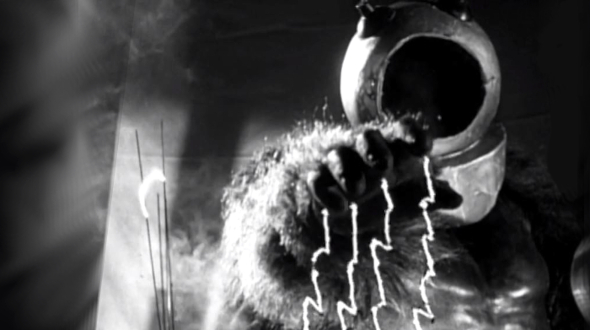
Robot Monster is even less substantial than the cinéma maudit of Ed Wood: it’s filmed completely outdoors, in Bronson Canyon and (we think) Chavez Ravine, the real estate that became the home of Dodger Stadium. Producer Al Zimbalist (Cat-Women of the Moon, King Dinosaur, Monster from Green Hell) had developed a 3-D camera rig for his ‘Tru-Stereo Corporation’ just when Hollywood was scrambling for such exotic equipment. Perhaps Robot Monster was squeezed in between other rentals?
Tucker and Zimbalist lined up actors who wouldn’t flub their dialogue, including the blacklisted Selena Royle, a top supporting actress seen in shows as prestigious as The Heiress. Hopeful Claudia Barrett had a lot of TV experience. Rugged-looking George Nader would later win a major contract with Universal-International. The film’s moppets were also good with dialogue — it’s likely that Robot Monster had few ‘take 2’ slates, considering that it cost so little, with twice as much film as normal running through the 3-D dual camera rig.
Let’s put on a show!
The idea must have been to put anything on the screen, as long as it resembled a real movie. The project could have been thrown together over a weekend, leaving no time to even think about constructing a robot. Thus was created the ‘alien robot’ creature that is nothing more than a gorilla costume with a prop diving helmet augmented with a pair of Philco TV rabbit ears. In at least one interview Tucker said the robot suit he wanted to rent was too expensive, and he was already buddies with gorilla performer George Barrows.

Wyott Ordung’s screenplay is 80% actors standing still and talking about a cataclysmic invasion from outer space — none of which is depicted on screen. A close reading of the details of the invasion . . . goes nowhere. If you’ve never seen Robot Monster be assured that little of what’s said makes any functional sense in the plot — ‘armadas of invading space ships’ — ‘the entire planet devastated by ‘Calcinator Rays’ (did I even remember that correctly?).’ Scientist-paterfamilias ‘the professor’ (Ukranian-born actor John Mylong, the evil plastic surgeon in His Kind of Woman) can’t decide if the last 8 people left on Earth have survived because of his electronic interference barrier (wires with electric arcs) or his anti-Calcinator vaccine. If these details matter, I don’t know how.
As filmed, Robot Monster is a tiny backyard fun-play scenario. It’s apparently meant to be a dream, or daydream, of little Johnny (Gregory Moffett). The kid snoops in the rough landscape behind his house (Bronson Caverns) and discovers a one-man invasion by Ro-Man XJ-2 (George Barrows), whose alien technology consists of two tables. One holds a bubble machine and the second a crude view-screen through which he communicates with his fearless leader, the Great Guidance (also George Barrows). Ro-Man has exterminated all of humanity, but ‘calculates’ that a few Hu-mans are immune to his weapons. He eventually realizes that he must kill them himself, ‘physically.’ His hit list even includes Johnny’s little sister Carla (Pamela Paulson).
The professor’s scientist daughter Alice (Claudia Barrett) and young scientist Roy (George Nader) get cozy between soldering circuits, and an improptu marriage is performed. Ro-man is love-struck by the charms of Alice . . . who he endearingly calls ‘Al-ice.’ Instead of murdering her like the others, he ties her up next to the bubble machine, and phones home to tell his boss. Reacting to Ro-man’s traitorous mutiny, the Great Guidance unleashes the Ro-man equivalent of The Nuclear Option, his ‘Cosmic Tube Rays.’

What we get in Robot Monster is just over an hour of plain-wrap filming, in broad daylight, with very good 3-D. As much of the movie is filmed from a middle distance, with little in the foreground, the 3-D displacement isn’t always strong, but it is indeed there. Ro-man hikes up and down paths in Bronson Canyon, walking past all three cavern entrances: his headquarters is in cave entrance Number ‘5’ in this 2018 photo. The camera setups stick to one angle for each location, at the cave entrance, and at the Professor’s backyard patio. That’s how someone shoots an entire 3-D movie in just four days.
Robot Monster’s complicated 3-D optical work can’t have been included in the film’s reported sixteen thousand dollar budget, and Astor Pictures reported a final figure closer to $60,000. The presence of ‘alien disruptor rays’ (?) is created by quick flashes to negative, accompanied by a good electric-sizzle sound effect. The view-screen composites have a good 3-D depth, even if they look utterly artless. Those 3-D effects were all created in post-production, likely by Jack Rabin and his visual effect associates. We don’t know who was in control for post-production: Tucker, Zimbalist or distributor Astor Pictures.
Ersatz 3-D optical sequences illustrate some of the Great Guidance’s re-caps of the alien invasion. A major stock footage raid was carried out, lifting special effects from movies by Robert Lippert and others — atom war scenes from Invasion, U.S.A. and Captive Women, rockets from Rocketship X-M and It Came from Outer Space. Invader dialogue voiceovers about resurrecting prehistoric animals to ravage mankind is what ‘motivates’ absurd shots of dinosaurs from One Million B.C. and Lost Continent. Some of these flat stock shots of destruction and disaster are sandwiched into a view-screen frame, and others are (confusingly) superimposed over each other. Bob Furmanek explains how a couple were done in one of the disc’s extras — different images were aligned for the left and right 3-D eyes.
Sound effects, bolts of lightning, and flashes to negative do the rest. A rather good original soundtrack by just-starting-out composer Elmer Bernstein helps a lot as well. The main theme has a strong pounding beat — heard above an impressive array of comic books in deep 3-D.

That’s Entertainment!
Tucker’s show can be a fall-down funny experience. It’s best received in a room with a minimum 5 college friends, beer optional. In larger-scale screenings it brings the house down. The mind-boggling assault really kicks in when one tries to make sense of the stilted dialogue. At first we wonder if the non-sequitur logic of the awkward alien-speak is aiming for a specific effect — the word ‘calculate’ is used very oddly. The kid dialogue is just as phony as that for the adults. Johnny tries to sound real broken up when he learns that Sis has been attacked by Ro-man:
“Gee — I wish now I’d played house with her when she wanted to.”
It’s as if every script line has been put through a ‘moronic pulp dialogue’ filter, and augmented with indigestible verbal zingers. Since Ro-man and the Great Guidance have no faces to match synchronization, we at first suspect that everything they say was written in post. Both gesticulate with their gorilla arms and hands, emphasizing their words like bad Shakespearian actors. There is nothing quite like the deathlessly iconic ‘I cannot, but I must’ dialogue:
“I cannot – yet I must. How do you calculate that? At what point on the graph do must and cannot meet?”
Ro-man’s growled threats somehow don’t frighten:
“The child is impertinent.” “It was a simple matter of strangulation.” “Show yourselves, and I promise you a painless death.” “Your deaths will be indescribable.”
Ro-man’s ro-mantic antics lead only to frustration. He attempts to disrobe Alice, but modesty prevails. He also mismanages his attempts at bondage thrills. The invasion story is revealed as a dream so clumsily that viewers might not understand. Although destroyed, Ro-man makes an encore at the curtain, walking toward the camera with arms outstretched — a motion repeated three times, just for effect. Did the filmmakers hope that someone at MoMa would read Eisensteinian significance into that editorial flourish?
Of course the movie gets laughs now, but we can’t help but wonder how audiences received it in 1953. Did they roll with the joke, or did exhibitors receive complaints and walkouts? What would a date say, being taken to Robot Monster, when Shane was playing down the street? A critic for Harrison’s Reports warned,
“The exhibitor may be able to use this 3-D science fiction picture on the lower half of a double bill, but he should not expect his patrons to like it, for it is the poorest 3-D picture that has been made so far . . . . A few more like this one and the desire of picture-goers to see 3-D pictures will be dead.”
Now that’s an endorsement.
Here’s Joe Dante on Robot Monster:


