

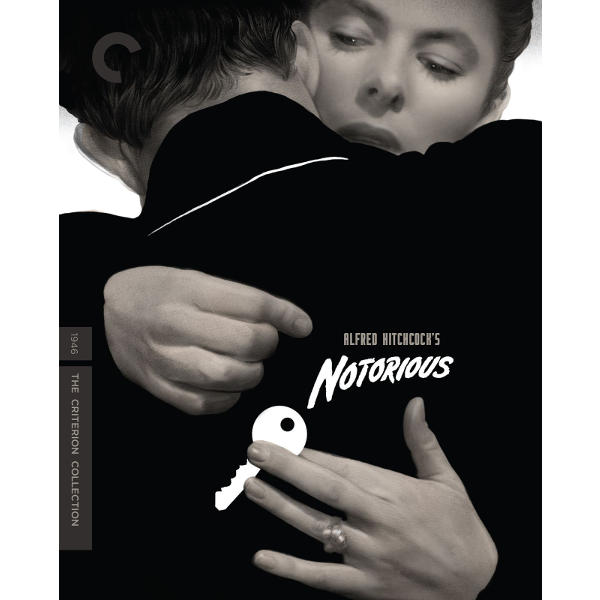

Along with the best of Hollywood, RKO had a banner year in 1946, profiting from several films produced in conjunction with David O. Selznick, a super-agent who profited six ways to sundown by providing his personally contracted talent. Probably the best of the Selznick-owned Hitchcocks and still the most dramatically satisfying product of that producer-director arrangement, the fascinating Notorious is a superior romance and a model of suspense construction. It follows up Hitchcock’s noir classic Shadow of a Doubt with another fundamentally sick premise, one that meshes well with the hazy post-war moral climate. It also offers proof that Hitchcock was aware of the Manhattan atom project before Hiroshima!

The story begins with a headline court case. U.S. spymaster Capt. Paul Prescott (Louis Calhern) needs to ferret an agent into the midst of some surviving Nazi conspirators operating out of Rio de Janeiro. The solution is to recruit Alicia Huberman (Ingrid Bergman), the daughter of a convicted traitor. Emotionally disturbed by the revelation of her father’s crimes, Alicia volunteers mainly because of her attraction to agent T.R. Devlin (Cary Grant). Their romance is cut short when Devlin discovers Alicia’s role will be to play Mata Hari with the enemy. In Rio, Alicia renews her acquaintance with the shady industrialist Alexander Sebastian (Claude Rains), and in no time weds him. After more or less seducing Alicia into the role of sex-spy, Devlin communicates his amorous distress via perverse insults and bitter resentment. Professionally, Devlin and Huberman zero in on Sebastian’s secret, which has something to do with uranium ore hidden in champagne bottles. But Sebastian is beginning to suspect that something is amiss with his new bride, confirming the suspicions of his calculating mother (Madame Konstantin). Besides adding to Alicia’s misery, Devlin’s abusive, unprofessional behavior is beginning to put her at risk.
Almost perfectly constructed by writer Ben Hecht, Notorious combines pitch- perfect Hitchcock direction with excellent casting. Hitchcock’s visual command is always in the service of the story, raising the suspense sequences to impressive heights. Even the editing is of the not-one-frame-more, not-one-frame-less variety. The movie is a model of understatement and intelligence, which must be why it got away with its rather racy theme of a woman sleeping with the enemy.

The characterizations and casting are fascinating from several points of view. Ingrid Bergman’s Alicia actually does what her character Ilsa Lund tried to do in Casablanca, feign love and sleep with a man for a higher principle. In the queasy postwar years the morality of victors and defeated alike could sometimes seem to be in question, and Alicia Huberman’s past promiscuity and personal shame are terrible burdens to bear. Agent Devlin’s unpleasant situation, watching as his woman romances another man, adds another level of doubt and tension. Seeing Cary Grant carry out such a coldblooded affair is faintly disturbing — these are complicated characters, and so are our reactions to them. Even the villain Claude Rains adds to the growing interpersonal tension. As the romantic fall guy, he’s more than sympathetic, and viewers probably identify more closely with his predicament than with Bergman and Grant’s.
Finally, in light of the public castigation soon to be given Ingrid Bergman in retribution for choices in her personal life, Notorious seems almost prophetic. Agent Devlin’s condemnation of Alicia parallels the hypocritical media lynch mob that excoriated Bergman for running off with an Italian film director. Of all the vintage scandals that hit Hollywood this may have been the most unjust. The situation is comparable to The Scarlet Letter.

Writer Julie Kirgo in Film Noir: An Encyclopedic Reference to the American Style (still a key book on the subject) brought out the truly perverse angle in Notorious, where a man encourages his lover to sleep with another man for patriotic reasons, only to despise her supposed low morals when she does. The resulting love triangle acknowledges a weird undertow in the common concept of romance. People raised in a repressive society can be completely hypocritical when judging those that violate conventions. The burden on women to be simultaneously saints and sluts creates a tangle of crossed messages and emotional barriers.
The movie has a real edge. Grant’s T.R. Devlin comes off as nearly psychotic: we can imagine a modern version where Alicia succeeds in her mission, only to be murdered in a fit of male rage. Audiences responded to the credibility of Devlin’s cruelty, and the romantic reversal of the conclusion. But cut to five years later… we can see the married T.R. irrationally convinced that Alicia is cheating on him, like one of Luis Buñuel’s mentally twisted husbands. The image of secret governmental spy agencies is not reassuring either. Louis Calhern’s (C.I.A.?) boss Paul Prescott feigns concern now and then, but several scenes imply that he knows he’s callously using Alicia Huberman, and doesn’t care: her status as the daughter of a traitor makes her completely expendable. Calhern’s Prescott is this film’s queasily unforgiving authority figure, like the frequent judges and district attorneys in Hitchcock pictures that take a cavalier attitude toward sentencing men to death.

Hitchcock’s MacGuffin in this thriller is uranium ore, which Hitchcock claimed he was aware had something to do with a super-bomb secretly being made in New Mexico — in 1944! Although the idea was just a hook for his story, Hitchcock liked to hint that during production he had been investigated by the FBI. The same year’s Gilda also took as its plot motivator the notion that Nazi-sympathizing industrialists were engaged in a South American conspiracy to corner the world’s supply of Tungsten. The idea of counterpointing twisted political intrigues against twisted sex relationships worked well in that film, too. Until Hollywood dropped the Nazi threat in favor of a Communist threat in postwar thrillers, producers turned out several grim international intrigue pictures hinting that Nazis had not been fully defeated, such as RKO’s Cornered. Cloak and Dagger and The Whip Hand were re-edited to remove material suggesting that Nazi conspiracies persisted beyond the victory.
A decade later, when postwar jitters had condensed into a continuous Cold War, Hitchcock and writer Ernest Lehman revisited the central idea of this film. Their North by Northwest often plays as a Notorious-lite thriller, emphasizing humor and absurd situations. Cary Grant redeems his ungallant behavior with Ingrid by being decent with Eva Marie Saint. His Roger Thornhill is not such a priggish jerk about the idea that a love interest might be independent, might sleep with another man. NxNW shifts the burden of hypocrisy to the C.I.A.: audiences cheer a pointed line, when Thornhill tells his a spymaster that if America can’t fight communism without sending their women off to sleep with the enemy, “…perhaps you ought to start learning how to lose a few cold wars.” Good show.
