


How did two self-described ‘New York Jews’ come to make the best ’60s drama about the black experience in Alabama? A few minutes listening to Michael Roemer explains everything. The man’s demeanor is instantly likeable; wary young talents Ivan Dixon and Abbey Lincoln surely saw him as a man they could trust. Roemer was a European childhood holocaust survivor, a German rescued by the famed Kindertransports. Armed with a screenplay that Dixon said ‘could have been my own story,’ the filmmaker had the elements in place to make a movie of great significance. But was America ready for such a story?
Roemer and his partner Robert M. Young were established documentary filmmakers, having worked on several NBC White Paper projects. Back in the 1960s, TV networks earned their right to profit from the public airwaves by producing quality public information programming. Several talented feature filmmakers came from the ranks of TV documentaries.
The initial plan was to film in the South. Roemer and Young had researched the realities of black American life in Alabama, but everybody advised them not to even think of filming there. Tensions were at a boiling point in the Deep South; no longer could a rogue independent film company surreptitiously shoot in a small Southern community. Nothing But a Man was filmed in New Jersey. The locations and cast were so carefully chosen, nobody could tell.

A story that wasn’t considered ‘movie material.’
Most racially-themed films from the Civil Rights era focus on a violent conflict or employ a gimmick to include white characters for audience identification. Carl Lerner’s hard-hitting Black Like Me tells a true story yet still feels like a sideways interpretation of African-American problems through white experience. The makers of Nothing But a Man keep things simple. We see how difficult it is for many black Americans to establish a stable family, something most whites take for granted.
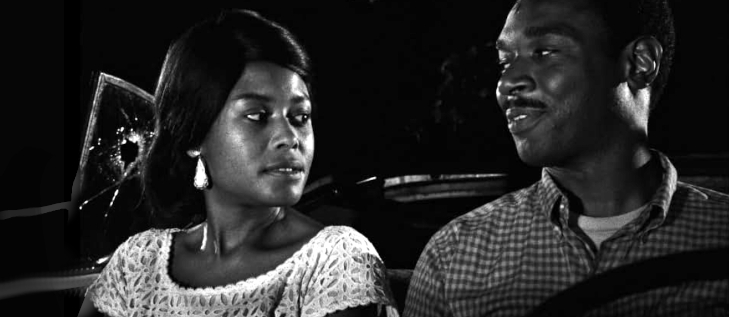
Union railroad laborer Duff Anderson (Ivan Dixon) repairs tracks with his work crew, living in railroad cars and always on the move. It’s a rootless life. When they stop in a town, his friends drink and look for prostitutes. But Duff wants something better. At a church meeting he encounters Josie (jazz vocalist Abbey Lincoln), a schoolteacher and the Reverend’s daughter. Wholesome but spirited, Josie knows her own mind and is not afraid to accompany Duff to a saloon. Duff likes her from the start. With an aim to straighten out the loose ends in his life, he goes in search of a son he’s been supporting, that an old girlfriend claimed he sired. Duff also looks up his estranged father Will (Julius Harris), a one-armed alcoholic who mistreats his common-law wife, Lee (Gloria Foster).
Josie’s father reacts as she thinks he might, rejecting Duff as a marriage candidate. Duff won’t surrender his pride, as has his father and some of the men he works with. Josie thinks her old man mainly wants to protect his standing with the local white establishment — which even for him requires a compromise with ‘benign’ racism.
They take a chance on each other. Duff soon encounters problems in his new job at a sawmill. He remarks on his new workmates’ passivity to everyday racism, and someone talks to management. He quits rather than apologize, and is blackballed as a troublemaker. Duff can’t even work at a gas station — the local white supremacists won’t tolerate his quiet insistence on one-to-one fairness. Duff defines his self-worth by his ability to provide for his family, and Josie already has a baby on the way. Feeling the rage building inside, he knows he’s becoming unfit to live with.

Except for Josie, Duff Anderson has little support in his life. His family background is a shambles. His neighbor is so ashamed to face his wife that he just sits on his front porch and does nothing. The factory work situation in infuriating. White coworkers and supervisors want the blacks to like them, but as inferiors. Things go bad the moment Duff refuses to play the N_____ for them.
Duff only wants to be his own man, but most of the black men he meets are crippled in spirit. Some cope with powerlessness by abusing loved ones. Old Will Anderson tries to save face by humiliating his ‘woman,’ the joyless Lee. She spends her days ignoring his insults. Duff’s good pals on the railroad gang are impressed by his new wife. They have more job security than Duff, but little ability to establish lasting homes for themselves. They give Duff a hard time, but haven’t the strength to take similar chances with their own lives.
Filmed in a realistic style on real locations, Nothing But a Man is not a theater showcase with big emotions and grand speeches, like the well-known A Raisin in the Sun. Everything is underplayed. Josie is an impressive, intelligent individualist. Michael Roemer says that Abbey Lincoln filled out the bare-bones character with her own interpretation. Too smart to rebel against her restrictive father, Josie holds her ground and waits for her opportunities. Accepting Duff is no desperation move. Josie can’t be sure of what she’s getting into, but bravely takes her chances, trusting her own judgment.

Julius Harris’s Will Anderson is a convincingly bitter and abusive wreck of a man. ↖ We eventually see him in the later stages of breakdown. This was Harris’ first film role, and the filmmakers had to talk him into taking it. It’s hard to believe that the man was then only in his ‘forties. Nine years later he’d impress as a bruising, grinning menace in a comic James Bond thriller. Gloria Foster began acting on Broadway and had gained attention in Shirley Clarke’s experimental film The Cool World. ↗ With her hard stare and sullen intensity, Foster’s Lee is the film’s most original character. Her interactions are not happy, but she and Duff understand each other without having to exchange a word.
This is also a film debut for Yaphet Kotto, who in a few scenes sketches a mini-portrait of Jocko, a rail worker. A darker version of Duff, Jocko channels his low self-esteem into a slightly belligerent attitude. But he comes to respect what Duff is trying to do.
Top-billed Ivan Dixon enjoyed a busy career as both an actor and a director. We grew up knowing Dixon from his several years on the Hogan’s Heroes TV show, an assignment that couldn’t be more different than this movie. Dixon says that the character of Duff could have been written about him, personally. Duff can’t resolve his fundamental conflict with society. He won’t surrender his dignity, but too many interactions with whites demand exactly that of him.

Again, how did two white Northerners write a screenplay that so many good black actors felt was an authentic view of American black reality? Michael Roemer more or less says that he didn’t realize how unqualified he was to make Nothing But a Man, until he directed Abbey Lincoln. The intelligent activist told him that racial understanding wasn’t a matter of sincerity. But Ms. Lincoln liked Roemer’s candor. He stated that he was making the movie for himself, not as some kind of ‘gift’ to the actors.
The creative fusion between Michael Roemer and Robert Young sounds ideal. Young was the dedicated documentarian, who talked his college pal into working with him on the White Paper shows. But Roemer was more interested in real-life drama, with a commitment to humanitarian values. He felt a kinship to the black experience because of simliarities to his own background in Nazi Germany, when his family was stripped of their rights and prevented from making a living. The movie is grounded in human decency, among a class of people denied the benefits of what mainstream America lauds as a universal birthright.

Robert Young is said to have been the more politically motivated filmmaker, and the film promotes unionization as a partial fix for social inequality. Even though the roaming nature of railway repair work prevents Duff’s pals from putting down roots, they enjoy a baseline of decent treatment. The sawmill employees are simply oppressed. Anybody who speaks up about anything will lose their job.
Young’s captures everything with the realism of a docu camera, in locations that feel authentic. The visuals prioritize honesty over artistic effects, and Michael Roemer’s uncommonly sensitive direction liberates the performers. Each vignette offers a new insight. Will Anderson ends up a miserable old wreck, clutching at Lee like a helpless baby. Lee never has anything to smile about, yet her love for that man gives him dignity he never found for himself.
Nowwhere does the film pander to the audience. Roemer doesn’t mine big emotions to make his points. Duff stays true to his values — he doesn’t want to become like his father, blaming those around him for his own lack of courage. The film respects these people, as opposed to feeling sorry for them. Mr. Roemer says he regrets putting in what he calls ‘manipulative’ moments. We don’t see them. The rays of hope at the finish simply underline that Duff and Josie haven’t lost their inner strength, and aren’t going to give up.

Roemer and Young had already learned that Filmmaker Control was essential. They had been proud of a White Paper program about poor conditions in Sicily, that NBC refused to air because it was ‘too disturbing.’ Nothing But a Man garnered critical praise and two awards at the Venice International Film Festival, but its theatrical release didn’t take off. We’ve long noted its inclusion in Andrew Sarris’s ‘auteur approved’ film list, where it just made the cut for 1964. ↙ But it’s there … we can now highlight it in our ancient, crumbling copy of Sarris’s The American Film.

Roemer’s output has been sparse; his hilarious, offbeat comedy The Plot Against Harry waited 20 years for a release. Robert Young was much more prolific, making many documentaries plus two-score dramatic features that include the notable Short Eyes, The Ballad of Gregorio Cortez and the excellent ¡Alambrista!, one of the first and best movies about undocumented workers.
Nothing But a Man was resurrected in the early ’90s, celebrated as a milestone in American independent filmmaking, and given a re-issue that actually made money. Robert M. Young passed away just a few weeks ago; Michael Roemer still looks hale and hearty in his recent disc interview, at age 95.

Outstanding review, thank you.