

By the end of the 1950s, fantastic monster movies had been thoroughly publicized as one more crazy aspect of the Teenage Wave that had taken over America, along with Rock ‘n’ Roll, hot rods and juvenile delinquency. Kids had money to spend and movies were their most accessible weekend entertainment. The popular ‘drive-in’ movie craze of those years was a clear case of ambitious independent filmmakers filling a need that the established studios were slow to recognize. But they did catch up.
By 1959 the winning marketing formula initiated by Roger Corman and American-International was coming to an end. Screens were flooded with cheap exploitation double bills, and their popularity was starting to become more of a rural phenom — mainstream Hollywood was making similar films, often with name stars. One of them, Fox’s The Fly, was a major hit.
One reason Roger Corman made so many ’50s pictures so quickly, is that he could sense that the gold rush wouldn’t last forever. He personally directed as many as 7 pictures a year, while producing several others, with or without his name on them. He made his pictures for more than one studio, partnered with other independents, and started his own distribution company, The Filmgroup. He also teamed with his brother Gene Corman for several pictures, playing executive producer but taking a hands-on role where he could.
Corman increased production efficiency by shooting films in pairs, keeping on crew and cast members as needed. Shot back to back in the Los Angeles area, Night of the Blood Beast and Attack of the Giant Leeches were sold to A.I.P.. The initial runs were brief, but they stayed on the lower half of double bills for years before establishing themselves as permanent residents on late-nite TV syndication. Each barely an hour in duration, the films were stretched to fill 90-minute time slots. They were often carved into 6-minute pieces sandwiched between car dealership ads.
You’d tune into one of these things at midnight, but if you were sleepy the commercials made it impossible to follow the story. At some point you’d start to snooze and then be jolted awake by a commercial, always broadcast at a higher volume: “GO SEE CAL GO SEE CAL GO SEE CAL!” We never found out how some of these pictures ended. Were they any good?
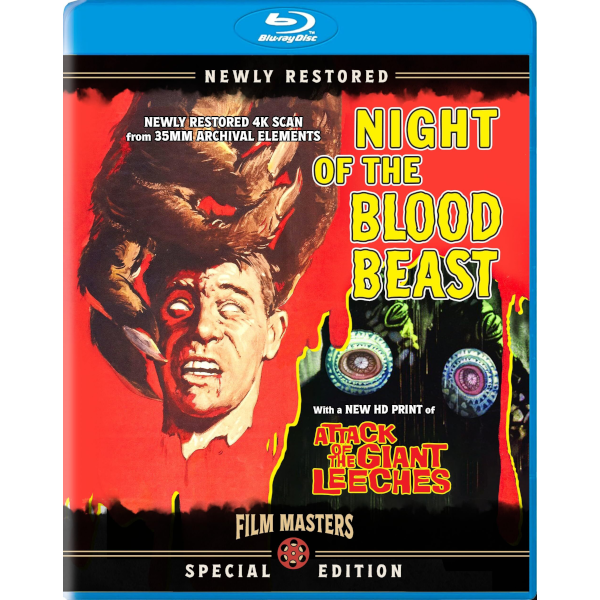
Collectors love to see these pictures restored on disc, sourced from theatrical film elements instead of the murky 16mm prints that found their way onto graymarket tapes and discs. Film Masters has been giving us snappy double-bill remasters and reconstructions of this gray-area genre of movie exploitation, sometimes from found original printing masters, and sometimes from what they call ‘the best available elements.’ The evaluation section below tries to sort out what we’re seeing in this Gene & Roger Corman monster duo.

Night of the Blood Beast
1958 / 1:85 widescreen + 1:37 Academy / 61 min.
Starring: Michael Emmet, Angela Greene, John Baer, Ed Nelson, Tyler McVey, Georgianna Carter, Ross Sturlin.
Cinematography: John M. Nickolaus Jr.
Art Director: Daniel Haller
Film Editor: Jodie Copelan
Original Music: Alexander Laszlo
Screenplay by Martin Varno
Executive Producer: Roger Corman
Produced by Gene Corman
Directed by Bernard L. Kowalski
This ambitious attraction was sold as a horror film, with the image of a giant hairy claw-hand hefting a decaptitated human head. The movie’s synopsis promises a Sci-fi monster mash, featuring an experimental manned space launch, the recovery of a crashed spaceship, a high-tech space science lab, a revived astronaut and a space monster that incubates its offspring inside the astronaut’s body, as do some insects.

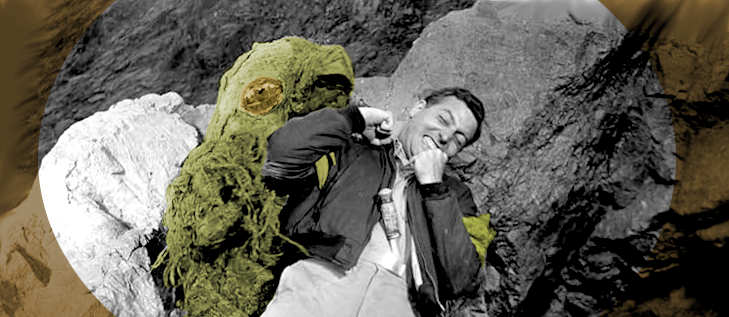
Night of the Blood Beast instead delivers a micro-budgeted thriller with enthused performances but little production value. Unexplained phenomena isolate the space science lab, supposedly in Florida but in a hilly, dry area — Griffith Park and a TV station building immediately above the Hollywood Sign. Corman’s faithful designer Daniel Haller fabricated a section of wrecked space capsule small enough to carry in a pickup truck. The shapeless alien monster was recycled from another Corman film then still playing in theaters.

The story does have one very squeamish Sci-fi idea that had not yet been exploited on film. But the presentation collapses in ‘microscope’ views visualized with pitiful fake animation. ← Astronaut John Corcoran (Michael Emmett) comes back from space with what look like cartoon seahorses crammed into his insides, via yet more fall-down funny cel animation. But he isn’t singing this. (Sorry, it’s the influence of commentator Tom Weaver.)
A crash-landed astronaut infected by an alien lifeform? It doesn’t take long for fans to realize that Blood Beast is constructed from off-the-shelf borrowings from earlier movies — not a capital crime in the realm of exploitation but not exactly ‘original screenplay’ material either. Naming the movies isn’t necessary — half of Blood Beast is a dinner theater replay of the Sci-fi classic in which a man is found slaughtered and hung up by his feet, soldiers use fire to fight a monster close-quarters, and a pleading scientist pushes a pacifist line of thought: “It’s a stranger in a strange world, the first of its kind to come here — we must let it communicate with us.’ Blood Beast opts to condemn the alien as Bad News, but not before several dialogues on the issue, including a one-on-one with the alien itself.
Alien monsters that ‘dialogue’ instead of act menacing can become something of a bore, even when the words are written by Ray Bradbury. The lost teleplay of the original The Quatermass Experiment reportedly ended with the infected, transformed astronaut talking to Quatermass and then voluntarily committing suicide. Blood Beast’s writer Martin Varno may have come up with his near-identical climax completely by accident.
Michael Emmet is just okay as Col. Corcoran. He, the capable Ed Nelson, John Baer and Tyler McVey know how to vamp their way through rushed takes with minimal direction, and still give the impression of dramatic engagement. Angela Greene (The Cosmic Man) needed more direction, as her character alternates between stoicism and fretting at inappropriate times. The ‘extra’ female presence Georgianna Carter is okay when given something to do, but spends too many scenes standing around like extra set dressing, wearing a neutral facial expression.

TV director Bernard L. Kowalski and cameraman John M. Nickolaus Jr. find some decent camera angles, and the shadowy lighting is a big asset as well. The exteriors make decent use of Griffith Park, while the climax plays out at the ubiquitous Bronson Caverns. Movie fans in Iowa, Alabama, London and Rome surely felt familiar with that over-used location. The ledge from which the gun-toting scientists watch Corcoran and the alien is the same place where Touch Connors knifed Adele Jergens in Day the World Ended; the steep incline they try to descend without falling down is the same path taken by Natalie Wood’s stunt double at the climax of The Searchers.
The Corman brothers must have been impressed with Nickolaus’s speed — there is a LOT of coverage of the final scene, with lens changes and some good angles apparently filmed from atop a truck. The show barely makes the grade as matinee fodder, something suitable for monster addicts only. The trade papers found it an exploitable novelty, one that gave reviewers the opportunity to joke about ‘a pregnant man.’

Attack of the Giant Leeches
1959 / 1:85 widescreen / The Giant Leeches / 62 min.
Starring: Ken Clark, Yvette Vickers, Jan Shepard, Michael Emmet, Tyler McVey, Bruno VeSota, Gene Roth, Daniel White, George Cisar, Ross Sturlin.
Cinematography: John M. Nickolaus Jr.
Art Director: Daniel Haller
Production Secretary: Kinta Zertuche
Film Editor: Carlo Lodato
Original Music: Alexander Laszlo
Screenplay by Leo Gordon
Executive Producer: Roger Corman
Produced by Gene Corman
Directed by Bernard L. Kowalski
Filmed second and reportedly held up several months before A.I.P. found a slot for it on the release schedule, Attack of the Giant Leeches is an efficient but threadbare production that must pad its footage to fill out a 62-minute time slot. Bernard Kowalski and cinematographer John M. Nickolaus Jr. are back, along with Tyler McVey and Michael Emmet. What qualifies Leeches as a bona fide cult item is the presence of starlet Yvette Vickers, who had just heated up movie screens as Honey Parker in the fan favorite Attack of the 50 Foot Woman.
Yvette Vickers is here half the show, working up a hotsy act worthy of Erskine Caldwell’s God’s Little Acre. Vickers’ Liz has three scenes tormenting her unhappy Okeefenokee hubby Dave Walker (Bruno VeSota), an emasculated loser who runs a little swamp trading post. Dave’s friends all know that Liz is making time with local loafer Cal Moulton (Michael Emmet, again). Meanwhile, a second story thread concerns Steve Benton (Ken Clark), the Dudley Do-Right of wildlife wardens. When unsubstantiated reports of monster attacks come in, the ecology-conscious Steve refuses to use dynamite in the waterways. His girlfriend Nan Greyson (Jan Shepard) and her scientist father Doc (Tyler McVey, again) complain, but Steve sticks to his conservationist ideals. Good goin’, Steve-O.

The lustful Liz and the pitiful Dave make their exit a little after the halfway mark, leaving the balance of the film to chart a dull monster hunt in the swamp. The monster leeches look better than the Glad Bag trash bags derided in countless reviews, but not that much better. We shake our heads when we think of the elaborate, expressive Slime Man monster suits fabricated for a later Z-Picture, a genuine backyard production.
A great deal of the show is filmed quite effectively in the Los Angeles County Arboretum & Botanic Garden, in Arcadia. The location was almost as busy as Bronson Caverns around this time. The actors’ willingness to jump into the cold water proves how badly Hollywood aspirants wanted to be in the movies. The glamor factor decreases when one is asked to perform in dank pools of slime, and the direction is to ‘look alluring, Yvette.’
Giant Leeches’ enduring reputation rests on the fun-sleazy aura of Yvette Vickers — when she and Cal make out in the swamp, the embrace is horizontal. Even in juvie delinquent epics, lovers usually smooched sitting upright in their hot rods. In reality, the teens at drive-ins showing fare like Blood Beast would likely repair to the back seat, where no annoying gear shift would get in the way. *

Vickers’ sensual spell gets a workout in Giant Leeches’ mildly transgressive Leech Grotto scene. Five or six unlucky Leech victims are strewn about in the underwater cave, covered with sucker welts and blood smears — they’re limp and torpid, barely alive. They weakly groan and writhe in slo-motion, as the big galumphing leeches keep coming back for snacks.
The grotto is surprisingly effective, with camerawork that shows some style. Slurping, bubbling sound effects and insistent music combine to cap off the film’s one nightmarish thrill: the grotto resembles a bad-trip Opium Den, the aftermath of a backwoods orgy, or a small-scale Dante’s Inferno. By mainstream standards, the whole setup is also in rotten taste. But as yet there is no Leech Defense League to stand up for defamed freshwater parasites.

Despite decent performances most of the dialogue scenes are a bore after VeSota and Vickers make their exit. Handsome Ken Clark would soon go to Italy and spend a decade in various genre pix, including one of Mario Bava’s dreadful westerns. His nature warden is decent enough, but Gene Roth’s sheriff gets the task of dispensing dull exposition. Attack of the Giant Leeches hangs together, and never lapses into outright incompetence. But it lacks Roger’s dramatic sense or Charles B. Griffith’s sense of ironic humor.
Bernard Kowalski’s camera direction uses the same gag with almost every scene: shots begin on some object or detail, and tilt up or pan over to frame the scene. Either that, or the scene will finish by finding some object for the camera to settle on before the cut. If the shooting was so rushed that cameraman Nickolaus was left on his own to improvise, it’s possible he added these ‘scene buttons’ to his coverage on the fly. The trick makes the film seem even more predictable, even as it keeps the camera active.
Fans seeking more opportunities to glom the spirited Yvette Vickers shouldn’t forget her one appearance in a major, high-class studio film: she has an excellent supporting part in the Paul Newman semi-classic Hud, as the motel tramp ‘Lily Peters.’ Nobody could have played it better.


I spoke with Jonathan Haze and other Corman associates, and he said fondly that Corman may never have paid well, but unlike many other low budget producers, he paid exactly what he promised. Jack Nicholson said many years after his Corman career that if Corman would meet his price, he would work for him tomorrow. He was someone they could trust.