

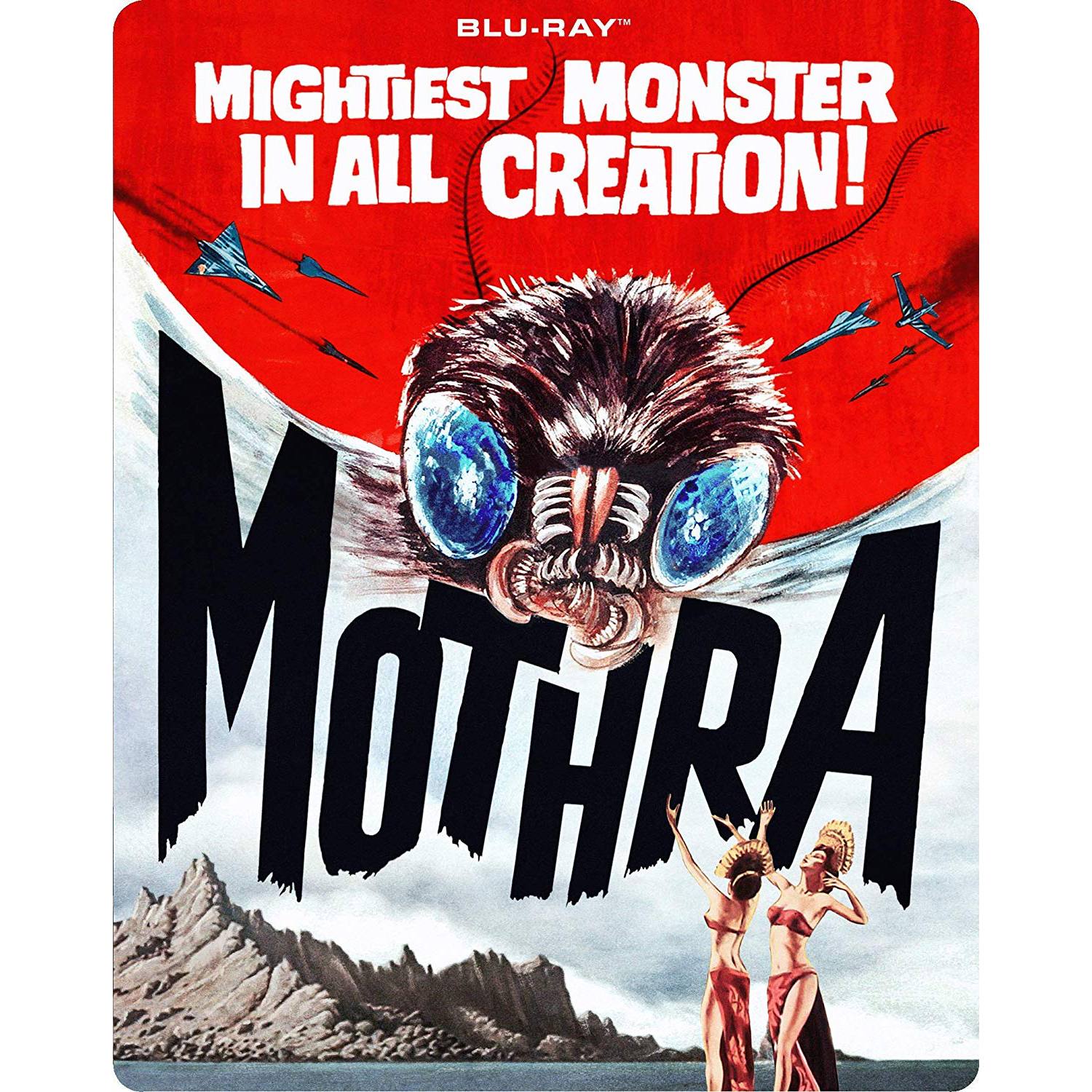
The early 1960s were boom years for Japanese filmmaking — the relatively small country was producing more movies than Hollywood. At the same time that Toho was trying out more overt horror in pictures like the disturbing Matango, they also experimented with a giant monster fantasy suitable for impressionable children. Mothra (Mosura) is a colorful storybook tale with a Kaiju context and some interesting political comment. The shortened American version omits some of the flavor of this saga about the giant insect god of a mysterious lost civilization. In keeping with Sci-Fi’s newfound ecological theme — perhaps taken directly from the previous year’s Gorgo — Mothra is the first Kaiju in which the monster is the hero, and the villain is modern society itself. Mothra blows cities to rubble with the force of its giant wings, yet retains the full sympathy of the audience.

The tale begins in a fashion similar to the original Godzilla. A scientific team is dispatched to investigate a mysterious radioactive isle. Thought to be uninhabited, Infant Island supports a population of sad, reclusive natives. Dr. Sinichi Chujo (Hiroshi Koizumi) meets the tribe’s tiny ‘Shobijin’ fairies, (popular singing stars Yumi & Emi Ito, aka ‘The Peanuts’). The tiny twins communicate telepathically. Stowaway reporter Senichiro ‘Sen-chan’ Fukuda (Frankie Sakai) befriends the Shobijin, but the greedy gangster-entrepreneur Clark Nelson (Jerry Ito) secretly returns to the island, murders a number of natives and kidnaps the fairies to sing in his stage show back in Tokyo. Official efforts fail to force Nelson to relinquish the tiny girls, as do the reporters’ attempts to liberate them. The Shobijin tell Senichiro that they are sad, not for themselves, but for innocent Japanese citizens: Mothra will come to their rescue and obliterate Tokyo. And indeed, as the Infant Island natives dance, a giant egg hatches an equally monstrous caterpillar, which immediately sets sail for the Japanese capital.

Mothra is a charming monster tale with excellent effects and terrific set pieces. The giant larva plows through the ocean waves and leaves a wake of destruction across enormous miniature sets. Kids react positively to the psychic connection between the fairies and the monster, and the metamorphosis from caterpillar to colorful moth is an affirmation of nature’s triumph over man’s petty politics. The title bug has an impressive screen presence despite the fact that it is little more than a giant fuzzy marionette. The blast of wind from its mighty wings hits like an atomic-era Big Bad Wolf.
The giant larva climbs Tokyo Tower to spin its cocoon. When the fairies are taken to a foreign country called Rolisica, the newly hatched giant moth files halfway around the world to rescue them. In the context of the movie, the nation Rolisica is an amalgam of Russia and the United States. The arrogant Rolisican Clark Nelson is the trouble behind everything — he assumes control of the expedition to Infant Island, which his country once used as an atomic blast site. Rolisica denies that the island is inhabited despite hard evidence to the contrary, a kind of pre-echo of the documentary Radio Bikini. The villainous Clark Nelson is a combo of Carl Denham and Al Capone, committing theft and mass murder against a native population. Clark wiggles out of charges of kidnapping and slavery by claiming that the Shobijin are merely merchandise: they like to sing and dance, so he’s making them happy! The Rolisican government is complicit with Nelson’s efforts to loot the world, at least until Mothra arrives to wipe out its capital, ‘New Kirk City.’ The Russian aspect of Rolisica can be seen in the combination of symbols on the flag of the Rolisican Embassy and the Russian-looking uniforms of the Rolisican generals helping to fight Mothra.

Every Anglo performer that could be rounded up is used to play Rolisican citizens, including familiar Toho faces Robert Dunham and Harold Conway. New Kirk City has Manhattan skyscrapers, the Golden Gate Bridge and Los Angeles’ Harbor Freeway. We also see a short clip of the row of hotels on the bluffs over Santa Monica Beach. Nelson’s gangster thugs occasionally speak in English. He and his main crook pals laugh themselves silly:
“Mothra is dead! Now we can be filthy rich and happy! Ha ha ha ha!”
Clark Nelson’s last ten lines are all the same: “Shut up!” I hadn’t noticed before, but the rotten gangster’s final act is to knock the cane out from under an old man! I think there were some happy subversives at Toho that year.

Co-star Kyoko Kagawa plays the hero’s female photographer sidekick, a fairly thankless role. Ms. Kagawa did this film between stunning appearances in two Kurosawa classics, The Bad Sleep Well and High and Low. The nickname of the lovable Frankie Sakai in the original is ‘Snapping Turtle,’ changed to ‘Bulldog’ for the dubbed American version. Sen-chan never lets go, see? In keeping with the overall nonviolent tone, Sen-Chan is a master of the obscure martial art of slapping bad guys on the head with folded pieces of paper.
Of course, violence in films is relative. Mothra sinks several ships and lays waste to two of the world’s major cities, but those are unseen fantasy deaths, that take place on miniature sets with Toho’s amazing toys. Besides, kids respond quickly to the lesson that it’s not nice to fool with Mother Nature. The storyline is equally respectful of the Infant Islanders’ religion. Mothra worships a symbol that looks like a Christian Cross with ‘extra’ illumination detail. In New Kirk City, church bells are sounded at Mothra’s approach.

Within the special stylization of Kaiju pictures, Mothra maintains a colorful charm. Nothing looks ‘real,’ although the effects are often impressive just for being so elaborate. Those giant miniature sets must have filled an entire sound stage. An over-use of blue-screen opticals result in some rather ragged composites, but many shots skillfully combine foreground full-scale action and background miniatures. The larva’s onslaught across the countryside is beautifully visualized, sometimes with the monster visible only in the background of very wide compositions. A not particularly successful wide shot of the egg on Infant Island places the natives’ dance arena as a small round area at the bottom of the frame. Being about 70% matte painting, this composition always reminds me of shots of the Base Camp in Close Encounters of the Third Kind.
Some of the matte paintings are a little rough, and in a few wide shots of the island, a camera problem gives the artwork an annoying pulsing effect. For additional military montages and bits of panic, Toho raids isolated stock shots from The Mysterians and even The H-Man. Mothra herself is a pleasing design, just ‘buggy’ enough to resemble a real insect but as charming as a child’s fuzzy toy.
We kids learned early on that all Toho Kaiju had distinctive ‘voice signatures,’ often heard over the main titles… well, that’s at least true for Godzilla and Rodan. We immediately knew when the American editors that adapted Gigantis The Fire Monster swapped out Godzilla and Anguirus’s signature roars. Mothra’s eerie vocal cry is the creation of some brilliant sound designer. It now happily resides on my iPhone, as a timer alarm.


