

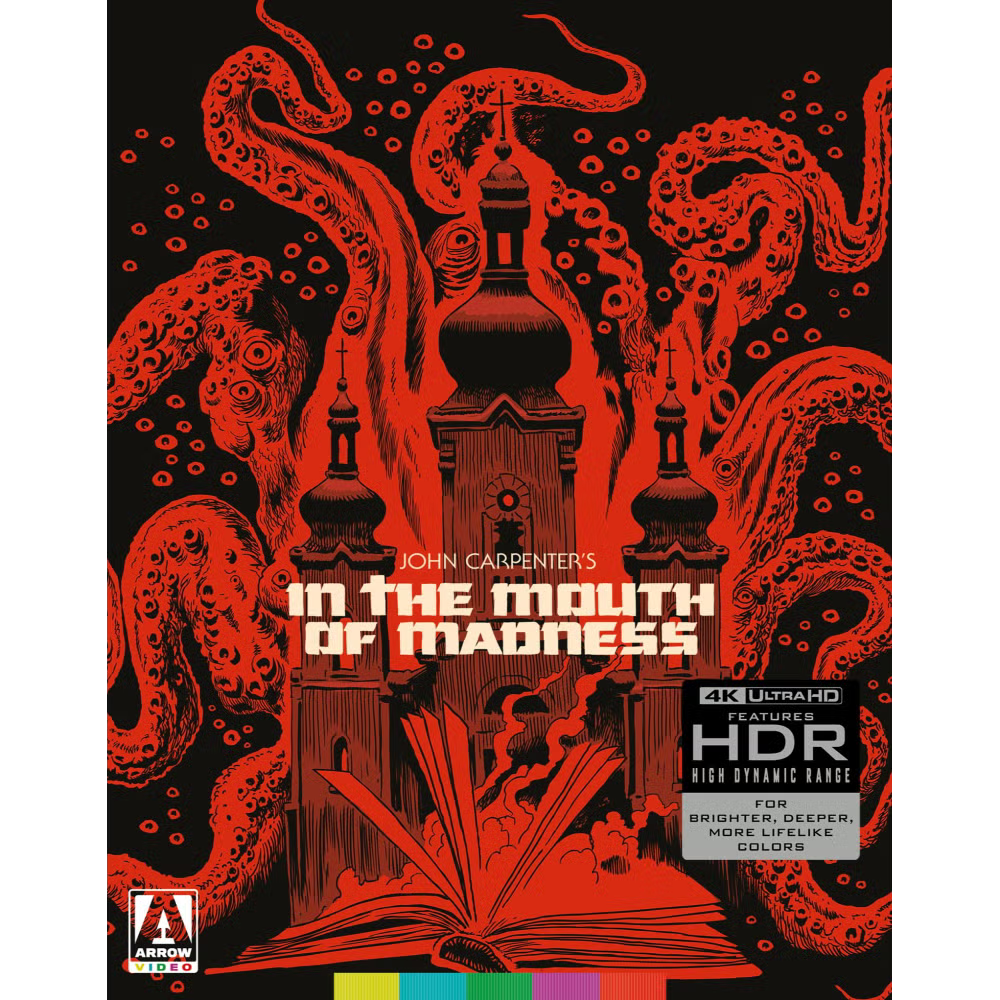

Unsolicited opinion: too many modern filmmakers think that a good horror movie must push knee-jerk nihilism to sadistic extremes. In the Mouth of Madness is a sincere stab at expressing the H.P. Lovecraft world view. The horrible world is spiraling toward an inhuman apocalypse, but even the madmen have a sense of humor.
The show bears the visual style of John Carpenter, whose pragmatic approach to storytelling appeals even when he has a dynamite first act and only vague ideas of where to go from there. We note that the show’s title carries a full possessive for its director: John Carpenter’s In the Mouth of Madness. Had the movie been a monster hit, New Line executive Michael De Luca might have stepped forward to take credit: not only was it filmed from his screenplay, De Luca surely secured the film’s top-rank production assets that enabled Carpenter to create so many finely-crafted fantasy images. This show is all of a piece, as opposed to Carpenter films that lose their way in the storytelling: Prince of Darkness, They Live.

If audiences rejected In the Mouth of Madness, it can’t be because they found it dull. They may have not liked a premise that builds a vision, instead of delivering shocks on a reliable time schedule. Some horror films think it clever to play games with cultural references, in-jokes and subtext that isn’t subtext. This show’s ‘demonic author’ is clearly a conflation of Stephen King and H.P. Lovecraft. One of the first recognition gags is a song by The Carpenters. Sam Neill shakes his head and mutters something to the effect of “Not the Carpenters!”, which we accept as an on-the-surface reference to the director. We like it — it suggests that Carpenter does have a sense of humor.
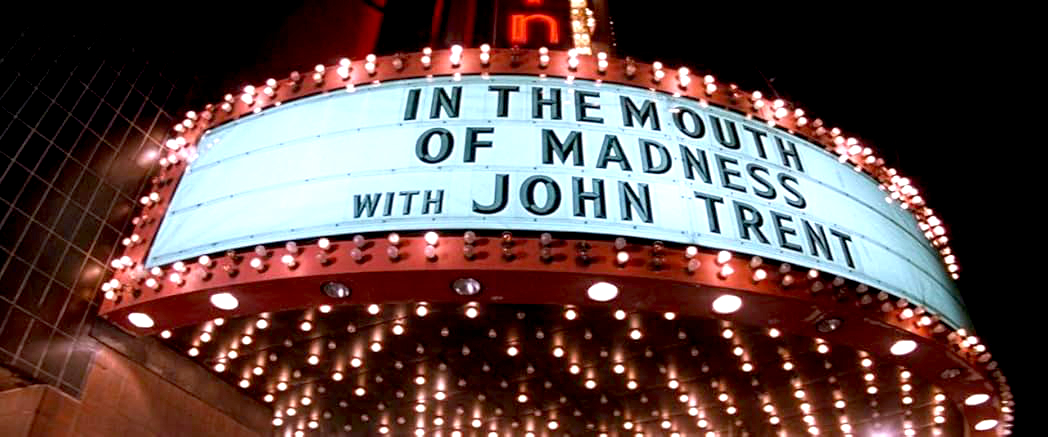
The story is an extended nightmare flashback that eventually blows itself apart with a narrative blunderbuss: ‘you didn’t think reality is real, did you?’ Instead of a reporter or cop, the protagonist is John Trent (Sam Neill), a self-confident insurance investigator committed to the principle of provable facts, i.e., he’s somebody with a stake in a stable reality. We first see Trent being hauled into an asylum corridor lined with padded cells. He’s totally freaked out, yet tells the investigating Dr. Wrenn (David Warner) that he’s happy to be there, because civilization is about to shatter into murderous chaos.
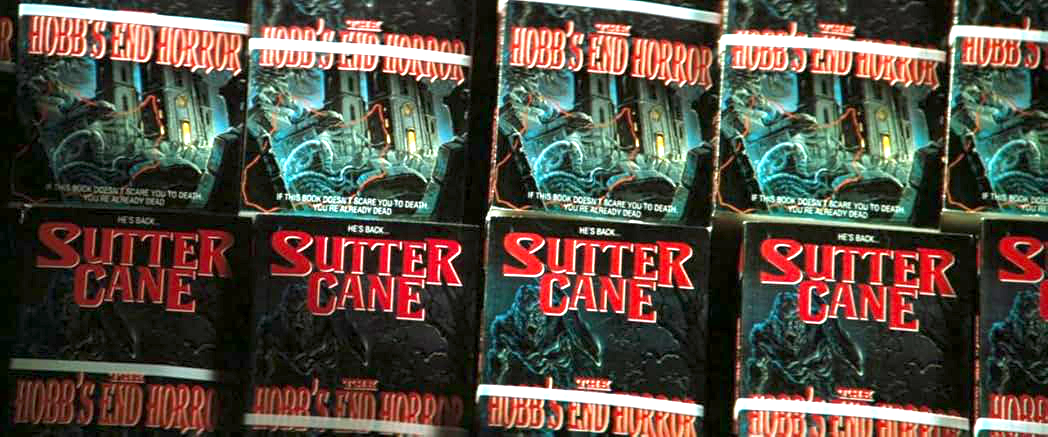
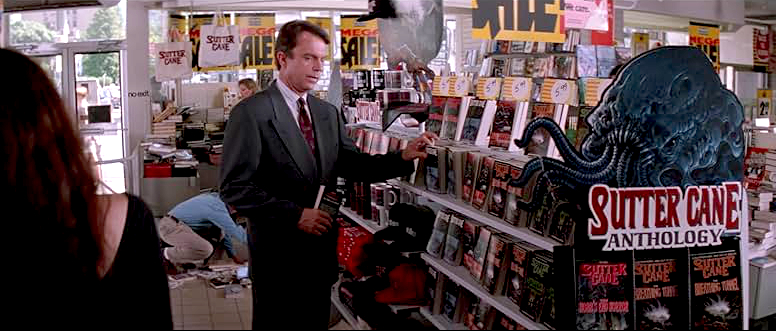
Why is Trent in a strait-jacket? In the flashback, he goes to see publisher Jackson Harglow (Charlton Heston, spot-on with his supporting part) over an insurance issue related to the mystery disappearance of Sutter Cane, an incredibly successful horror author. Cane has disappeared without turning in his newest book, to be titled In the Mouth of Madness. His fanatical international readership is reacting to the book delay with incidents of irrational violence. Trent ‘decodes’ clues from Sutter Cane’s latest paperbacks to pinpoint a place in New England that might be Cane’s fictional town of Hobb’s End. No such town is on the map, but Trent and Harglow’s top book editor Linda Styles (Julie Carmen) elect to go to where Hobb’s End ought to be, to see if Sutter Cane is hiding out there.
They head North by car. After what seems a day — and a number of unexplainable incidents — they arrive at a town that appears deserted. Linda recognizes it as Hobb’s End, from descriptions in the Cane books. She intuits how to get to Pickman’s Inn, and after they check in, she shows John that the view from their room does indeed look upon a ‘haunted cathedral’ just a short drive away…
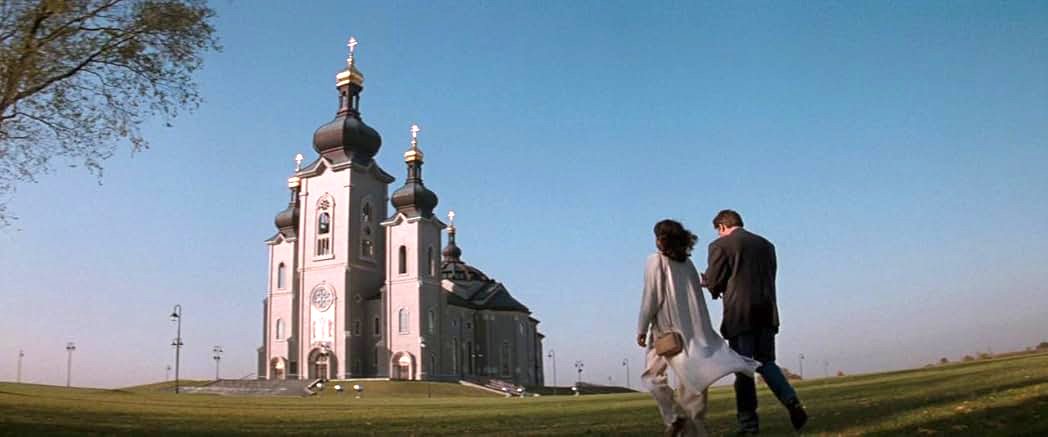
The apparent ‘reality’ John Trent thinks he’s experiencing is broken up by frantic, violent hallucinations; things happen on the dark road at night, including an insanely irrational transition from night to day, possibly inspired by Ealing’s classic Dead of Night. We already know things are ‘off’: it takes a full day and night to drive to this place in New Hampshire, even though the Canadian border is fewer than 400 miles from New York City.
Sam Neill plays more of a wiseass than his usual movie self, but he wears the cocksure attitude well. Julie Carmen has less success with her character. It’s a really thankless role, because it’s purposely inconsistent. After a while, Linda has stopped telling Trent to be careful, and is herself marveling at what happens, as if reality is a book she’s reading, with a surprise at every turn of the page.
It’s not as complicated as it sounds. After some of the Stephen King parallels are out of the way, In the Mouth of Madness settles into direct representations of H.P. Lovecraft’s horrible ‘Elder Gods’ itching to break out into reality. The nasty Lovecraft vermin are pretty impatient, too. A giant oaken door flexes as they push from the other side, a visual much like the unforgettable scare from way back in Robert Wise’s The Haunting.

We get some excellent set-pieces. Carpenter stages an unnerving assault by an axe murderer, with his targets (Trent and insurance man Bernie Casey) sitting quietly in the foreground, unaware of the man charging toward them. ↑ We note that a bus billboard advertising a Sutter Cane book passes through the extended shot: Cane is an unavoidable presence, with posters everywhere. The culture is supersaturated with the influence of Sutter Cane. It’s seen as a kind of social sickness, because ‘it is rumored’ that Cane’s writing affects his readers.
‘Carpenterologists’ intuit that the ads serve the same function as the ‘secret signage’ in Carpenter’s They Live: we are all suggestible to messages in the environment. Has the axe murderer been warped by Cane’s malevolent philosophy, a dog-whistle ‘spell’ hidden in the text of the books?
John and Linda’s journey into the country, especially the night driving, reminds us more than a little of Candace Hilligoss’s nighttime trek across Utah in the still-creepy Carnival of Souls. Carpenter tries to pare things down to a minimum, isolating the driver in the dark. His nightmare is constructed around innocuous things … what is an elderly bicyclist doing on such a lonely road in the middle of the night?
The travelers are soon being clobbered by increasingly unexplainable phenomena. Trent refuses to consider supernatural explanations. He’s convinced that Styles and Harglow have cooked up an ‘author disappearance’ as a gag to sell more books. Sam Neill’s performance fits in well with the absurd situation … the only reason he could keep on scoffing at the ever-more convincing horrors, is because he’s also being affected by Sutter Cane’s malevolent influence.
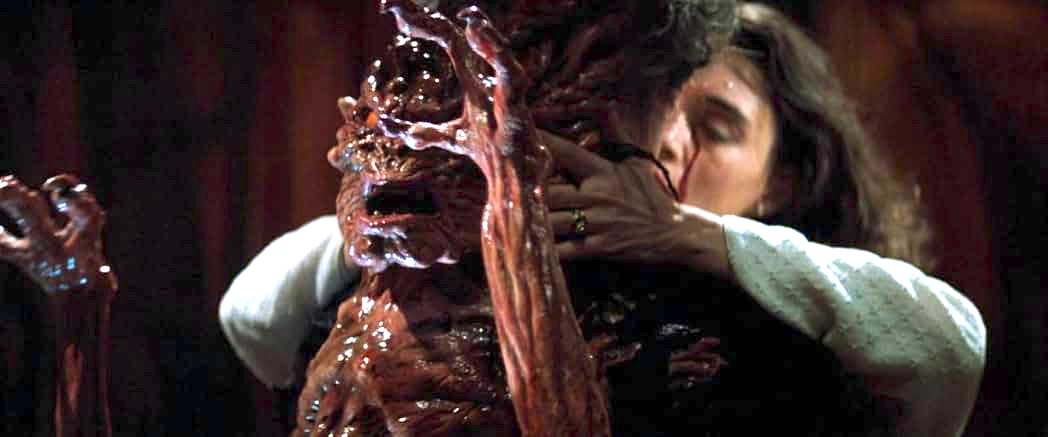
We won’t describe the best and the worst scenes, because we appreciated discovering them cold, on our own. There are many bizarre images and fleeting glimpses of Lovecraftian monsters and demonic distortions; Hobb’s End is basically Arkham from the Charles Beaumont / Roger Corman adaptation The Haunted Palace. Carpenter opts for too many ‘jump scares’ that simply push something on screen with a loud noise. But the sense of the uncanny is consistent. We do feel that John Trent is wading into psychological quicksand.
As for reality bending to accommodate Cane’s book, we almost expect Robin the Boy Wonder to walk on screen and shout “Holy Pirandello, Batman!” That’s as close as we’ll get to a major spoiler. The wholly pessimistic conclusion ends up treating the ‘end of the world’ as a philosophical joke, something to be laughed at. Carpenter or De Luca even have a character say that nothing matters because everything we know is falling apart anyway.
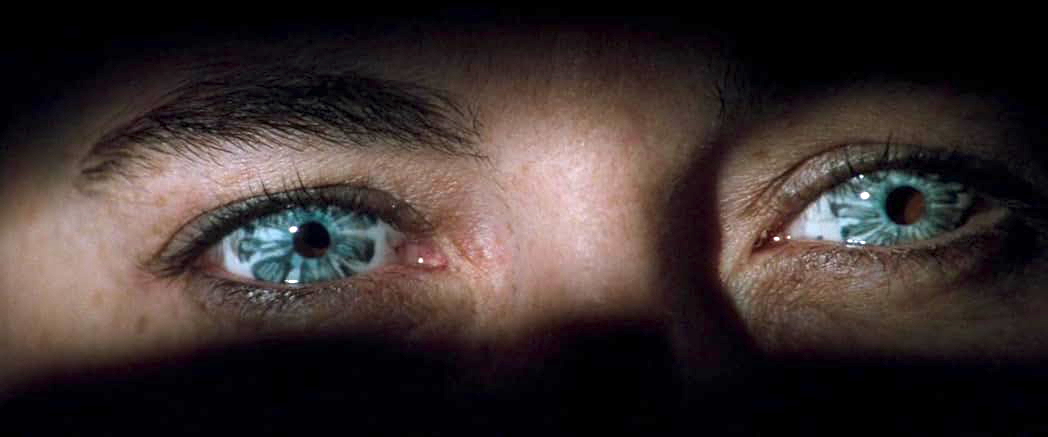
We normally tune out when a horror picture tries to sell us a bill of goods about a nihilistic universe. In the Mouth of Madness continues to engage because our identification figure is a rational egotist who clings to his skepticism to the bitter end. Like Dana Andrews in Jacques Tourneur’s Night of the Demon, Trent is willing to believe any explanation that isn’t supernatural. Tourneur’s movie is one of few in which the conflict between real and the unreal satisfies; a shrug and a question mark are the only sensible conclusion. Carpenter’s film treats the cosmos as a cruel joke, yet we approve of John Trent’s attitude. Manic laughter seems an appropriate response to all-out cosmic chaos. Remember Dana Andrews’ immortal words:
“I refuse to let this thing take possession of my good senses.
If this world is ruled by demons and monsters we may as well give up right now.”
The supporting characters fill in functional roles, like Bernie Casey’s insurance man; others have connections to other horror pictures, or in one case, Carpenter’s favorite director Howard Hawks. The German actor Jürgen Prochnow is here; we won’t say who he plays. The choice of the young actor to play a boy on a bicycle is almost prophetic — he’s Hayden Christensen, who plays the young adult Anakin Skywalker in the George Lucas entertainment franchise that has blanketed the culture in the same way as the fictional books of Sutter Cane.
We’re not grateful for Carpenter’s expected pessimistic finale. But he finds an elegant Easy Out for a story with no hard finish: the final moments hijack a brilliant 1966 avant-garde film by Paul Bartel.
I notice that the cast also includes Wilhelm von Homburg, who played Vigo in Ghostbusters 2.
Anyway, cool movie.
One of my favorite Carpenter movies.