
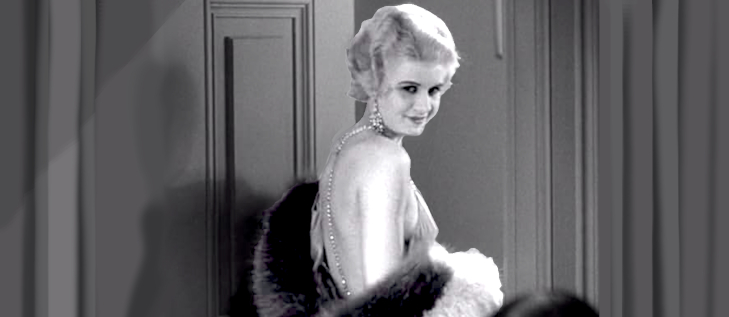


According to Hollywood legend, the only thing aviation and tool works magnate Howard Hughes loved more than airplanes and womanizing was the movies. He took one look at Paramount’s Wings, the first recipient of a Best Picture Oscar, and committed his fortune to making the most spectacular World War I flying film of all. He personally took charge of the movie’s astounding aerial scenes, that include a giant dogfight in the clouds. At least 30 planes are on-screen at the same time.

Begun as a silent film, Hell’s Angels took so long to shoot that it was made obsolete by the arrival of talking pictures. Howard Hughes responded by reshooting all of the dramatic scenes with spoken dialogue. He employed stage director James Whale to guide the actors, but took sole directing credit for himself. That’s also when Hughes replaced his leading lady, igniting the career of one of the movies’ greatest sex goddesses. Jean Harlow shocked them all, setting a high bar for filmic sensuality. There was a censorship system called the Production Code, but the big studios had found various ways to circumvent its rules. Being a wildcat Hollywood independent, Hughes made the film the way he wanted it made, with no censor consultation. The resulting movie is unusually violent, racy and profane, even for a pre-enforcement Code thriller.
At 4 million dollars, this also may have been the most expensive film of the era. Twenty years ago the UCLA Film and Television Archive helped Universal restore Hell’s Angels, reconstructing it at full length and reinstating a sequence filmed in color — the only color feature footage ever shot of Jean Harlow. Her hair really was platinum blonde.
Some of the show still resembles a silent movie. Brief scenes begin and end with full fades, and the editing retains numerous silent-style inter-titles. The story commences in prewar Germany. After seducing a German woman, the undisciplined Oxford student Monte Rutledge (Ben Lyon) weasels out of a duel of honor with her rigid, traditional husband, Baron Von Kranz (Lucien Prival). Monte’s ethical brother Roy (James Hall) quietly takes his place. He survives, and tells no-one what he has done, especially not Monte. Back at Oxford, Roy is too noble to realize that Monte is making moves on his new girlfriend, the beautiful Helen (Jean Harlow, billed originally as Harlowe). War breaks out. The brothers’ friend Karl (John Darrow) is repatriated to Germany, and is made to fly a dirigible raid over London. The Rutledge brothers join the RAF for different reasons and are soon in France flying suicidal raids over enemy territory.

The big draw for Hell’s Angels is its spectacular flying, the realistic aerial scenes filmed and re-filmed for years by Howard Hughes. Paramount’s Wings had shown exciting aerial combat but it pales in comparison to Hughes’ two major flying sequences, which made minimal use of special effects and miniatures. Almost all the aerial scenes including star close-ups were filmed while aloft in aircraft that now look like flimsy kites. Thirty or forty biplanes careen through the sky in one close combat sequence.
Hughes’ flyers were a rough bunch of veterans eager to make big money and just as eager to prove their stuff on camera. Many shots look as though the pilots were taking heavy risks. Criterion’s extras report that two or three of them died while filming. We learn that Hughes’ ‘private air wing’ included Paul Mantz, who became Hollywood’s pre-eminent stunt flyer until his death in 1965. Also listed is aviatrix Florence Barnes, aka ‘Pancho’ Barnes, the colorful adventuress immortalized in the book and film of The Right Stuff.
The first flying scene is a giddy combination of expert special effects and anti-Hun sadism. Pacifist ‘good’ German Karl is a junior officer on a Zeppelin crewed by Kaiser fanatics. He misdirects their bombs away from Trafalgar square and into a lake. When the RAF closes in the German commander lightens ship by sacrificing his crew, ordering them to jump to their deaths. It’s a disturbing and macabre scene. The scene’s flying was all accomplished with miniature effects; the Zeppelin was an enormous model. In original showings of Hell’s Angels the Zeppelin looked even bigger through a gimmick called ‘Magnascope.’ Special stage masking opened up the projected screen, and a lens change (some say a zoom lens) enlarged the picture greatly.

Adding to the effect, the Zeppelin scene is tinted a bright blue. When the Zeppelin explodes, the flames burst forth in bright color, a staggering effect. It’s accomplished by what looks like the ‘Handschiegl process,’ a matting-tinting trick. The vivid color effect also appears to be utilized for the barrel flashes of plane-mounted machine guns.
Hell’s Angels’ final battle gave Hughes an excuse to build a two-engine German Gotha biplane bomber. It’s actually actor James Hall strapped into the open-air gun position up front, in what has to have been the most dangerous acting assignment of the era.
Self-styled ladies’ man Howard Hughes tuned the script’s non-flying scenes to make most of Monte Rutledge’s sexcapades in Berlin, London and France. Society wives and willing barmaids decorate scenes until the brothers finally come up against the blonde bombshell herself. Jean Harlow may be ludicrous as an English socialite, but accents don’t matter when she slinks around in such skimpy costumes. Her Helen is pre-Code glory all the way, and she gets to utter an immortal line of dialogue:

“Would you be shocked if I put on something more comfortable?”
The words always get a double laugh, because Jean Harlow is already wearing so little, we can’t imagine what she’s thinking of changing into. There’s nothing remotely mysterious about Harlow’s sex appeal — Clara Bow may have had ‘It,’ but Harlow convinces us that her characters thrive on ‘It.’ Helen literally looks game for anything: she likes sex, sleeps with men and is completely unapologetic about it. In a backless and all-but frontless evening gown, she comes on like Everything Young Men Want to Know about Women. It’s definitely ‘liberation’ of a kind — she set a libertine’s high bar for what could be gotten away with in the pre-Code era.
Helen is of course a male fantasy expressing Howard Hughes’ notion that women are unreliable, untrustworthy playthings. Helen’s story function is to reject one brother and humiliate the other. Just when we think she will be redeemed and the lovers reconciled, she opts for big-time harlotry in a petting party with a drunken British officer. The Rutledge boys must make do with other good-time girls.

The film’s language is pretty raw as well. The flyers shout very atypical dialogue from plane to plane: “Jesus Christ!” “You son of a Bosch!” and then “You son of a bitch!” The Production Code watchdogs were not ready for such blatant non-compliance. Hughes found the Code Office and many state censor boards better prepared when he produced the equally shocking Scarface. Then a group of church ideologues got involved, and successfully promoted Code enforcement with more restrictive new rules. Howard Hughes would spend years fighting legal battles over his 1941 film The Outlaw and his highly-promoted sex symbol Jane Russell.
The film has some interesting politics. It seems to agree with a street agitator who shouts that it is folly to fight in a war that is really about the profits of capitalists. The soapbox orator is labeled an anarchist and beaten by the crowd. But his subversive reasoning is later adopted by the Bad Brother Monte and equated with plain cowardice. The only true love and loyalty in the movie is represented by Good Brother Roy; he selflessly takes Monte’s sins upon himself until the very end.

Compared to the romantic excesses of later stories like The Dawn Patrol, Hell’s Angels is hardboiled to the extreme. Captured by the sinister Germans and accused as spies, the brothers’ fate is not sentimentalized. Monte and Roy recognize the officer who has captured them as Baron von Kranz, the dueling husband from their pre-war escapade in Berlin … he turns out to be an honorable enemy. ←
Hell’s Angels delivers the kind of spectacle that viewers never forget. The history of Hollywood moviemakers is a chronicle of greed and lust, sometimes combined with tremendous cinematic ambition. Howard Hughes was obstinate, selfish and particularly hard on actresses … he kept his contracted talents Jane Russell and Jane Greer idle, making no movies for years on end. After two or three great shows Hughes’ contribution to film was mostly destructive, especially his obliteration of the once-great RKO Studios. His achievements and disappointments seem insane … or just another parade of American extremes.


Paramount originated Magnascope for the battle scenes of OLD IRONSIDES in 1926-a separate projector was installed with a special lens that made the image larger and usually would be there until intermission. It was successful enough to be used for WINGS a year later (you can tell when those sequences were by the shrinking of the lettering in the inter-titles). As far as I know, Paramount only used that process for those two films so Hughes must have either leased or purchased it from that studio for HELL’S ANGELS. I saw HA when UCLA premiered its restoration and we were oohing and aahing during that zeppelin sequence but I honestly do not remember the image getting bigger during it. Lastly, James Whale did not get along AT ALL with Harlow when she shot her scenes-legend has it that when she complained about his criticism of her work and asked him what she should do, he replied “I can try to teach you to be a better actress but I cannot teach you how to be a better woman.” Hughes bought out Harlow’s contract from producer Hal Roach, where she had appeared in some Laurel & Hardy silent comedies (DOUBLE WHOOPIE, BACON GRABBERS) and she must have created a soft spot at that lot as she made cameo appearances in various films there through the use of portraits.
My understanding of James Whale is that no one got along with him, not Irene Dunne, Alan Jones, or Louis Hayward. Hayward was my close friend and associate for twenty years, Alan and Irene spoke out publicly.