

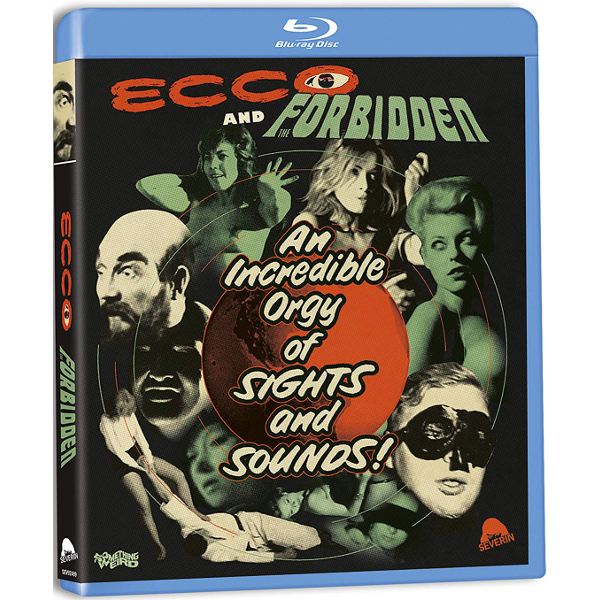

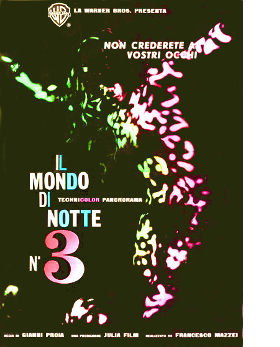
Ecco retains many of the production qualities of the previous year’s Mondo Cane, including another dramatic music score from Riz Ortolani. Relatively classy (but bored-sounding) English narration by actor George Sanders helped to earn Ecco a wide American release. The Italian word ecco means ‘look here,’ or ‘behold;’ Sanders’ bemused voice lends credibility to the film’s stated aim of showing us the extremes of behavior that make up the human race. Filmed in color and widescreen, this is not the original Italian cut Mondo di notte numero 3, but a hybrid re-edited by R.L. Frost and R.W. Cresse, reportedly replacing much footage with scenes from another shock travelogue feature, 1961’s Il mondo di notte numero 2.

Ecco features a couple of intriguing subjects among a long list of phony, staged events. The most impressive takes place in Japan, where a ritual festival called Saidachi involves hundreds of loin-clothed men rushing from freezing water to jam into an open-air pagoda and struggle for possession of a piece of paper. The crush of men is truly eye-opening. Ecco’s complete lack of contextual information undercuts any understanding of what we’re seeing. Are the Japanese men college students, and is Saidachi the equivalent of a fraternity rite? Considering the level of dishonesty in the narration, we don’t know what to believe.
A demonstration in Lapland of a traditionally garbed maiden castrating an adult reindeer with her teeth is equally baffling. We cannot tell if the reindeer ritual is still being done this way or if we’re seeing some wild stunt; the rest of the Lapp footage shows several photogenic couples pairing off in staged make-out sessions amid the beautiful northern scenery. The savagery of the castration ritual fires their passions, Sanders tells us.
The English narration written by the notorious exploitation producer Bob Cresse simply lines up prejudiced and racist statements for Sanders to read in his bored tones. The Lapps are sex-obsessed Scandinavians and the Japanese segment can’t be finished without a reference to treachery at Pearl Harbor. Another segment showing the activities of a German dueling society assures us that the young fencers are overjoyed to be given disfiguring facial scars; the Prussian dueling tradition is then equated with Nazi tendencies. A staged dirty party game in a ‘private club’ shows some inebriated Frenchmen (including actor Michel Simon) voting on a procession of nude derrières. The Frenchmen are decadent, and housewives gawking at an exhibition of musclemen are sexually frustrated … the list of generalized insults goes on.
Mondo Cane’s mostly tamer travelogue content at least seemed authentic, but Cresse and Frost realized what Reality TV producers now take as a credo: truth or integrity is secondary where low-common denominator entertainment is concerned. As with Mondo Cane, Ecco often pairs up subjects to imply an ironic contrast. For instance, a fancy Parisian debutante ball is juxtaposed with a (staged?) drunken bacchanal on the banks of the Seine. Several items in the ‘travelogue of sensation’ are simply various kinds of striptease acts.

The notion that the Mondo movies are the cinematic equivalent of a carny sideshow is borne out by a sequence featuring a ‘psychic wizard’ who proves to be a geek-like professional body piercer. A karate exhibition was surely more exotic in 1963 than it is now. The ‘last performance’ of the Parisian Theater of the Grand Guignol offers only a glimpse of action on the stage, but does show the theater’s famous interior with its carved wooden angels.
Director Gianni Proia ends his show with a phony contrast of the sacred and the profane. A patently faked English Black Mass, supposedly filmed secretly ‘through a window,’ ends with a shower of chicken blood splattered onto a reclining nude, dramatically lit for the camera. Then we’re shown an unconvincingly staged sequence in which a devout Italian bride climbs a long stone church stairway on her knees. The ritual is said to have the power to enhance fertility, but the visuals make for a limp conclusion. It takes Riz Ortolani’s rising music and George Sanders’ patronizing narration to let us know that the movie has ended.
The Forbidden
1966 / 1:33 flat full frame / B&W and Color / 65 min.
Starring Bob Cresse
Cinematography Guy Gunderson
Film Editor Eric Bentley
Produced by William Eldridge (Olympic International)
Directed by Benjamin Andrews, R. Lee Frost
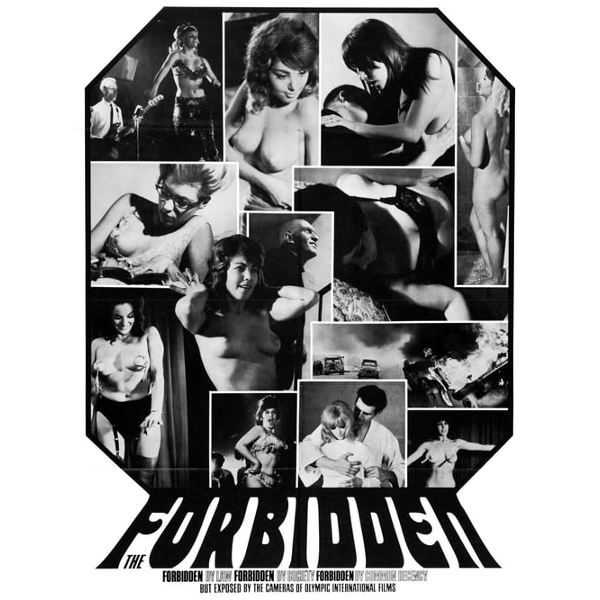
Something Weird always included a lesser-quality item on the lower half of a home video double bill. We hit the lower depths of Mondo moviemaking with R. Lee Frost and Bob Cresse’s The Forbidden, a mind-numbing exercise in tastelessness that appears to have been created by appending new color scenes to some existing European material. A relentless narration lectures on society and morals while the amateur images never rise above peepshow prurience. Most of the material is about women stripping, while the obnoxious voiceover claims a Redeeming Social Message. The show literally looks like discarded fragments crudely joined with the agonizingly bad narration.
An extended opening scene of two topless women fretting over a possible rapist (they simply open the door for him) eventually pretends to be an ad for a self-defense karate school. Most of the other sequences ‘filmed all over the world’ involve strippers: Nazi strippers, virgin strippers, etc. Everything about the film is faked. The same faces pop up in a Hollywood club and a supposed Swiss hangout for lesbians. A few shots of abandoned junk in the desert are offered as proof of the existence of a mobile topless bar that follows workers from job site to job site.
In between shaky shots of the Los Angeles skyline, a B&W fragment filmed in France depicts a ‘shocking murder story’ about a woman who kills her young friends so that she can see the man she loves when he returns to attend the funerals. It appears to be a failed short subject incorporated into The Forbidden to pad out the running time.
The film’s overall crudity makes Ecco seem accomplished by comparison. This trashy ’60s picture could only have played in a grind-house fleapit, possibly to clear the house. Frost and Cresse were also behind the Mondo concoctions Mondo Bizarro and Mondo Freudo, which are being offered in a second double bill. When hardcore pornography was finally deemed acceptable in the late 1960s, the Mondo movies were replaced by phony sex documentaries.
