

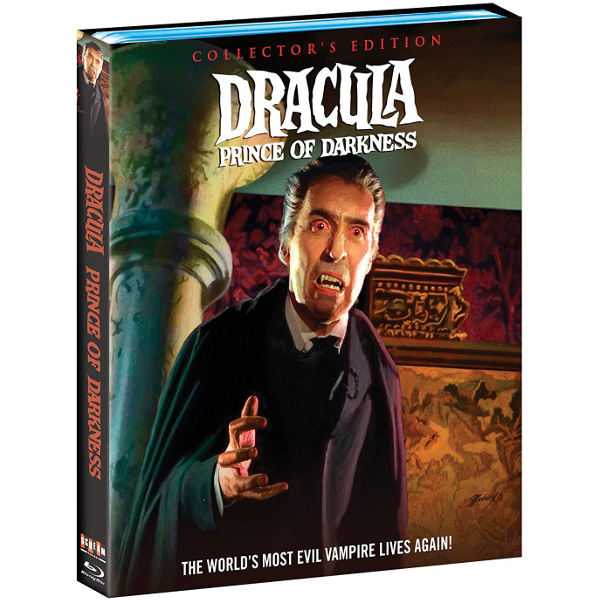

Third in Hammer’s Dracula series but only the second to star Christopher Lee, Dracula: Prince of Darkness is an effective haunted house thriller that was just what the studio needed: a big horror hit that didn’t require enormous sets or a large cast. After several seasons splitting himself between England and the continent, Chris Lee came back in his signature role, for the studio that gave him his breakthrough — but in a rather narrow groove. With Terence Fisher at the helm and much of the same crew that had launched Technicolor Hammer eight years before, Prince of Darkness was the most prestigious and successful of the cluster of 1966 horrors that Hammer turned out to fulfill a new contract with 20th Fox.

The film does not have a strong story. The conclusion of the eight-year-old Horror of Dracula plays out as a prologue, reminding viewers that a return for the nefarious Count won’t be easy — he was reduced to dust, which was blown away on a heaven-sent breeze. But this new story starts from scratch. Carefree vacationers try to breeze through the Carpathians but run into the expected tragedy that replays episodes from Bram Stoker’s Dracula not covered in the first movie. Two couples are stranded by a rude coachman and then picked up by a riderless coach. Undisturbed, they accept the hospitality of a castle even though the only person they see is a curious servant named Klove (Philip Latham). The rather thoughtless overnight guests thus become easy prey when it comes time for a classic vampire resurrection scene … for which they supply the human ‘life force.’ Of the four English folk that enter only two will emerge.
Dracula: Prince of Darkness shrinks the scale of Hammer filmdom even smaller, restricting itself to one castle and several village settings. Although several set pieces stand out as quality Hammer material, the pace is not well managed. A full forty-five minutes of preamble, scene & character setup grind out before the title fiend makes his first appearance.
The Hammer formula became creaky fairly early on, trying to stay within familiar gothic guidelines. Horror fans that had seen an old Universal thriller or two didn’t need to be reacquainted with the basics of Vampires 101, yet these films reboot at square one time and again. When all the story elements are finally in position, only 25 minutes or so are left to move on to fresh material. As this is one of the better Hammers the new elements are indeed exciting. But the final act seems intent on rushing to a finish and getting it over with. What that means is by the third viewing, those first 45 minutes seem intolerable. We’re way ahead of the vacationing foursome (Barbara Shelley, Francis Matthews, Suzan Farmer, Charles Tingwell) and they just aren’t that interesting. The wearisome haunted house tropes pile up when the clueless visitors go off one by one with the strange butler Klove.
But the promise of Christopher Lee in full Dracula mode would entice us to sit through any number of movies, the The Magic Christian, for one. Chris Lee does indeed deliver. Keeping his appearances brief and sharp was a good call. Lee also didn’t have that much screen time back in Horror of Dracula, but the film was built around his appearances, every one of which was a serious shock moment.

Prince of Darkness’es three original scenes indeed push the edge of the envelope of vampire cinema. Klove resurrects Dracula via an extended ritual: he hangs a victim over a crypt, slashes his throat and soaks the vampire’s ashes in shimmering crimson hemoglobin. We don’t ask how the hell he could possibly have collected the ashes in the first place, but as we find out in a later sequel, a single vial of powdered Chris Lee is enough to pull off the deed. Does this mean that multiple Draculas could be cloned? That’s not a good idea. Les Bowie’s superimpositions do a nice job of showing the vampire re-integrating. The scene is a rousingly unhealthy success, especially for horror fans surprised by the eager display of fountains of gore splashing downward in the crypt.
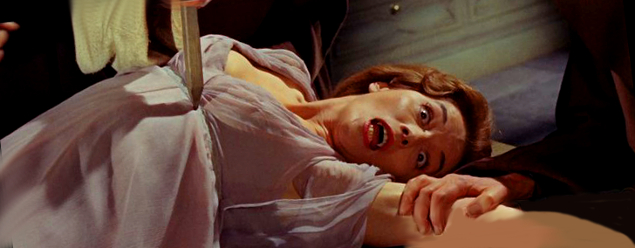
Actress Barbara Shelley earns top marks as a sexually-enhanced vampire bride. When the rating system brought the possibilities of R-rated nudity and perversion, any looker willing to soak herself in Max Factor blood could become a shockingly erotic vamp vixen. Like Carol Marsh, Andree Melly and Marie Devereaux before her, Shelley implies wanton promiscuous bloodsucking lust with just a low-cut gown, hungry fangs and a liberated, gleeful smile. She maintains a balance between poise and feral rage, when laid out for a staking the old-fashioned way. Several monks must hold her down as if she were a cat, scratching and kicking. Shelley’s always a welcome contributor in all of her movies; she’s made quite a few horror and sci-fi pictures.

The third startling scene involves Christopher Lee directly. Taken from the book, it’s another moment that one would think would raise censor objections — Stoker’s vampire makes a woman his bride by cutting his own chest, and having her drink blood from the wound. The movie doesn’t end up with a bloody-faced Suzan Farmer, but the implication of a perverse sex act with the Devil is pretty clear — it’s another rather rough scene in a 1966 movie casually marketed to kids. Lee really goes with this scene — his expression is neither that of a feral attack nor a lustful seduction — he’s offering an invitation. Lee’s performances yield subtleties that Hammer never properly recognized, or even exploited. When censorship eased, the company chose to sex-up their horrors with nudity, because it was the cheapest way to add commercial value.
The series would reuse the ashes ‘n’ blood revival method for Dracula. With a gory or inventive death scene now a requirement of the series, subsequent entries became more predictable than the jack-in-the-box demise/resurrection of classic monsters back at Universal in the 1940s. Remember the clever trick of pulling a wooden stake out of a skeleton to revive John Carradine? To understand the method used to kill Dracula in this show, one must go back to Bram Stoker’s book, which rattled off scores of things that repelled the Undead and added a laundry list of things that would kill him outright. I thought a Vampire simply couldn’t cross clean running water, but when Chris Lee is dunked in this show, he might as well be Superman lowered into a river of Kryptonite. We don’t know if that’ll keep him sparkling fresh for the next movie, or if he’ll simply show up soaking wet and surly, wringing water out of his cape. Actually, for originality Prince of Darkness deserves high marks.

Terence Fisher sticks with his traditional style of direction, which serves the picture well. Eye-lines in his cutting scheme are always very clear. Cutaways to reactions always illuminate a character’s surprise. The resurrection ritual is creepy the first time through, as we watch Klove go through the entire process of suspending a body by a rope. The scene was completely ‘spoiled’ in an issue of Famous Monsters but I know that if I had seen the movie fresh I’d have been thinking, ‘surely they’re not going to show that.‘ And then Terence Fisher proceeds to the bloodletting without as much as blinking.
Michael Reed’s camerawork blends well with Fisher’s style. He throws Jack Asher-like unmotivated colors about now and then just for atmosphere, but it’s nicely restrained. Dracula’s face and makeup inside the castle seem slightly older, a little more devilish; outdoors he hasn’t aged a bit. Andrew Kier is a formidable vampire hunter but I like my Van Helsing surrogate to be a little less self-righteous — I’d hate to see Father Sandor unleashed on accused witches in Salem. Some fans are really big on actor Philip Latham, who indeed is a fine enabler-slave of the undead king.

