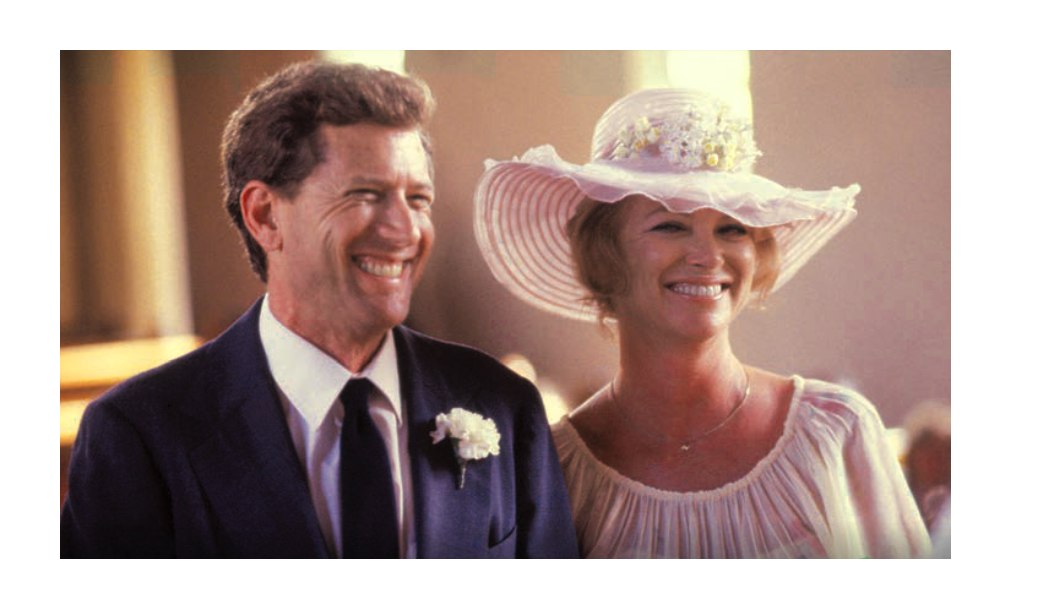
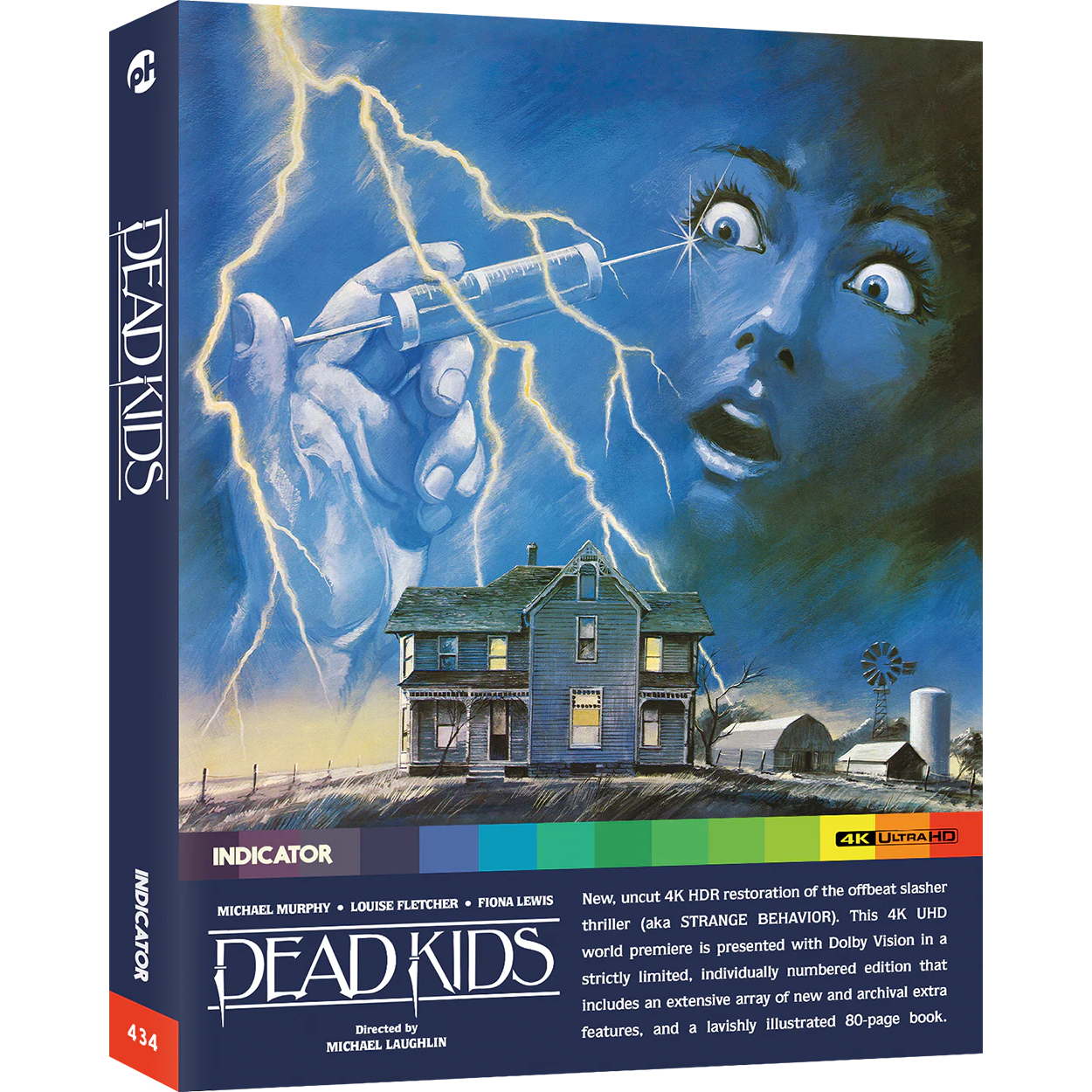

The movie we knew as Strange Behavior got a good theatrical rollout late in 1981, somehow tagging on to residual Punk sentiment, with a poster that looked like a notice for a rock concert.
Part of the film’s appeal may be that it doesn’t try to be grungy or grimy, like MS. 45 or Liquid Sky. Instead, horror rears up in a retro America with nostalgic, lived-in vibes of 1950s security: nice old cars, friendly cops — and nasty experiments on tap down at the college.
The good U.S. release for Strange Behavior is likely due to the picture’s hookup with Hemdale, an outfit that scored some big hits in the ’70s and ’80s. The movie was filmed in New Zealand, but designed and cast to look like Middle America. In all other markets it went out under its original title, Dead Kids. That would maybe have been a tad too Punk.

Co-writer and director Michael Laughlin had certainly earned his stripes for off-the-beaten-path filmmaking. His name as producer is on the highly-regarded Bryan Forbes film The Whisperers, Michael Sarne’s Mod-gay disaster Joanna, Monte Hellman’s terrific road epic Two-Lane Blacktop, Floyd Mutrux’s eccentric account of heroin addicts Dusty and Sweets McGee and the failed neo-noir thriller Chandler. In the early ’80s Laughlin brought his star connections to a fantastic genre exercise in New Zealand for the prolific Australian producer Antony I. Ginnane. He hooked up with fledgling screenwriter (and later Oscar-winner) Bill Condon. They gave their utmost to a freaky semi-throwback teen horror opus aiming to cash in on the current wave of slasher horror.
The show did decent business in Los Angeles, but also became a favorite on L.A.’s’ then- indispensable “Z” Channel. But we had to wait until the DVD era to escape wretched pan-scanned video releases.
Dead Kids is a one-of-a-kind horror treat, a teen mayhem tale in which the small town ambience ambiance brings a fresh sense of innocence to what had for several years become an exceedingly ugly genre. A string of knife killings in tiny Galesburg, Illinois baffles Police Chief John Brady (Michael Murphy, of pictures by Robert Altman), as no two murders are alike. Meanwhile, John’s teenage son Pete Brady (Dan Shor) volunteers for some paid psych experiments at Galesburg College, encouraged by his friend Oliver Myerhoff (Marc McClure of the Reeve Superman movies).
That’s our entrée into the lab of beautiful Gwen Parkinson (Fiona Lewis of The Fearless Vampire Killers), who his aided by an odd assistant, Nagel (Arthur Dignam). Gwen offers little or no explanation of what her experiment entails. All Pete must do to earn his first $100 is take a pill. His spirits are so high that he invites the lab receptionist Caroline (Dey Young of Rock ‘n’ Roll High School) out for dinner.
Chief Brady intuits that the murders have something to do with the college lab, but others suspect that he’s harboring a personal grudge: sixteen years ago his wife worked on the Galesburg campus. She died under mysterious circumstances, which Brady felt were related to bizarre experiments being conducted by the notorious Dr. Le Sange, who himself died not soon after. Or did he?

New Zealand of 1980 comes across as a perfect idealized U.S. Midwest, with tidy frame houses, pristine green grass and streets teeming with vintage American cars. Pete Brady drives a beat-up Ford Thunderbird. The American actors seem right at home and the Kiwi talent fits in beautifully. Director Laughlin shows the characters doing ordinary chores. The driving scenes are particularly expressive. At first glance, Dead Kids passes as Made in America. It certainly scores better than the Italians did twenty years before, when they Anglicized all the names on their horror film credits to make them look like English productions.
Between its horror content, Dead Kids lets us engage with likable characters and a compelling, sympathetic image of family life. The teens are individualized and the cops aren’t at all unpleasant. We see no rotten parents driving their children into trouble. A prospective teen girl victim sneaks out of her window to attend a forbidden party, but she’s very much concerned with returning before dawn, so as to not upset her folks. Chief Brady’s son Pete is very close to his dad, and understands the older man’s continuing ill temper. John Brady’s suspicions are heightened when he realizes that all the victims so far are related to the four or five men who opposed Dr. La Sange so many years ago. But nobody will listen to him.
Chief Brady has a steady love interest in Barbara Moorehead (Louise Fletcher), an understanding woman who wishes John could let go of the unpleasant past. Brady doesn’t even wear a uniform. His office clerk is played by the old-time American character actor Charles Lane. Normally one would think a local actor would be given such a role. In Hollywood pictures Lane specialized in obnoxious clerks and unfriendly bureaucrats. Here he’s good pal, competent worker and a thoughtful helper. The production also flew in character actor Scott Brady, of Johnny Guitar, among dozens of memorable films. Scott Brady’s Chicago detective isn’t much use in a case that makes no criminal sense. He tells some dirty jokes, orders in a ‘bunch of scientific stuff,’ and that’s about it.

Horror movies often forget that scares seldom work unless we’re concerned for the characters. Dead Kids affords everyone an unusual degree of respect. Nobody is present to be the butt of humor or a disposable victim. Typical of this concern in Dead Kids is a housekeeper played by Beryl Te Wiata. It’s a throwaway role until she witness a grisly killing in progress. Even after being stabbed herself, she manages to describe her attacker over the phone. The movie treats her as an unfortunate heroine, not killer bait.
At the core of the picture is a concept time-warped from a ’50s mad-doctor picture like The Unearthly or I Was a Teenage Werewolf, the kind of medico-fantasy that David Cronenberg would later exploit. The alluring Gwen Parkinson is using drugs and who-knows-what to remotely control her teenaged subjects. They are apparently programmed to commit appalling crimes, and then experience complete memory loss. Didn’t Jesús Franco use that gag 30 times? It works here because we like the people so much.
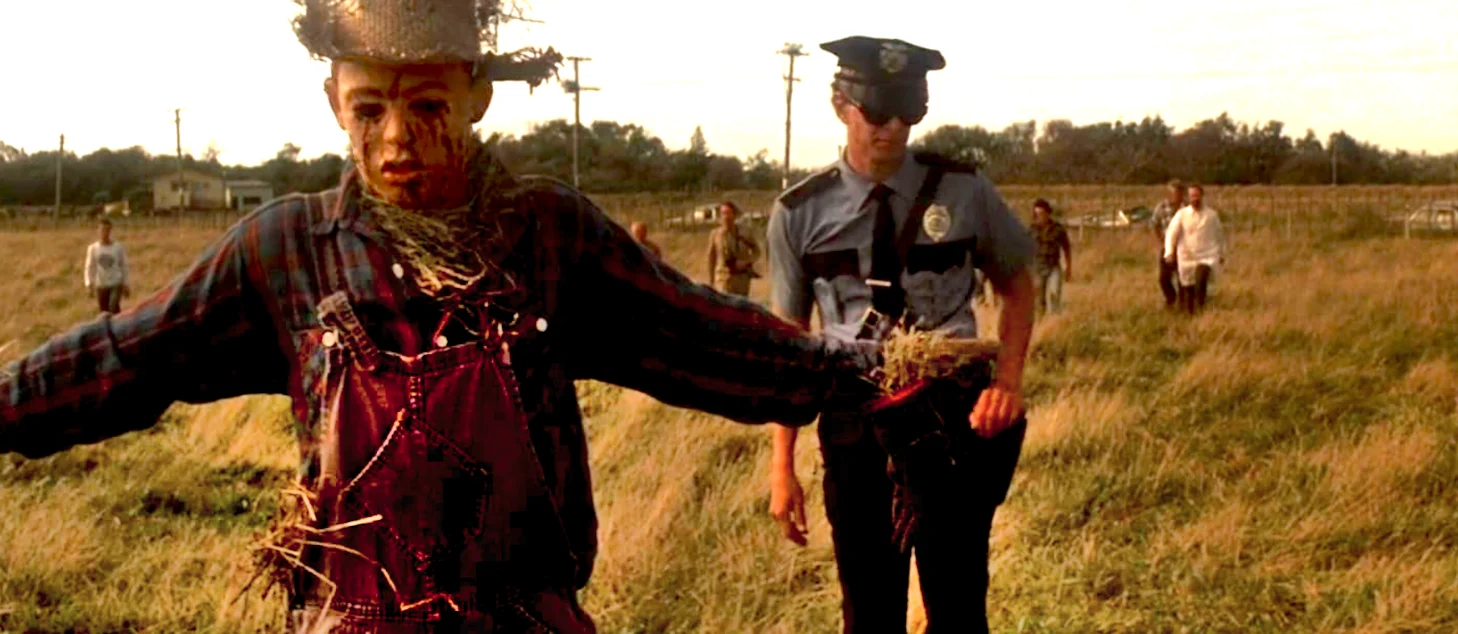
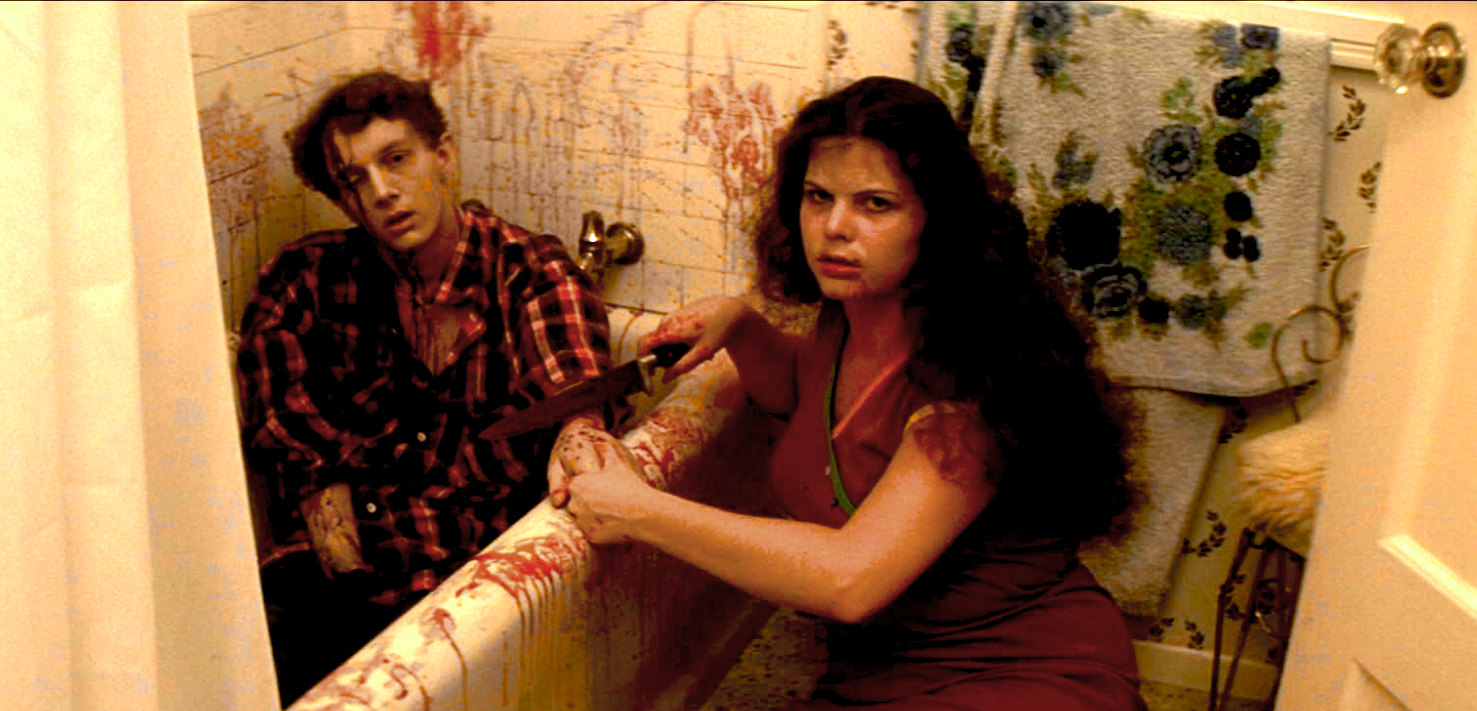
Laughlin and Condon stage their killings with finesse. Some of the stabbings are explicit and others less so, but each is shocking. One dismemberment in a bathtub makes us fear for more atrocities. A close-up of a boy trussed up as a scarecrow with his eyes carved out is strong stuff. Yet the film doesn’t revel in the individual killings. Lovers aren’t skewered and eyes are not pierced because of a need to top the latest Argento or Fulci gorefest. The tone is different. One of the killers wears a rubber Tor Johnson mask, reminding us of a more famous killer’s Captain Kirk mask.

The most disturbing scene plays off a simple medical anxiety. Pete Brady is strapped into a chair by the attractive but utterly un-reassuring Gwen, who reaches for the largest, most wicked-looking syringe seen this side of The Amazing Colossal Man. Without so much as a “hold still sweetie,” she plunges the needle into the corner of Pete’s eye socket and pumps in several ounces of green fluid. If this isn’t performed in one shot, it feels like it — and is effective enough to make an entire audience yelp and squirm.
The film also knows how to just have fun. On first viewing, the film’s best sequence is an unexpected quasi-musical number during a rather kitschy costume party. Pete shows up and meets a desirable girl just as Lou Christie’s Lightning Strikes causes all the kids to hop-dance in unison, with a handsome camera pullback to display the high-spirited choreography. For two minutes the goofy teens of Dead Kids rock out in a perfectly gratuitous dance scene. Who cares if it’s not realistic? It’s what we wanted a fun party to be back in the day. And hey, the song lyrics about an unstoppable compulsion seem fully appropriate.

Perhaps Dead Kids’ final scenes were meant to show director Laughlin’s higher ambitions. These were the years in which horror films were working overtime to outdo each other for grim nihilism. With the threat vanquished we’re treated to several images of happiness unexpected in a horror film from anywhere. The peace won by Michael Murphy’s character is hard-earned and much deserved. The movie is particularly kind to the great (and sexy!) actress Louise Fletcher, who since her oppressive nurse in One Flew Over the Cuckoo’s Nest had difficulty obtaining sympathetic parts.
Michael Laughlin and Bill Condon would move on to the more ambitious retro- Sci-fi tale Strange Invaders, with even more imported Yank actors (Paul Le Mat, Nancy Allen, Diana Scarwid, Michael Lerner, Louise Fletcher, Wallace Shawn, Fiona Lewis, Kenneth Tobey, June Lockhart, Charles Lane, Dan Shor, Dey Young) set in a past-tense America of the 1950s.
.