


Prolific writer, producer and dealmaker Philip Yordan lucked into a gold mine when he became one of the main operatives for Samuel Bronston’s massive epics produced in Spain in the first half of the 1960s. An entire studio was built, including artisan workshops to manufacture sets and costumes. Money went everywhere and the accounting was loose. While helping to ramrod production, Yordan took writing credits on Bronston’s King of Kings, El Cid, 55 Days at Peking and The Fall of the Roman Empire … and also found the time to produce his own smaller productions filmed in Spain, The Day of the Triffids and The Thin Red Line.
As the Bronston organization sank into the quicksands of insolvency, Yordan launched another ambitious science fiction project, helped by associates from the Anthony Mann and Nicholas Ray epics. One of the best of ecological nightmare movies, Crack in the World doesn’t use a giant monster to make its point about human meddling with Mother Nature. A group of idealistic geologists accidentally open up devastating fissures in the earth’s crust that threaten to tear the world in two.

The plot mixes disaster and soap opera in unequal measures. In Tanganyika, the terminally ill Dr. Stephen Sorenson (Dana Andrews) goes forward with his reckless Project Inner Space despite the misgivings of his younger, more cautious assistant Dr. Ted Rampion (Kieron Moore). Inner Space plans to drop a nuclear warhead into a deep well shaft, to punch through a final barrier deep within the earth. If Sorenson can bring superheated core magma to the earth’s surface, mankind will gain an unlimited power source. Rampion believes that a blast that deep will weaken fault lines in all directions, causing a cataclysmic geological chain reaction. But Sorenson forges ahead out of pure hubris, determined to become mankind’s savior before he dies. Stephen also wants to justify himself to his young wife Maggie (Janette Scott), who was once Rampion’s lover.
The blast seems wonderfully successful, until earthquakes and volcanic eruptions open up the Macedo Fault, which extends from near the Inner Space lab out into the Indian Ocean. Ted Rampion tries to stop the moving split by using a second nuclear weapon to blow a stopgap in an island volcano. The crack instead doubles back along another fault line, forming a giant circle that will close back at the project. The scientists evacuate the subterranean lab but Sorenson refuses to leave. As lava flows threaten the lab, Ted and Maggie have no choice but to take the two-mile elevator ride down to try to change Sorenson’s mind.
Crack in the World’s outlandish concept widens into an ever-escalating spiral of excitement and jeopardy. Unlike so many earlier disaster thrillers, it delivers on its advertising promise of worldwide calamity. Although scientific advances have made the story concept obsolete — Crack in the World precedes the adoption of the Plate Tectonic theory — the fantastic geological events are clear and understandable for any audience … nuclear meddling will rip the world apart, in an entirely unexpected way. You know, like Global Climate Change.

This movie has TWO nuclear bombs — no waiting!
Every scene builds on the excitement. Rampion’s deep-sea submarine locates a fiery rupture at the bottom of the ocean. Scientists descend into an active volcano with a bulky nuclear bomb, trying to properly position it before their special suits melt from the intense heat. The film’s one unforgivably juvenile image is a conventional missile positioned upside-down over the Inner Space bore hole. Will hitting the barrier harder make the nuclear explosion more effective? To give the obsessed Sorenson something to do while searching for an answer to the calamity, the script has him looking at file footage of nuclear explosions. Can’t go wrong with more explosions!
Although a few dialogue lines are unintentionally funny, the performances are consistently earnest and professional. Dana Andrews is sympathetic as the scientist who puts personal pride ahead of the world’s security. Corporate greed has no part in the cataclsym, just scientific hubris. Sorenson’s grant supervisor back in London is played by Alexander Knox, the misguided mastermind from Joseph Losey’s These Are the Damned. Knox no longer raises radioactive children; he instead green-lights a crazy plan as if approving a new freeway offramp.
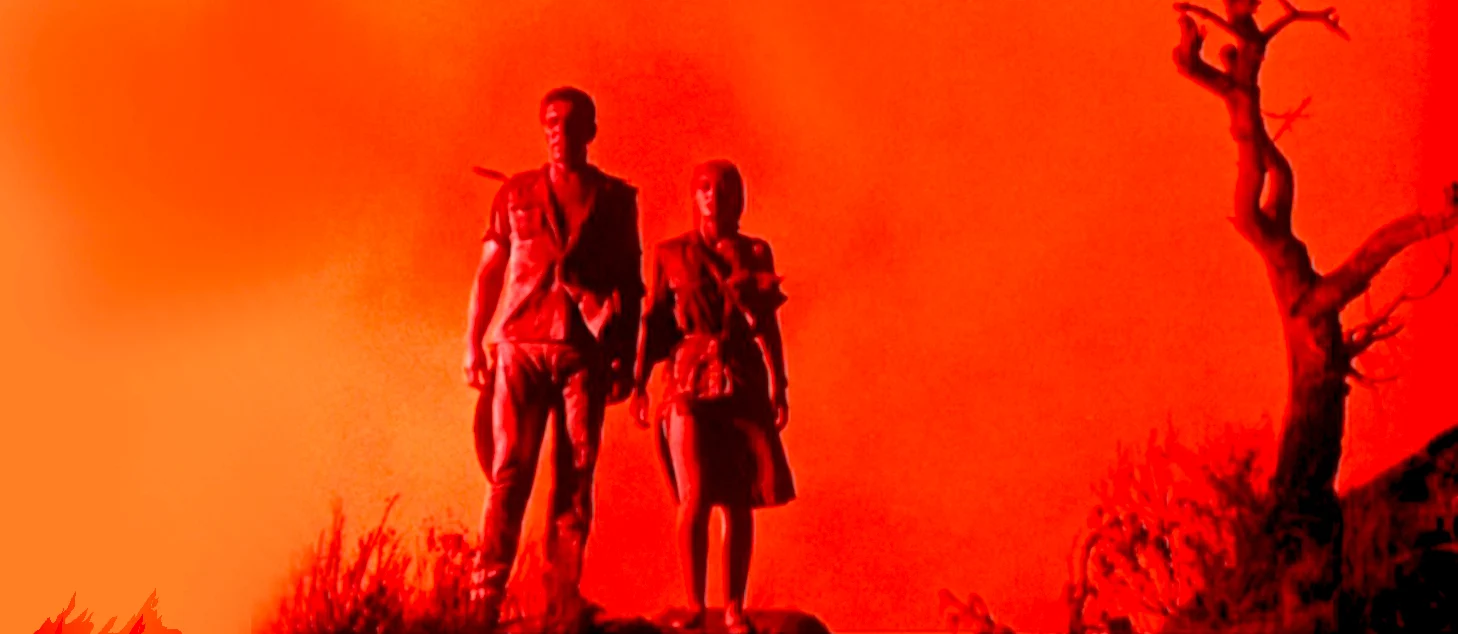
Kieron Moore and Janette Scott had helped out Philip Yordan on The Day of the Triffids, performing in added sidebar scenes to pad out the show’s running time. Here they get to be dynamic action scientists, racing across the African landscape in a Range Rover. The muscular Moore has a tad too much testosterone bottled up, and Scott gets an unintentional laugh screaming like a ninny when escaping from an elevator shaft two miles deep. But the couple make an excellent Adam & Eve on the run from a colossal eruption, kicking down a chain link fence to escape a fiery Garden of Eden. Filmed at Madrid’s Bronston studios and on location in Spain, the movie manages a convincing African locale. Is the one view of some African tribesmen watching, a stockshot borrowed from another movie?
Andrew Marton was an ideal directing choice for a movie in need of a high energy level. The screenplay is good, but Marton’s camera angles are better, and he does well balancing complicated special effects with the romantic-scientific love triangle. It can’t have hurt that actors like Dana Andrews and Alexander Knox didn’t really need much in the way of direction. A second-unit director on other people’s epics, Marton was responsible for the memorable action scenes in everything from Ben-Hur (1959) to Cleopatra (1963), as well as bringing in plenty of pictures on his own. Crack in the World is graphically precise and hasn’t an ounce of narrative fat. Several shots place the actors near dangerous-looking action. Even the cutaways to volcano stock shots have impact.

It’s the best ‘stuff blows up’ movie of the decade.
The film’s equally important contributor is Eugène Lourié, a genius designer and creator of superb special visual effects. Lourié had been an ace art director on a number of French film classics of the 1930s and ’40s, including world classics as prestigious as The Rules of the Game. When he became a director, he found himself typecast as a maker of monster movies. His first success was the Harryhausen film The Beast from 20,000 Fathoms, which he more or less remade twice, as The Giant Behemoth and Gorgo. Several years later, he handled the special effects sequences for the volcano-based disaster picture Krakatoa East of Java, but Crack in the World remains a career highlight. It’s likely that Lourié’s designs dictated the action montage work of director Marton. By the 1970s Mr. Lourié was art directing for TV. I met him briefly in 1978, when he held a pitch meeting for the effects for the TV show Supertrain. Unless the IMDB is wrong, he didn’t get the job.
Crack in the World employs numerous opticals and traveling matte shots but some of its most impressive images, such as the vista of the twin lava flows converging on the Inner Space Project, are clever stage illusions produced with very large minature landscapes. The film’s many explosions are some of the best ever … Lourié’s superior design and planning make the most of fancy pyrotechnics and multiple high-speed cameras. Substantial explosive charges must have been used for the large-scale detonations — the Inner Space launch pad, an entire volcanic island. The only disappointment is an unwelcome cut to another stock shot of a nuclear bomb explosion.

The main lab set is a brilliant hanging miniature. Sorenson’s underground lab is a bold concrete construction, the kind of thing that Ken Adam might make for a 007 movie. The upper part of the lab is a foreground model neatly aligned with the live-action set. The 007 people must have been impressed, as the exact same design concept shows up again in the Roger Moore spy epic Moonraker, for the underground headquarters of the arch-villain Drax.
Miniature maker and effects specialist Charles-Henri Assola is credited on both Crack and Moonraker. He also created special effects on Georges Franju’s Eyes without a Face (the surgical scenes, maybe?) and worked with Eugène Lourié and Alec Weldon on Battle of the Bulge … the Cinerama epic with lots of large-scale model Panzer tanks.
Lourié’s deep sea submersible sequence is a riot of colorful bubbles. Nobody forgets his scene in the interior of the volcano, or the spectacular scenes of destruction that follow. Several chapters end with the detonation of something BIG, and the sense of disaster elevates with each new disaster. At the climax, the sense of claustrophobic panic is overpowering: whichever way the hero and heroine turn they’re confronted by towering volcanic eruptions and collapsing ruin of the Inner Space headquarters.
The climax is the awesome spectacle of a 20,000 square-mile slice of East Africa hurled into the sky. Several shots attain the feeling of chaotic planetary apocalypse missing from movies like When Worlds Collide and even Deep Impact. Twenty years later, when the editors for Nicholas Meyer’s nuclear holocaust thriller The Day After needed abstract images to express obliterating fire and force, they made use of Crack in the World’s climactic upheaval. Johnny Douglas’s majestic music score adds greatly to the sight of billions of tons of fiery rock and earth exploding into outer space.

Philip Yordan often hired blacklisted writers, but not always under their own names. For Crack in the World, the name Julian Halevy was an alias for Julian Zimet, an associate of the likewise blacklisted writer Bernard Gordon. Yordan had brought them in on some of the big Samuel Bronston epics. In an interview in Patrick McGilligan and Paul Buhle’s Tender Comrades (St. Martin’s Press), Zimet details his mistreatment by the government. For not cooperating with the HUAC witch hunters, the U.S. State Department found ways to both deny him a passport and block his employment abroad.
It would seem that someone — Philip Yordan himself — couldn’t resist turning Crack in the World’s story structure into a big joke about SEX. The impotent Sorenson can’t impregnate his wife Maggie, and he can’t stave off the rugged competition represented by his scientific rival Rampion. To compensate, Sorenson sublimates his sex drive into his work. His upside-down phallic missile ‘impregnates’ the earth like an atomic sperm plowing into a terra firma ovum. This isn’t a case of over-interpretation: the graphic symbol for the ‘Inner Space’ project just happens to be a red triangle piercing a blue globe. At one point the masculine Rampion alerts his staff that his bomb needs extra insulation — to prevent a premature explosion!
Sorenson imagines himself a sexual Prometheus, bringing unlimited power (potency) to our energy-starved (flaccid) male-dominated world. He instead precipitates a global cataclysm: Mother Earth has her own agenda. The sterile Sorenson succeeds in fathering a new moon, although like most useless drones, he perishes after fulfilling his function. Crack in the World concludes with a powerful image of the newly-chastized couple, standing tattered but still alive astride a fiery volcanic landscape. The message seems to be that men are the despoilers of the earth, and that even their most noble efforts are based on vain dreams of power and immortality. Either that, or the movie is about the need to invent Viagra.


2 comments