


1976 was a pretty momentous year for America, viewing-wise. We were enjoying Saturday Night Live, cringing at Taxi Driver and already looking forward to sci-fi epics from both Steven Spielberg and George Lucas. With the fallout from Watergate and the Vietnam war being over (officially, anyway) our Bicentennial was a rather strange time — what were we celebrating, exactly?
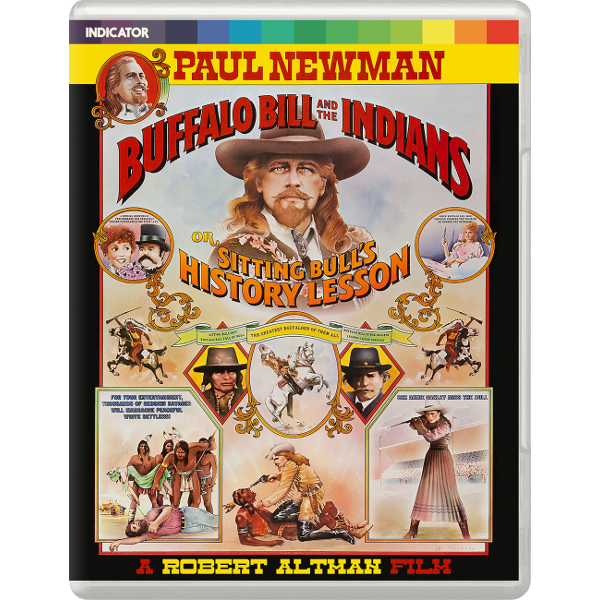
Robert Altman’s Buffalo Bill and the Indians, or Sitting Bull’s History Lesson had arrived a couple of months earlier to add its voice to the Bicentennial confusion. Did America have any use for yet another caustic satire about the Old West? Straight ‘revisionist’ westerns had been the default setting since The Wild Bunch; Altman had himself made a good one. The movies congratulated themselves for telling us that the history books had lied about the western expansion, but Altman and co-writer Alan Rudolph put a neat spin on the notion. Buffalo Bill Cody was a showbiz creation, an original American superstar built on image and publicity. In Nashville Altman and Joan Tewksbury had postulated that politics was just more show biz, a chaotic circus. Buffalo Bill gives us a conscious circus of commercialized mythomania. Its rather acid point is that America’s historical self-image is just a circus of exaggerations and fraudulent hucksterism. That’s a message that’ll leave ’em laughing.

America pretty much rejected Buffalo Bill and the Indians without much discussion. Even with its big stars it made almost zero impact. Altman buffs hip to the man’s style found plenty to admire, but those ordinary audiences that did show up mostly thought the movie to be less than involving, either for emotions or action.

Happily, Altman’s image of a tent-show Wild West isn’t fully a tragic downer, as were most revisionist Westerns of the time: Doc, Dirty Little Billy, Tell Them Willie Boy Is Here. Buffalo Bill is in fact quite funny at times. Bill Cody (Paul Newman) all but personifies the adventure of the West — in show biz terms. He has the great looks — that terrific beard and mustache, and a wig to provide the full head of hair. His circus celebrates the conquest of the plains. Large-scale action pageants of Indian attacks and frontier shoot-outs all end with Buffalo Bill riding to the rescue on a magnificent horse. Exhibition horse-riding and stunt demonstrations fill in between acts. Add the real-life sure-shot magic of the star performer Annie Oakley (Geraldine Chaplin), drape everything in salute Old Glory reverence, and the entertainment is complete. Buffalo Bill’s Wild West Show gives the public an image of itself that it wants to see.
After Nashville Altman was able to broaden his reach for desirable actors, even for marginal parts. Cody’s producer Nate Salisbury (Joel Grey) is a practical showman, a hard-working Easterner. More crass and always ready with a flowery speech is Cody’s publicist Major John Burke (Kevin McCarthy), who also grooms his hair in a Custer/Cody fashion. Cody’s inoffensive nephew Ed Goodman (Harvey Keitel, rather wasted) functions as a gopher. He reminds us too much of Radar in Altman’s M*A*SH. The mission of journalist/biographer Prentiss Ingraham (Allan F. Nichols) is to churn out reams of dime novel fiction about Buffalo Bill. An unwelcome visitor in the troupe is Bill’s original biographer, Ned Buntline (Burt Lancaster). Buntline is the most erudite of several ‘experts’ that feel compelled to explain the glory and/or contradiction of Buffalo Bill. Lancaster’s Buntline might work better on a stage; his speeches slow the movie down.

The most compelling ensemble characters are the husband and wife sharpshooter team of Annie Oakley and Frank Butler (John Considine). Annie must shoot with her left hand because her right is in a sling (due to a real horse accident suffered by Ms. Chaplin during filming, we’re told). Chaplin’s Oakley has one of the movie’s few bursts of full emotion. She weeps openly, but not for her husband. Poor Frank is now just Annie’s assistant, a professional target-holder. He’s treated as an accessory, negotiating for Annie while having difficulty getting her full attention. But we ought to respect Frank … he loves his woman and is willing to be shot to prove it. The fact is that Annie is the most ‘real’ thing in Bill’s Wild West Circus, a magician with firearms. A 1894 silent excerpt of the real Annie Oakley is included as a disc extra, and her skill is applause-worthy.
Not every Altman ‘broad canvas’ picture focuses its conflict as well as does Buffalo Bill… we’re looking at you, Popeye. Bill must keep building his show up as new and bigger, and this season’s showcase item is the genuine Indian Chief Sitting Bull. Never mind that the ‘fearsome brave’ delivered by Indian agent McLaughlin (Denver Pyle) turns out to be a harmless-looking little man who almost never talks; everyone at first assumes that Bull’s massive interpreter William Halsey (Will Sampson) is the new star. Bill expects Bull to play the savage murderer of Custer, but their visions of showbiz are not compatible. Halsey explains that the Chief wasn’t personally present at the Battle of the Little Big Horn. After disappearing for days Sitting Bull simply shows up at the crack of dawn to dictate ‘what he is willing to do:’ a pageant showing a U.S. Cavalry massacre of Indian women and children.

Bill Cody and his showmen never get a handle on the unpredictable Sitting Bull, who wins every negotiation by simply not cooperating. Bull and Annie are friends (a truth musicalized in Annie Get Your Gun). At one point she intervenes to see that Bull isn’t fired.
We’re told that Paul Newman enjoyed ribbing his own image in Bill Cody, a showman with an image to uphold. Bill struts around being ‘inspirational’ to his employees. He coins idiotic-sage zingers such as, “Remember, son, the last thing that a man wants to do is the last thing he does.” Bill has a thing for opera singers, and we see a succession of three move in and out of his personal quarters. When frustrated by Sitting Bull or his own failure to maintain the Buffalo image baloney, Bill loses his temper both verbally and physically. The only uncontrolled shooting in the show comes about when he draws his six-guns to blast his latest paramour’s pet canary bird. The frustration has to go somewhere. ↓
Native American spiritualism was celebrated in Arthur Penn’s Little Big Man, and Altman & Rudolph use Sitting Bull’s Dreams to further dramatize the disconnect between white and red culture. Bull’s dreams reveal the future and tell him what he must do. It’s no joke, as Bull predicts a visit by President Grover Cleveland (writer-comic Pat McCormick), who shows up with his new bride Frances (Shelley Duvall). The gala show and reception is the film’s real climax.

The concept may be deep but the images are SHALLOW.
Buffalo Bill further develops Robert Altman’s ‘broad canvas’ style of staging and direction, a strategy with its plusses and minuses. Group scenes in Nashville resemble cartoons in Mad Magazine, the broad panels that spread a crowd of characters across a page, with ‘direction’ created by the order we read their dialogue balloons.
Altman covered wide group scenes with multiple cameras, and multi-track miked scores of characters. All of the dialogue was recorded semi-cleanly no matter how much actors talked over each other. Every actor needed to be on at all times; not knowing which camera view would be edited into the final cut at any given point. The camera is forever picking out the most interesting parts of an ongoing ‘group encounter session.’ With its natural overlapping dialogue, this method sometimes brings out a terrific atmosphere of group involvement.
But the insistence on long lenses dampens our involvement in the action. Indoors we always seem to be way on the other side of the room, while action outdoors seems to be fifty yards away or more. Close-ups aren’t close-ups, they are selections from an ultra-wide tapestry. In some later pictures (Dr. T and the Women) the effect is highly artificial. In Altman’s final film A Prairie Home Companion (another movie about show biz) the cameras seem to be on automatic pilot, hosing down the action on stage. Lots of great match-cuts, very little dramatic focus.
The stand-offish style prevents some scenes from making an impact. Sitting Bull is so frustrating that Bill Cody wants the wiry ‘little bastard’ to lay an egg ‘on stage.’ For his so-called performance, the chief simply rides to the front of the audience and sits there, without expression. Bill is crushed when Bull outlasts the hoots and catcalls, winning applause and cheers just by staring down the audience and being himself. Sitting Bull is the real deal, history itself — it only makes Bill feel more like a phony.

That’s followed by what should be yet another classic scene. Bill experiences a spiritual hallucination of his own — Sitting Bull either invades his dream, or appears to him for real, from beyond the grave. Altman’s endistancing visuals neutralize the mystery — the spectre simply shows up in different places in different shots, while Newman does an excellent soliloquy, talking to a phantom he knows isn’t really there. Even though Sitting Bull pops in and out of the scene across cuts, the tone is so subdued that audiences might have missed it entirely. This payoff scene calls out for special treatment it doesn’t get. Even the casual pace of M*A*S*H knew when a special style was needed. Hazy images and faux-religious music help trigger its amusing ‘Last Supper / Suicide is Painless’ scene.
In other respects the production is magnificent. The location in Alberta, Canada places Bill’s show camp on a plain where we can see for miles. The movie shoot attracted impressive pro riders and rodeo specialists. The costumes are marvelous, as are the gaudy banners and other flimflam vintage circus decorations. We’re told that the actual Cody Show compound was copied for many details.
It is no wonder that Buffalo Bill and the Indians didn’t repeat the comedy success of M*A*S*H from six years before. America didn’t want a movie to deflate the already flat national morale. The preferred caustic satire for 1976 was Network, which assured us that everything was somebody else’s fault, that it was all right to be Mad as Hell. The Centennial Year movie that the country went nuts for was Rocky, a boxing drama that repackaged feel-good lies about the inherent nobility of an American ignoramus — with a heart. That movie literally wrapped its hero in the flag, Buffalo Bill-style. Ironically, Sylvester Stallone’s great performance achievement was just an overripe imitation of Paul Newman in the twenty-year-old boxing movie Somebody Up There Likes Me. As with William Cody and his Buffalo Bill persona, Stallone fused with his ‘Rocky’ image. He became a cultural icon based on nothing. A statue was erected in his honor.
In Buffalo Bill, Paul Newman’s character knows he’s a fraud… and must work harder than the Devil to keep the show-biz cash coming in. Now that’s the American Dream.

