



During World War II James Cagney made a couple of ‘special’ films for Warner Bros., including the patriotic classic Yankee Doodle Dandy. His own movies produced with his brother William didn’t fare as well. One of them was 1945’s Blood on the Sun, a highly dramatized ‘exposé’ about a leaked document advocating a Japanese invasion of America. Brought to light in 1929, the ‘Tanaka Plan’ was often quoted as proof of Japan’s ambition for conquest. Unlike the movie, no ‘intrepid reporter’ broke the news of the Plan’s existence. Some sources still insist that the Plan was a forgery … but that’s like real History, not something we can clear up with a 20-second Wikipedia search.
Lester Cole’s screenplay puts Baron Giichi Tanaka’s written document at the center of an espionage thriller set in Japan just before the militarists seized power. Tojo & Company will do anything to get it back; in terms of scenario structure, the much-discussed document functions much like Casablanca’s legendary letters of transit. Cagney reportedly had money differences with Warners but also complained that the studio kept him in a very narrow range of roles. Yet here he is again, playing his standard studio character, a cheerful, cocksure straight shooter. The economics of independent filmmaking gave him little choice.

The Japanese government clamps down on Tokyo’s international news bureaus when ace Tokyo Chronicle reporter Nick Condon (James Cagney) writes up rumors about a secret letter written by Prime Minister Baron Tanaka (John Emery of Kronos) that contains plans for world conquest. Nick’s timid publisher Arthur Bickett (Porter Hall) wants to defer to the demands of the Emperor’s Secret Police. Nick plays it cool, and jokes with the humorless agents that harass him in the street. Other reporters are leaving the country. Politicians are being assassinated, so what’s stopping the Kempeitai from killing newsmen?
Blood on the Sun gives us numerous Japanese characters, almost all of them villains and each with a different ‘sinister’ facial expression. Arrayed against Nick at various junctures are Foreign Office flunky Hayoshi (Joseph Kim), Secret Police Captain Yomamoto (Philip Ahn) and Major Kajioka (Hugh Ho Chang) and Police Chief Yamada (Marvin Miller). All report to Baron Tanaka and his Army co-conspirator Colonel Hideki Tojo (Robert Armstrong of King Kong!). Harassing Nick on an hourly basis are the brutal Captain Oshima (John Halloran) and his snoop agent Hijikata (Leonard Strong). The one reasonable Japanese character is the pacifist Prince Tatsugi (Frank Puglia).

The Anglos impersonating Japanese do so under extensive yellowface makeup. Josef Norin and Ern Westmore receive the screen credit. The unrecognizable John Emery is kind of vague, but John Halloran, Leonard Strong and especially Marvin Miller (the future voice of Robby the Robot) hit the exact images of racist stereotyping, smiling hideously as they lie and scheme. As soon as the pacifist played by Frank Puglia voices temperance, we know he won’t make it to the fade-out.
→ Surely eliciting boos from wartime audiences Robert Armstrong as Tojo. For Americans, army strategist Tojo was the most hated enemy name save only for Adolf Hitler. Armstrong’s appearance is so altered, audiences likely didn’t even know it was him.
Nick can shrug off the smear campaign accusing him of drunk and disorderly behavior, but he goes rogue when the militarist conspiracy murders two of his best friends, reporter Ollie Miller and his wife Edith (Wallace Ford and Rosemary DeCamp). Nick suspects that the corrupt Yank newsman Joe Cassell (Rhys Williams) may be collaborating with Tanaka’s crooks, and he’s initially unsure of the Eurasian beauty Iris Hilliard (Sylvia Sidney). Iris claims to be promoting the liberation of Japanese women, but we know that she is working for Tanaka and Tojo, both of whom would seem to be attracted to her as well. But is she really working as a double agent against them? Is her attraction for Nick sincere, or is she just after the Tanaka document?

Four years into the war, Hollywood features were still demonizing the enemy across the Pacific. Lester Cole’s previous big script was for the Errol Flynn combat film Objective, Burma! It pulled no punches when it came to ‘anti-Jap’ vitriol: “They’re degenerate immoral idiots! Stinkin’ little savages! Wipe ’em out, I say! Wipe ’em out! Wipe ’em off the face of the Earth! Wipe ’em off the face of the earth! The bastards! GOD!”
Blood on the Sun doesn’t try to raise that kind of bloodlust in the audience. It uses the word ‘Japs’ only once or twice, but orchestrates a full gallery of sneering Japanese villains. The makeup for John Halloran’s Oshima includes a bucktoothed prosthetic. The message is that ten years before the war, the Army militarists were already committing murders, faking evidence and leaning on the press to print only approved news. The unreality comes in when our Yank hero Nick Condon handles the problem ‘the Cagney way,’ as if he were taking on a corrupt Police Chief in a Warners picture. Nick smart-talks his way out of some jams and punches his way out of others. His motto is ‘to forgive, but first get even.’
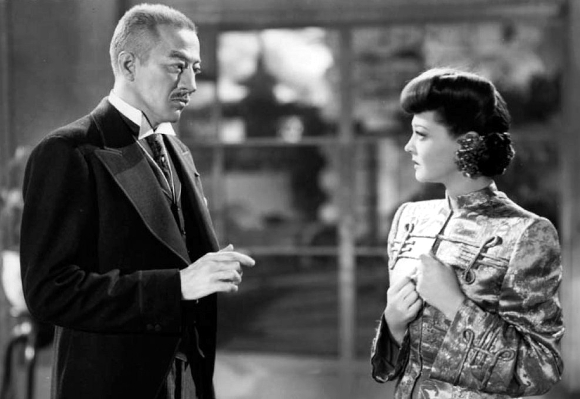
It doesn’t take much to make the Japanese villains revert to racist ‘Fu Manchu’ behavior. Iris Hilliard has agreed only to serve as a go-between to secure the Plan document, but Tojo orders her to become intimate with Nick, as if he were giving orders to a prostitute-soldier. When threatening Iris, Tanaka switches from wanting Iris as his concubine, to insisting that she die slow-w-ly.
Sylvia Sidney gives the Iris Hilliard character some distinction, but she’s still an Oriental Woman of Mystery, the kind that American heroes kiss but don’t marry. Even though Nick Condon pledges his love to her, Iris still reads as a more sophisticated variation often Cagney’s Shanghai Lil. Their great romance is interrupted by the need to split up, and for Nick to make a sacrificial gesture. Their drawn-out farewell scene is one of those head-scratchers — there seems enough time for both of them to easily slip away, and escape together.
The production is fairly lavish — Wiard Ihnen’s designs and A. Roland Fields’ set decoration won the film’s only Oscar. But 1945 audiences likely saw the adventures of Nick Condon as interesting, but tame. We see Nick at a Japanese bath, but in a little private tub instead of the communal tank. A ‘daring’ scene, reportedly fully researched, shows part of a formal seppuku ceremony. The character that commits hara-kiri suicide is an actual public figure, whose cause of death was reported to be a heart attack.

Action fans are given several minutes of athletic judo fighting and fisticuffs. Nick is a student of martial arts, see, and can best the locals at their own fighting specialty. That cultural appropriation game has never worked, not for Michael Dudikoff in American Ninja nor Tom Cruise in The Last Samurai. We recall that John Huston’s 1958 historical drama The Barbarian and the Geisha was initially deemed uncommercial because John Wayne didn’t hit anybody in it. We always suspected that the studio ordered the addition of the ‘funny’ scenes in which John Wayne’s diplomat Townsend Harris fights a big Japanese lug, Ryuzo Demura. Wayne’s Yankee wins, of course.
James Cagney wrote that he loved Judo and was excited about doing his own fighting. Nick Condon’s on-screen opponent John Halloran was an ex- LAPD cop and Cagney’s judo instructor. By today’s standards the fight is too tame and too slow, but it’s still fun to see Jimmy going through his mat exercises.

From the AFI catalog, we learn that Orson Welles was at one time slated to play Baron Tanaka. Actress Ann Dvorak was first named to play Iris Hilliard. This was Sylvia Sidney’s first film role since before the war began, and her only picture with James Cagney. They do well together, even if the romance angle isn’t fully compelling. Nick Condon’s other helpers are his newspaper office manager Charley Sprague (James Bell) and an Embassy official, Johnny Clarke (Hugh Beaumont). With cowardly Porter Hall and openly crooked Rhys Williams kowtowing to the Japanese crooks, Nick needs all the help he can get.
The death of the character played by Rosemary DeCamp comes as a unwelcome shock that doesn’t fit in with the film’s general lighter tone. Otherwise veteran director Frank Loyd’s work is competent and fast-paced. The finish takes place on a rainy street that threatens to bring Nick Condon to an end as grim as those suffered by Cagney’s Tom Powers or Eddie Bartlett. It all seems a bit old-fashioned, relying on the image of James Cagney as ‘that tough guy’ who most famously dies in the gutter.
Blood on the Sun will certainly please James Cagney fans. But it can’t hold a candle to his other wartime-set movie, Fox’s 13 Rue Madeleine (1948). As an OSS agent in occupied France, Cagney must deal with nasty Nazis and a wily double agent. Fully exploiting Cagney’s appeal as a defiant anti-hero, Madeleine gets one’s blood going, and wraps up with an explosive finale. If you have an older DVD copy, hang on to it. We haven’t seen 13 Rue Madeleine offered on TCM for quite a while. The 20th-Fox library is now owned by Disney, vintage discs from the label have dried up, and we don’t know when The Mouse will let the majority of its vault holdings be distributed by anybody.

I’ve never heard of “yellow face” makeup. Aren’t they just acting?
This should help https://yellow-face.com/