
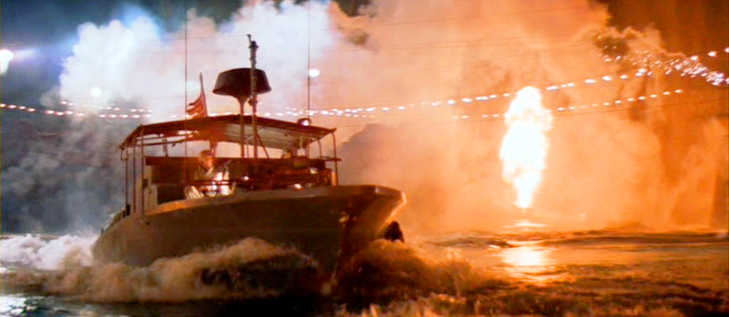


They might have thought to install seat belts in the first 20 rows of the Cinerama Dome when Francis Coppola’s Apocalypse Now came to town. It was an overwhelming audiovisual experience, a cinematic onslaught in a New-Wavish package. Not since 2001: A Space Odyssey had audiences exited in such a fine confusion: what were those last thirty minutes all about, with Marlon Brando lolling like a musk ox and mumbling to himself?
Was Vietnam really like that? The movie cued heated arguments, perhaps because no two veterans had the same experience. My brother-in-law was a Marine working with exotic landing craft. A CE3K co-worker declined to offer details because too much of what he experienced was ‘crazy.’ A family friend spent his ‘in country’ tour as a warehouse slug and often had to sleep on packing crates. An editing partner joined the National Guard, and trained in the desert every few weekends. I personally was the perfect age for conscription, but a high birthdate number in the 1972 draft lottery saved my student-deferment hide.

Apocalypse is certainly not the movie to see for a documentary picture of the war. Yet its insane excess doesn’t feel like a lie. The epic film is a realistic fantasy, a stylized attempt to express a ‘poetic truth’ about an ugly war, and wars in general. Francis Coppola had experience writing big war movies starting with Is Paris Burning? in 1966. His screenplay for Franklin J. Schaffner’s Patton presented the controversial General as both a patriotic warrior-genius and a reckless military fanatic. Thus the Oscar-winning film was accepted by both extremes of our political divide.
The finished Apocalypse Now is a different animal from the earliest drafts by John Milius. I read one at UCLA’s Theater Arts Reading Room around 1974. Milius envisioned the fighting in Vietnam as unending comic-book insanity — Colonel Kilgore’s name was originally Colonel Kharnage, if I recall. The finale was a zonked-out fantasy battle to either top John Wayne’s ‘Fort Apache’ battle in The Green Berets, or to mock it. Expecting thousands of Viet Cong attackers, Colonel Kurtz organizes his defense as a series of concentric circular trenches. When the ammo runs out and barrels melt down in the first trench, Kurtz’s irregular army retreats to the next trench where await fresh weapons and ammo.
The capper is difficult to imagine on film. For the final battle Kurtz is dressed literally like a DC Comics superhero, in colored tights and a cape. Milius can’t have been proposing a radical anti-American effect like that of William Klein’s Mister Freedom. But that’s how the draft read.

Perhaps what I read was some proto-idea Milius threw together at USC? Coppola’s Apocalypse did indeed take a strong left turn into deep-dish Joseph Conrad territory. The novel Heart of Darkness seems to have provided a thematic life preserver when Coppola had to improvise a final chapter that could be filmed with his scarcely-cooperative three-million-dollar star. Marlon Brando arrived at the Philippine location too out-of-shape to perform any kind of action scene. With his back to the wall Coppola came through with a good third act, a brooding contemplation of dark, elemental savagery.
Sometime in 1977 or 1978 I heard from friend Mark Stern, that he had attended a special event screening Coppola conducted in Westwood, showing hours of cut footage from the movie to an invited audience. He wanted to gauge their reaction and to perhaps keep the movie alive in the public mind. I think it worked, as the attendees came out as true believers convinced that something incredible was coming. In the early 1990s editor Michael Thibault loaned me a 3rd or 4th generation VHS of the elusive ‘Apocalypse Rough Sketch Pad,’ with several hours of footage not seen in the movie. It included what seemed like an entire hour of a chanting, dancing, drinking & drugs ritual in Kurtz’s compound. The rough material, all of it potentially interesting, made me respect Coppola and his editors even more: they had the fortitude to throw out reels and reels of expensively-filmed scenes, carefully shaping the narrative into a fever dream of ever-darkening incidents.
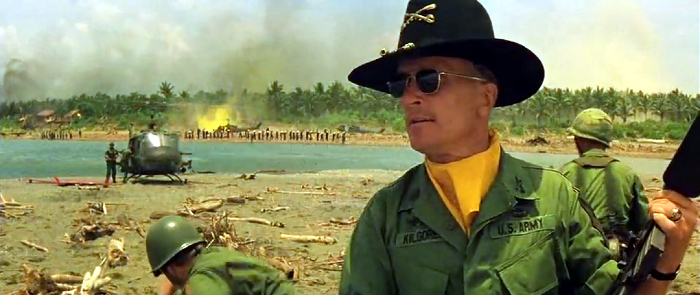
These days when I bring up Apocalypse Now my ‘industry’ friends often praise its soundtrack. I don’t believe we had ever heard a sound design as complex and rich. Walter Murch indulged his full sonic imagination, going to town with all those surround channels. The layered tracks, the blending of the helicopter noises into the electronic music — all remarkable. Even the transitional cues seem to meld with key sound effects, producing a specific emotional impression. Murch certainly came off as a prime innovator — who was spending as much attention to sound? For American Graffiti Murch had gone to the trouble of de-focusing and perspective-izing all those top ten tunes, as heard from car radios on the street.
The audio-scape of Apocalypse beautifully supports the Michael Herr-John Milius narration. It’s rare for a movie with so many voiceovers to work so well. Plus, I’d imagine every sound designer alive would envy Murch the ability to take apart and re-mix original songs from the Doors and Jim Morrison.
Is Apocalypse Now Marlon Brando’s last ‘great’ movie? Although I strongly remembered Martin Sheen as early as The Subject was Roses, I think he at last became a household name with this show. Robert Duvall added to his list of ’70s classic performances, claiming one or two of the most-quoted movie lines ever. The show also made a solid name of the experienced Frederic Forrest, and launched the less experienced Laurence Fishburne. Sam Bottoms received his best role, at least for visibility, as did the veteran actor Albert Hall. Scott Glenn was cut out of the first release version.
Audiences didn’t know what to make of Harrison Ford’s brief part — by the time Apocalypse came out he had already become one of the most famous people on the planet with Star Wars. Helping bouoy the third act immensely is Dennis Hopper’s manic chatterbox of a photographer. It’s the role he was born to play, rattling off some of the best spaced-out dialogue ever: “You can’t go out into space, you know, without, like, you know, uh, with fractions!”

Vittorio Storaro’s striking images maintain the film’s scary Wonderland vibe even when the story momentum grinds to a standstill. An article in American Cinematographer had taken a somewhat mocking attitude toward the Italian cameraman’s theories of colors having intrinsic psychological signatures. But it certainly worked for us, especially in the occasional near-psychedelic shot, such as the one of Captain Willard’s head rising out of the water, on his mission of assassination.
In the long run I think Apocalypse Now has held up as no ‘realistic’ Vietnam war movie has. True, there aren’t that many. Cimino’s The Deer Hunter succeeded now and then but (for this viewer) sank into hollow sentiment at the finish. Coppola, Milius, Herr and Brando emphasize that war is just an obscenity pure and simple, the juncture of everything corrupt, hypocritical and savage about us imperfect humans. The war was indeed fought by young men who a year before were teenagers listening to Top-40 radio, ‘rock’n’rollers with one foot in their grave.’ The Vietnamese civilians staring through the chain-link fence make the USO show seem even more vulgar and grotesque. This is the American culture we’re spreading around the world?

The show gets plenty heavy, but not even its darkest episodes are pretentious; they’re too honest and unvarnished. In repeated viewings Brando can seem static, sitting in the dark pouring water over his bald head. But his speech about ‘little children’s arms’ expresses a Conradian horror that civilians can understand, without Coppola having to shove visual atrocities in our faces.
When we see regular combat troops Apocalypse fully expresses the ‘bored terror’ of life on the edge. The poor guys way out in the trenches at the Do Lung bridge seem like lost boy scouts abandoned in a corner of Hell. Not only do they not know why they’re fighting, they don’t even know who’s in command. When Willard asks, a crazed soldier replies, “Ain’t you?” That’s perfectly right — nobody’s in charge. One way or another, it’s every soldier for himself.
Here’s Josh Olson on Apocalypse Now:


