
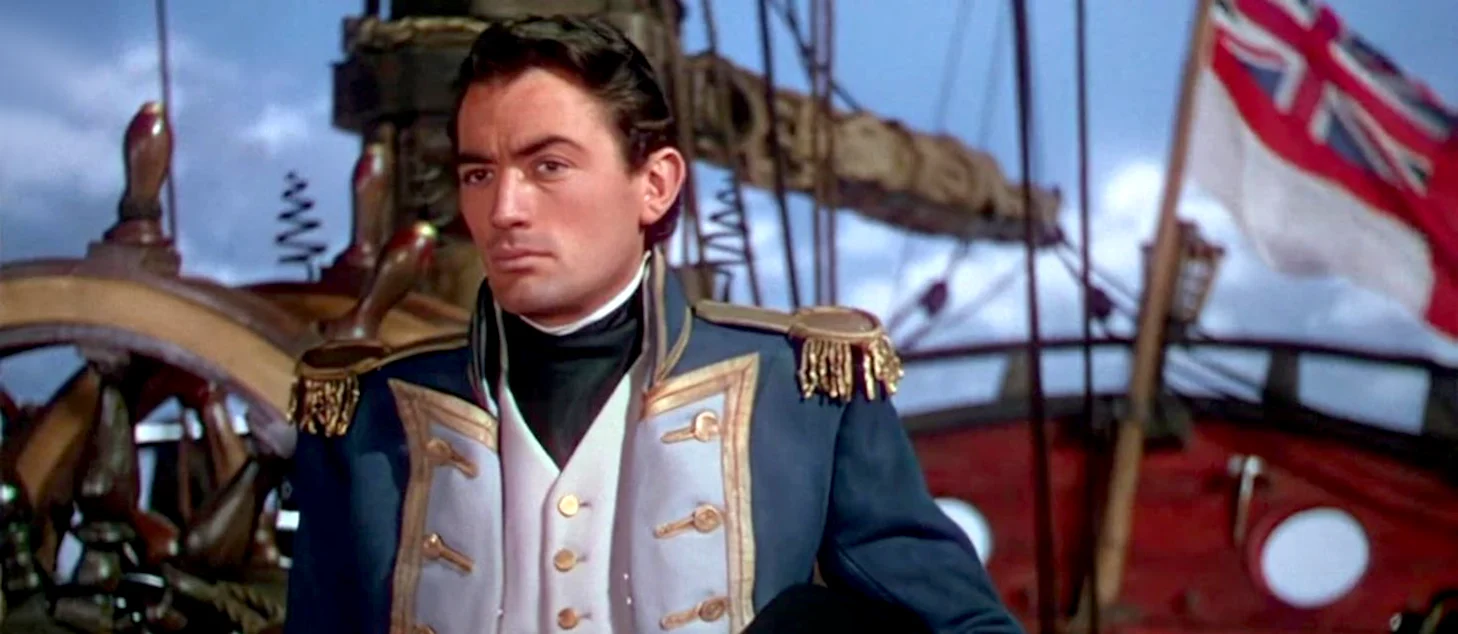


Back in the 1930, Warner Bros. had taken in record profits with its spectacular swashbuckling pirate adventures starring Errol Flynn. The war stimulated studio filmmaking but curbed the production of most big-scale epics. But everything changed after the victory, when Hollywood discovered that the U.S. dollar could buy almost anything in the economically-depressed Europe. England, France and Italy had the exotic locations ready for Technicolor, and craftspeople eager to work for far less than the Hollywood guilds. Big-scale adventure movies once again got the green light at Warners — as ‘runaway’ productions made overseas.
A couple of years later, an enthusiastic Burt Lancaster would film the matinee spectacles The Crimson Pirate and His Majesty O’Keefe out of Warner Bros.’ London studio. and Errol Flynn eventually contributed The Master of Ballantrae, the last of his major action films.
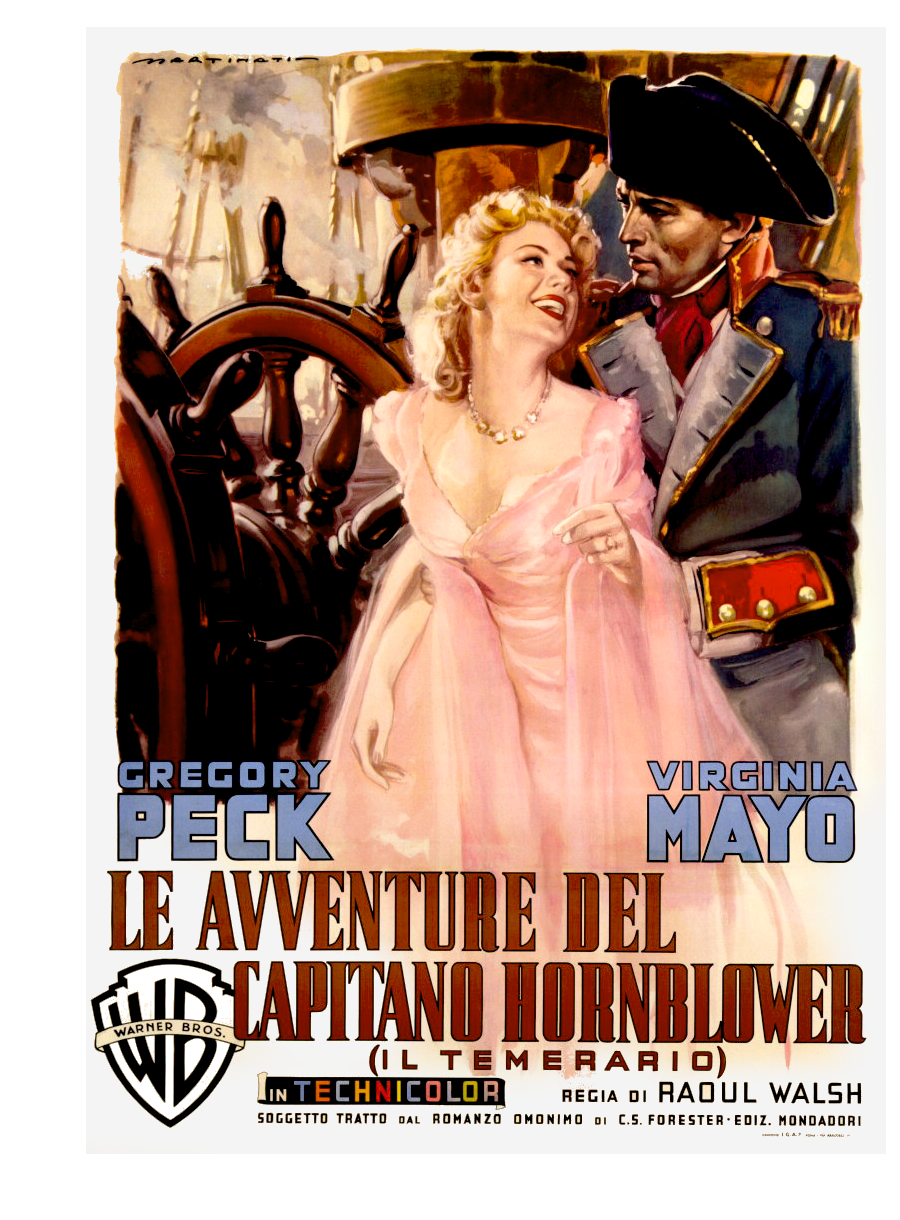
But Gregory Peck’s Captain Horatio Hornblower was the first. Instead of going back to classics by Rafael Sabatini or Robert Louis Stevenson, Warners tapped a 12-episode series of popular books by C.S Forester, who also wrote the source novel for The African Queen. Forester’s Captain Hornblower is an officer in the Royal Navy, who becomes the hero of numerous exploits during the Napoleonic Wars. Fans may have hoped for a whole series of Hornblower films … but Gregory Peck only made one of them.
Early in the 19th century, Napoleon is threatening much of Europe. England is thinking strategically, using the opportunity to goad its colonial competitors in the New World. Instead of fighting the French, Captain Horatio Hornblower (Gregory Peck) is dispatched on a secret mission into the Pacific. His ship is loaded with arms for the Central American despot Don Julian Alvarado (Alec Mango), who intends to rebel against the Spanish Empire. Despite the fact that Alvarado calls himself El Supremo and behaves like a madman, Hornblower carries out his mission. After he captures a Spanish ship and turns it over to the megalomanic Alvarado, news comes that Spain is now an ally of Great Britain, not an enemy. Hornblower must somehow take the Spanish ship a second time … a ship much more powerful than his own. Complicating matters, he has a new passenger in tow, Lady Barbara Wellesley (Virginia Mayo), a fugitive from a deadly fever outbreak in Panama.
Captain Horatio Hornblower manages to recapture the excitement of the old Curtiz/Flynn swashbucklers of the 1930s, if not all of their adventurous spirit. The Sea Hawk had been filmed in B&W to allow the recycling of stock footage from earlier pirate epics. Warners had to start afresh with this Napoleonic-era sea tale in Technicolor. It must have been quite an expensive proposition. Technicolor films tended toward fewer setups whenever possible. At least fifteen solid minutes of this picture is detailed special effects and quick-cut battle action.

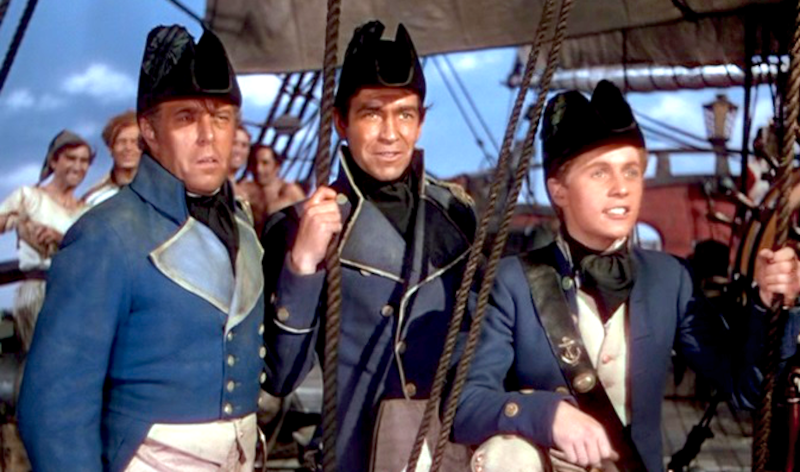
Gregory Peck makes a fine Hornblower, no doubt filling out his vintage uniform better than most real officers of the era. Producer-director Raoul Walsh surrounds Peck with English actors to offset the fact that the actor makes no effort at an accent. The role isn’t much of a stretch for Peck, considering that all he must do is look decisive, bark orders and then play nice guy to favored members of the crew. His key officers carry most of the on-deck dialogue. They provide light humor while admiring their captain’s leadership prowess. Hornblower’s decisions can be unpredictable, and his First Lt. Bush (Robert Beatty) is forever taking bets on what he’s going to do.
It’s not a criticism per se, but the Hornblower character is actually rather thin. He has a wife back in port, but she’s mostly out of sight and out of mind. The one time Horatio does return home, he finds that he has a new son. But he ships out again in just a day or two.
With a lot of story to tell in just two hours, Horatio’s personality is sketched rather broadly. The script gives him a semi-comedic bit of business as a running gag. Whenever the Captain is confronted with something unexpected, he gives forth with a loud throat-clearing ‘harrumph’ noise more suitable for an old man. It plays against the formal poise that ships’ officers are supposed to maintain at all times. Kids probably found the gag hilarious. If it were used any more frequently, it would be distracting. “Harrumph!” We half expect somebody to jam a handful of hay into Peck’s mouth, so he can chew it like a cow.
In Peck’s defense, he carries quite a lot of drama by leaving things unsaid and playing emotions with his eyes. In keeping with the stiff protocol of the times, the romantic story is played out with zero Public Displays of Affection. Yet we can tell that Horatio is head over keel in love with Lady Barbara. The problem is that he’s married and she’s affianced to one of his superiors.
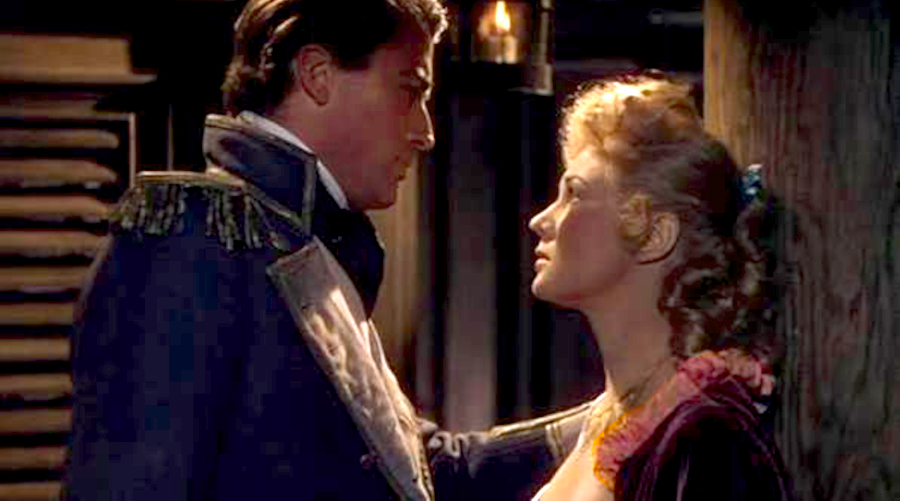
Coming off a little better is Virginia Mayo, direct from Walsh’s triumph White Heat. In contrast to her gum-chewing floozy in that movie, Mayo positively shines in the ‘Olivia de Havilland’ role of the proper lady forced to marry the wrong man. Ms. Mayo behaves with dignity, has a couple of great kissing scenes with Peck and looks swooningly, fleshily alive in her Technicolor close-ups. Lady Barbara’s entrances cue Hornblower to give forth with another mighty ‘harrumph’ noise. Just her presence puts him at a loss for words. This makes her see that the stuffy Horatio is really a boy at heart.
The movie has scope and spectacle on the sea, but goes a bit lean on the land — there are no enormous sets or crowd scenes. Hornblower tangles with a Latin American madman and the whole French Army, but we never see more than thirty or so uniformed foes at a time. Although the script pays respect to the French, it is mercilessly prejudiced against Latin Americans, all of whom are swarthy, foul creeps voiced with atrocious accents by Anglo actors. Mayo’s squealing, moronic Spanish maid is treated with contempt. That’s not at all unusual for movies, practically all the way to the 1970s.
The sea battles are what the matinee crowd cared about, and Captain Horatio Hornblower doesn’t disappoint. The film has a full range of effects work, physical and optical; the English studios must have been eager to prove that their facilities were the equal of Hollywood. Art director Tom Morahan supervised all of the on-stage work at Denham studio, with large-scale mockups of ships for the close-in live action fighting. The chaos on deck as guns explode and rigging crashes down is almost as exciting as in the originals. Union controls limit setups in which actors and extras might be put in harm’s way. There are fewer death-defying stunts than in the Errol Flynn shows, but likely fewer unreported casualties as well.
The old pirate movies had found various work-arounds to create fake ocean backdrops for those giant full-sized soundstage ship mockups. The English technicians ‘solve’ the problem by limiting the range of camera angles. Most setups on the ships’ decks show sky backgrounds, not ocean waves.

The miniature ships were enormous, nearly thirty feet long. The sky backing behind the water tank was over forty feet tall. A three-man crew hid inside each ship model, firing guns and making the sails work. The English cinematographer Guy Green matched studio work with location shoots off the coast of Southern France, and scenes shot on numerous English locations.
Tying everything together is the artistry of the English effects wizard Peter Ellenshaw, whose matte paintings added ships, islands and castles to location shots so well, they often went unnoticed. Ellenshaw didn’t go unnoticed by Walt Disney, who soon made him a key part of his life-action team.
As an uncredited art director, Ken Adam did an enormous amount of engineering work on Captain Horatio Hornblower. In Christopher Frayling’s career study we learn that Adam oversaw the refitting of one old sailiing ship, and re-built all of the above-water part of another. The work was done by shipbuilders in Villefranch, a port between Nice and Monaco. One big worry were the unreliable old engines; sometimes the ships had to be towed. As an ‘accidental’ expert on seagoing mockups, Ken Adam was kept on after filming finished to alter the ships for use in the next project, The Crimson Pirate. He sailed them to the new locations in Italy — and finally got full screen credit.

Raoul Walsh directs without a great deal of fuss, saving most close-ups for his two stars and featuring the able supporting cast only when necessary. Robert Beatty has the most lines, followed by James Robertson Justice, whose spirited common sailor more or less fills in the old Alan Hale role. Given a featured part is young James Kenney, who at this time seemed to be getting every desirable teenaged part, from an Irish rebel lad to a razor-wielding delinquent.
Fans can’t miss a very young Stanley Baker as the Bosun, taking orders and blowing his whistle a lot. We’d first notice him in The Cruel Sea, three years later. Favorite Alec Mango is the deranged ‘El Supremo,’ decked out in brown-face makeup to look sub-human as well as crazy. Christopher Lee did his best to get into every film he could; here he’s impressive as a Spanish ship captain. Lee plays his Spanish character as over-emotionally as do the other English actors. He loses a sword fight with the Captain, even though Hornblower admits that he got the lowest swordsmanship rating in his class at the Royal Academy.
The romance is old-fashioned and low-key, a nice switch from other movies’ wildly anachronistic love affairs on military ships. Lady Barbara is willing to throw caution to the wind, but Horatio calls the whole thing off after a single passionate kiss. Denis O’Day’s priggish officer will wed Lady Barbara; he’s clearly jealous and keen on curtailing Hornblower’s career. The way the finale works out is more than a little pat, but Raoul Walsh’s direction doesn’t allow it to feel rushed. Warners’ post-war editorial style didn’t dawdle when it came time to wind things up. Hornblower feels natural, but quite a few WB pictures rush to get the house lights up and another paying audience in the seats.

I just watched this and thought it terrific. Peck is a bit wooden as usual. IMDB said it was considered for Olivier and Leigh
I thought Peck was okay except for his Harrumphing. Virginia Mayo was perfect and lovely.
FYI – the throat clearing bit originated in the books.
Got it. Thanks.
Good to know Mark, thanks from me too.
Glenn, your review has sold me on this title. I’ll be picking it up at the first opportunity.
Virginia Mayo was at her best when directed by Raoul Walsh.